



MME Protein, Human (HEK293)
Based on 1 Customer Validation
MME proteins exhibit thermolysin-like specificity and primarily degrade polypeptides of up to 30 amino acids. Crucially, it plays a key role in cleaving the Gly-Phe bond to degrade opioid peptides, including Met-enkephalin and Leu-enkephalin. MME Protein, Human (HEK293) is the recombinant human-derived MME protein, expressed by HEK293 , with tag free.
- Species: Human
- Source: HEK293
-
Storage:Stored at -80°C for 1 year from date of receipt. It is stable at -20°C for 3 months after opening. It is recommended to freeze aliquots at -80°C for extended storage. Avoid repeated freeze-thaw cycles.


To place orders, for customer services and technical support, please contact: MedChemExpress USA
Tel: 609-228-6898 E-mail: [email protected] [email protected]


-
 Biological Activity
-
Technical Parameters
-
Product Properties
- Documentation
- Help & FAQs




Biological Activity
Description
MME proteins exhibit thermolysin-like specificity and primarily degrade polypeptides of up to 30 amino acids. Crucially, it plays a key role in cleaving the Gly-Phe bond to degrade opioid peptides, including Met-enkephalin and Leu-enkephalin. MME Protein, Human (HEK293) is the recombinant human-derived MME protein, expressed by HEK293 , with tag free.
Background
The MME Protein demonstrates a thermolysin-like specificity, predominantly acting on polypeptides of up to 30 amino acids. Biologically crucial, it plays a key role in the degradation of opioid peptides, including Met- and Leu-enkephalins, achieved through the cleavage of a Gly-Phe bond. Additionally, MME catalyzes the cleavage of bradykinin, substance P, and neurotensin peptides and is capable of cleaving angiotensin-1, angiotensin-2, and angiotensin 1-9. The protein is involved in the degradation of atrial natriuretic factor (ANF) and brain natriuretic factor (BNP(1-32)). Furthermore, MME displays UV-inducible elastase activity toward skin preelastic and elastic fibers.
Verified Bioactivity
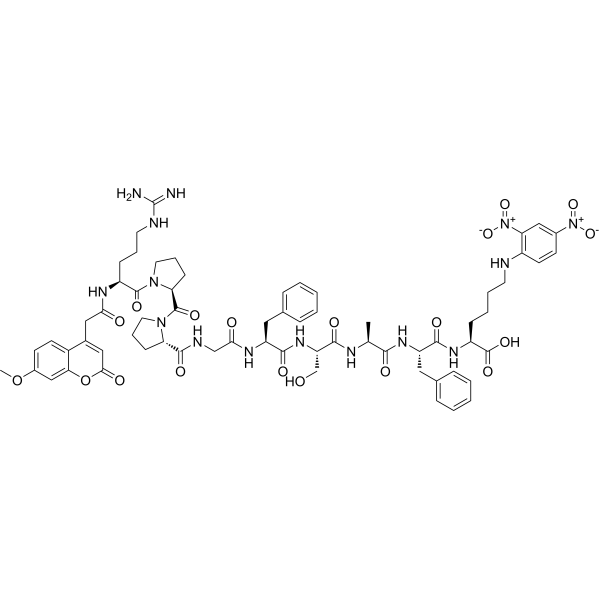
Measured by its ability to cleave the fluorogenic peptide substrate, Mca-RPPGFSAFK (Dnp)-OH (HY-P3749). The specific activity is > 1500 pmole/min/μg.
MCE Validation Data
-
Purity - SDS-PAGE
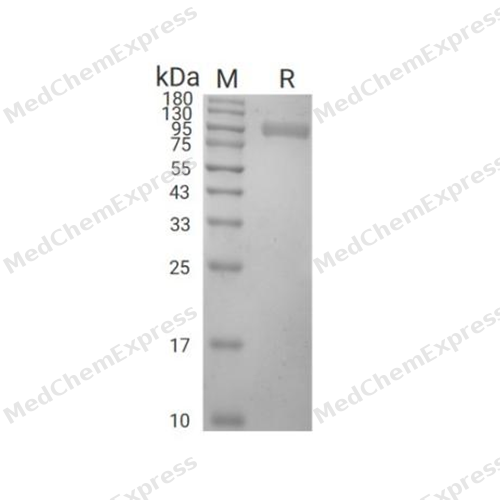
Purity - SDS-PAGE


Technical Parameters
-
Species Human
-
Source HEK293
-
Tag Tag Free
-
Accession
P08473 (Y52-W750)
-
Molecular Construction
-
N-term
-
MME (Y52-W750)
Accession # P08473 -
C-term
-
-
Protein Length
Extracellular Domain
-
Synonyms
MME; Neprilysin-390; Membrane Metalloendopeptidase; Neprilysin-411; Neprilysin; SFE; CALLA; Membrane Metallo-Endopeptidase (Neutral Endopeptidase, Enkephalinase, CALLA, CD10); NEP; Membrane Metallo-Endopeptidase Variant 2; Neutral Endopeptidase 24.11; Alt
-
AA Sequence
YDDGICKSSDCIKSAARLIQNMDATTEPCTDFFKYACGGWLKRNVIPETSSRYGNFDILRDELEVVLKDVLQEPKTEDIVAVQKAKALYRSCINESAIDSRGGEPLLKLLPDIYGWPVATENWEQKYGASWTAEKAIAQLNSKYGKKVLINLFVGTDDKNSVNHVIHIDQPRLGLPSRDYYECTGIYKEACTAYVDFMISVARLIRQEERLPIDENQLALEMNKVMELEKEIANATAKPEDRNDPMLLYNKMTLAQIQNNFSLEINGKPFSWLNFTNEIMSTVNISITNEEDVVVYAPEYLTKLKPILTKYSARDLQNLMSWRFIMDLVSSLSRTYKESRNAFRKALYGTTSETATWRRCANYVNGNMENAVGRLYVEAAFAGESKHVVEDLIAQIREVFIQTLDDLTWMDAETKKRAEEKALAIKERIGYPDDIVSNDNKLNNEYLELNYKEDEYFENIIQNLKFSQSKQLKKLREKVDKDEWISGAAVVNAFYSSGRNQIVFPAGILQPPFFSAQQSNSLNYGGIGMVIGHEITHGFDDNGRNFNKDGDLVDWWTQQSASNFKEQSQCMVYQYGNFSWDLAGGQHLNGINTLGENIADNGGLGQAYRAYQNYIKKNGEEKLLPGLDLNHKQLFFLNFAQVWCGTYRPEYAVNSIKTDVHSPGNFRIIGTLQNSAEFSEAFHCRKNSYMNPEKKCRVW
-
Predicted Molecular Mass
79.8 kDa
-
Molecular Weight
Approximately 80-100 kDa, based on SDS-PAGE under reducing conditions, due to the glycosylation.
-
Glycosylation
Yes
-
Purity
≥ 95%, as determined by reducing SDS-PAGE.


Product Properties
Solution
Supplied as a 0.22 μm filtered solution in 50 mM MES, 100 mM NaCl, 10% glycerol, pH 6.5.
<1 EU/μg, determined by LAL method.
Stored at -80°C for 1 year from date of receipt. It is stable at -20°C for 3 months after opening. It is recommended to freeze aliquots at -80°C for extended storage. Avoid repeated freeze-thaw cycles.
Shipping with dry ice.


Documentation
-
Data Sheet (239 KB)
-
SDS (254 KB)
- English - EN (254 KB)
- Français - FR (254 KB)
- Deutsch - DE (254 KB)
- Norwegian - NO (254 KB)
- Español - ES (254 KB)
- Swedish - SV (254 KB)
- Italian - IT (254 KB)
- Korean - KR (254 KB)
- Portuguese - PT (254 KB)
-
Handling Instructions (2659 KB)

Calculators
Concentration (start) × Volume (start) = Concentration (final) × Volume (final)


 Powered by Bioz

