



Nidogen-1 Protein, Mouse (P.pastoris, His)

Based on 1 Customer Validation
Nidogen-1 protein is a sulfated glycoprotein that is widely distributed in basement membranes and binds tightly to laminin, type IV collagen, and perlecan, suggesting multiple interactions between cells and the extracellular matrix .Nidogen-1 binds to partners such as FBLN1, LGALS3BP and PLXDC1 and plays a crucial role in the complex molecular network of the extracellular matrix.Nidogen-1 Protein, Mouse (P.pastoris, His) is the recombinant mouse-derived Nidogen-1 protein, expressed by P.pastoris , with N-His labeled tag.
- Species: Mouse
- Source: P. pastoris
-
Storage:Stored at -20°C for 2 years from date of receipt. After reconstitution, it is stable at 4°C for 1 week or -20°C for longer (with carrier protein). It is recommended to freeze aliquots at -20°C or -80°C for extended storage.


To place orders, for customer services and technical support, please contact: MedChemExpress USA
Tel: 609-228-6898 E-mail: [email protected] [email protected]


-
 Biological Activity
-
Technical Parameters
-
Product Properties
- Documentation
- Help & FAQs




Biological Activity
Description
Nidogen-1 protein is a sulfated glycoprotein that is widely distributed in basement membranes and binds tightly to laminin, type IV collagen, and perlecan, suggesting multiple interactions between cells and the extracellular matrix .Nidogen-1 binds to partners such as FBLN1, LGALS3BP and PLXDC1 and plays a crucial role in the complex molecular network of the extracellular matrix.Nidogen-1 Protein, Mouse (P.pastoris, His) is the recombinant mouse-derived Nidogen-1 protein, expressed by P.pastoris , with N-His labeled tag.
Background
Nidogen-1 protein, a sulfated glycoprotein, exhibits a broad distribution within basement membranes and forms a close association with laminin. This versatile protein extends its binding capabilities to collagen IV and perlecan, implying its involvement in diverse cell-extracellular matrix interactions. Nidogen-1 plays a pivotal role in mediating these interactions by engaging with various partners, including FBLN1, LGALS3BP, and PLXDC1. Its associations with these proteins highlight its multifaceted involvement in the complex network of molecular interactions within the extracellular matrix. These interactions likely contribute to the regulation of cellular processes and structural integrity in various tissues and underscore the importance of nidogen-1 in maintaining the dynamic equilibrium of the extracellular microenvironment.
MCE Validation Data
-
Purity - SDS-PAGE
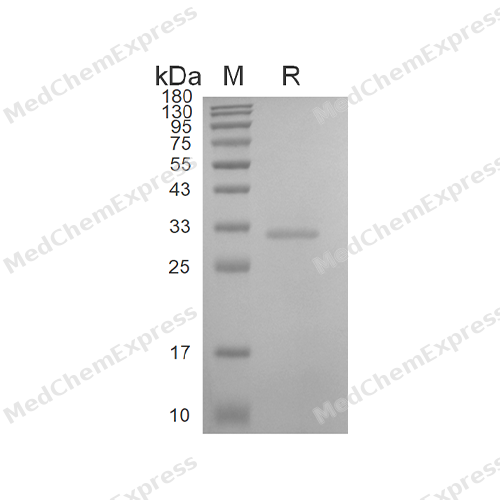
Purity - SDS-PAGE


Technical Parameters
-
Species Mouse
-
Source P. pastoris
-
Tag N-His
-
Accession
P10493 (S428-A665)
-
Molecular Construction
-
N-term
-
His
-
Nidogen-1 (S428-A665)
Accession # P10493 -
C-term
-
-
Protein Length
Full Length of Nidogen G2 beta-barrel Domain
-
Synonyms
NID1; NID-1; Prev. NID; Alternative Protein NID1; Entactin; Nidogen (Enactin); Nidogen-1; Enactin; Nidogen 1; Epididymis Secretory Sperm Binding Protein
-
AA Sequence
SPQRVNGKVKGRIFVGSSQVPVVFENTDLHSYVVMNHGRSYTAISTIPETVGYSLLPLAPIGGIIGWMFAVEQDGFKNGFSITGGEFTRQAEVTFLGHPGKLVLKQQFSGIDEHGHLTISTELEGRVPQIPYGASVHIEPYTELYHYSSSVITSSSTREYTVMEPDQDGAAPSHTHIYQWRQTITFQECAHDDARPALPSTQQLSVDSVFVLYNKEERILRYALSNSIGPVRDGSPDA
-
Predicted Molecular Mass
28.3 kDa
-
Molecular Weight
Approximately 31 kDa, based on SDS-PAGE under reducing conditions.
-
Purity
≥ 90%, as determined by reducing SDS-PAGE.


Product Properties
Lyophilized powder.
Lyophilized from a 0.22 μm filtered solution of 20 mM Tris-HCl, 0.5 M NaCl, 6% trehalose, pH 8.0.
Note: For SPR assay, please replace the buffer. Primary amine components (e.g., Tris, imidazole) can affect protein-coupled chips.
<1 EU/μg, determined by LAL method.
It is not recommended to reconstitute to a concentration less than 100 μg/mL in ddH2O.
Stored at -20°C for 2 years from date of receipt. After reconstitution, it is stable at 4°C for 1 week or -20°C for longer (with carrier protein). It is recommended to freeze aliquots at -20°C or -80°C for extended storage.
Room temperature in continental US; may vary elsewhere.


Documentation
-
Data Sheet (236 KB)
-
SDS (251 KB)
- English - EN (251 KB)
- Français - FR (251 KB)
- Deutsch - DE (251 KB)
- Norwegian - NO (251 KB)
- Español - ES (251 KB)
- Swedish - SV (251 KB)
- Italian - IT (251 KB)
- Korean - KR (251 KB)
- Portuguese - PT (251 KB)
-
Handling Instructions (2659 KB)

Calculators
Concentration (start) × Volume (start) = Concentration (final) × Volume (final)


 Powered by Bioz

