



PAP Protein, Human (His)

Based on 1 Customer Validation
PAP proteins play a dual regulatory role in cell growth, exhibiting different effects depending on the specific growth factors involved. In fibroblasts, it exerts a positive regulatory effect by enhancing PDGFA-stimulated cell growth. PAP Protein, Human (His) is the recombinant human-derived PAP protein, expressed by E. coli , with N-6*His labeled tag.
- Species: Human
- Source: E. coli
-
Storage:Stored at -80°C for 1 year from date of receipt. It is stable at -20°C for 3 months after opening. It is recommended to freeze aliquots at -80°C for extended storage. Avoid repeated freeze-thaw cycles.


To place orders, for customer services and technical support, please contact: MedChemExpress USA
Tel: 609-228-6898 E-mail: [email protected] [email protected]


-
 Biological Activity
-
Technical Parameters
-
Product Properties
- Documentation
- Help & FAQs




Biological Activity
Description
PAP proteins play a dual regulatory role in cell growth, exhibiting different effects depending on the specific growth factors involved. In fibroblasts, it exerts a positive regulatory effect by enhancing PDGFA-stimulated cell growth. PAP Protein, Human (His) is the recombinant human-derived PAP protein, expressed by E. coli , with N-6*His labeled tag.
Background
PAP protein plays a dual regulatory role in cell growth, demonstrating contrasting effects depending on the specific growth factor involved. In fibroblasts, it acts as a positive regulator by enhancing PDGFA-stimulated cell growth. However, simultaneously, it acts as a negative regulator by inhibiting the mitogenic effect of PDGFB. This protein exerts a fine-tuned control over cell growth, potentially influencing cellular responses to different growth factors and contributing to the overall balance and regulation of cell proliferation. The intricate interplay between PAP protein and growth factors like PDGFA and PDGFB highlights the complexity of cellular growth regulation and the importance of understanding the specific molecular mechanisms involved.
MCE Validation Data
-
Purity - SDS-PAGE
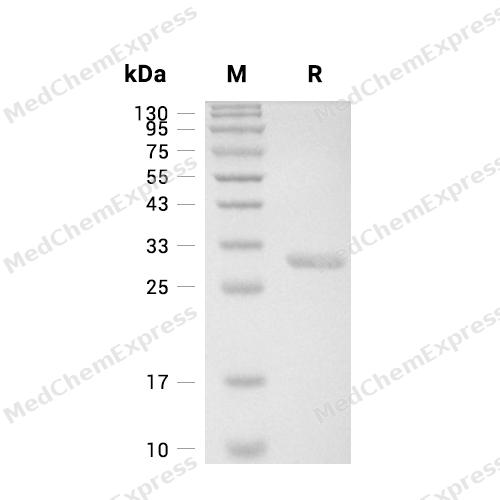
Purity - SDS-PAGE


Technical Parameters
-
Species Human
-
Source E. coli
-
Tag N-6*His
-
Accession
Q13442 (M1-K181)
-
Molecular Construction
-
N-term
-
6*His
-
PAP (M1-K181)
Accession # Q13442 -
C-term
-
-
Protein Length
Full Length
-
Synonyms
PDAP1; 28 KDa Heat- And Acid-Stable Phosphoprotein; PDGFA Associated Protein 1; PDGF-Associated Protein; HASPP28; PDGFA-Associated Protein 1; PAP1; PDGF Associated Protein; PAP
-
AA Sequence
MPKGGRKGGHKGRARQYTSPEEIDAQLQAEKQKAREEEEQKEGGDGAAGDPKKEKKSLDSDESEDEEDDYQQKRKGVEGLIDIENPNRVAQTTKKVTQLDLDGPKELSRREREEIEKQKAKERYMKMHLAGKTEQAKADLARLAIIRKQREEAARKKEEERKAKDDATLSGKRMQSLSLNK
-
Molecular Weight
Approximately 30 kDa, based on SDS-PAGE under reducing conditions.
-
Purity
≥ 95%, as determined by reducing SDS-PAGE.


Product Properties
Solution
Supplied as a 0.22 μm filtered solution of 20 mM Tris-HCl, 100 mM NaCl, 0.1 mM PMSF, 2 mM DTT, pH 8.0.
Note: For SPR assay, please replace the buffer. Primary amine components (e.g., Tris, imidazole) can affect protein-coupled chips.
<1 EU/μg, determined by LAL method.
Stored at -80°C for 1 year from date of receipt. It is stable at -20°C for 3 months after opening. It is recommended to freeze aliquots at -80°C for extended storage. Avoid repeated freeze-thaw cycles.
Shipping with dry ice.


Documentation
-
Data Sheet (235 KB)
-
SDS (252 KB)
- English - EN (252 KB)
- Français - FR (252 KB)
- Deutsch - DE (252 KB)
- Norwegian - NO (252 KB)
- Español - ES (252 KB)
- Swedish - SV (252 KB)
- Italian - IT (252 KB)
- Korean - KR (252 KB)
- Portuguese - PT (252 KB)
-
Handling Instructions (2659 KB)

Calculators
Concentration (start) × Volume (start) = Concentration (final) × Volume (final)


 Powered by Bioz

