



PD-1 Protein, Rhesus Macaque (HEK293, His)
Based on 1 Customer Validation
Programmed cell death protein 1 (PDCD1) is an immune-inhibitory receptor which delivers inhibitory signals upon binding to ligands CD274/PDCD1L1 and CD273/PDCD1LG2, playing a critical role in induction and maintenance of immune tolerance to self. PDCD1 plays a role in anti-tumor immunity and is involved in safeguarding against autoimmunity, but PDCD1-mediated inhibitory pathway is also exploited by tumors to attenuate anti-tumor immunity. PD-1 Protein, Rhesus Macaque (HEK293, His) is the recombinant Rhesus Macaque-derived PD-1 protein, expressed by HEK293 , with C-His labeled tag.
- Species: Rhesus Macaque
- Source: HEK293
-
Storage:Stored at -20°C for 2 years from date of receipt. After reconstitution, it is stable at 4°C for 1 week or -20°C for longer (with carrier protein). It is recommended to freeze aliquots at -20°C or -80°C for extended storage.


To place orders, for customer services and technical support, please contact: MedChemExpress USA
Tel: 609-228-6898 E-mail: [email protected] [email protected]


-
 Biological Activity
-
Technical Parameters
-
Product Properties
- Documentation
- References
- Help & FAQs




Biological Activity
Description
Programmed cell death protein 1 (PDCD1) is an immune-inhibitory receptor which delivers inhibitory signals upon binding to ligands CD274/PDCD1L1 and CD273/PDCD1LG2, playing a critical role in induction and maintenance of immune tolerance to self. PDCD1 plays a role in anti-tumor immunity and is involved in safeguarding against autoimmunity, but PDCD1-mediated inhibitory pathway is also exploited by tumors to attenuate anti-tumor immunity. PD-1 Protein, Rhesus Macaque (HEK293, His) is the recombinant Rhesus Macaque-derived PD-1 protein, expressed by HEK293 , with C-His labeled tag.
Background
Programmed cell death protein 1 (PDCD1) is an immune-inhibitory receptor expressed in activated T cells which delivers inhibitory signals upon binding to ligands CD274/PDCD1L1 and CD273/PDCD1LG2. PDCD1 is involved in the regulation of T-cell functions, including those of effector CD8+ T cells, PDCD1 protein can also promote the differentiation of CD4+ T cells into T regulatory cells, playing a critical role in induction and maintenance of immune tolerance to self. PDCD1 is expressed in many types of tumors including melanomas, and has demonstrated to play a role in anti-tumor immunity. Moreover, PDCD1 is involved in safeguarding against autoimmunity, however, it can also contribute to the inhibition of effective anti-tumor and anti-microbial immunity as the PDCD1-mediated inhibitory pathway is exploited by tumors to attenuate anti-tumor immunity and escape destruction by the immune system, thereby facilitating tumor survival[1][2].
Verified Bioactivity
Measured by its binding ability in a functional ELISA. Immobilized Human PD-L2 at 0.25 µg/mL can bind Rhesus Macaque PD-1. The ED50 for this effect is 0.104 μg/mL.
MCE Validation Data
-
Purity - SDS-PAGE
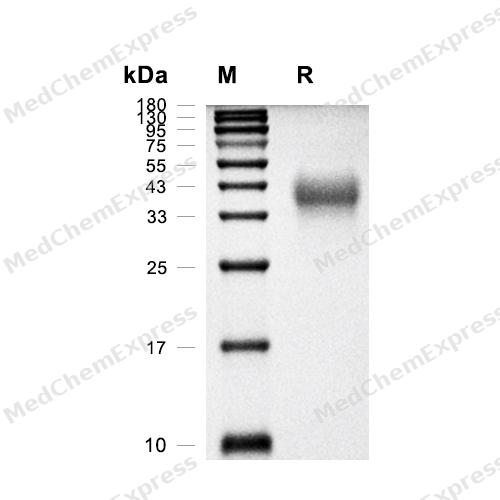
Purity - SDS-PAGE
-
Bioactivity - ELISA
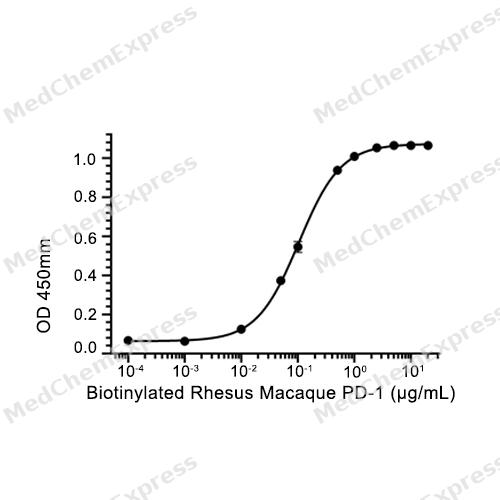
Bioactivity - ELISA


Technical Parameters
-
Species Rhesus Macaque
-
Source HEK293
-
Tag C-6*His
-
Accession
B0LAJ2/NP_001107830.1 (L25-Q167)
-
Molecular Construction
-
N-term
-
PD-1 (L25-Q167)
Accession # B0LAJ2/NP_001107830.1 -
His
-
C-term
-
-
Protein Length
Partial
-
Synonyms
PDCD1; Systemic Lupus Erythematosus Susceptibility 2; Prev. SLEB2; HPD-1; PD1; Programmed Cell Death 1 Protein; Programmed Cell Death Protein 1; CD279 Antigen; CD279; ADMIO4; HSLE1; AIMTBS; PD-1; HPD-L; Programmed Cell Death 1; Protein PD-1
-
AA Sequence
LESPDRPWNPPTFSPALLLVTEGDNATFTCSFSNASESFVLNWYRMSPSNQTDKLAAFPEDRSQPGRDCRFRVTQLPNGRDFHMSVVRARRNDSGTYLCGAISLAPKAQIKESLRAELRVTERRAEVPTAHPSPSPRPAGQFQ
-
Molecular Weight
Approximately 33-45 kDa, based on SDS-PAGE under reducing conditions, due to the glycosylation.
-
Purity
≥ 95%, as determined by reducing SDS-PAGE.


Product Properties
Lyophilized powder.
Lyophilized from a 0.22 μm filtered solution of PBS, pH 7.4.
<1 EU/μg, determined by LAL method.
It is not recommended to reconstitute to a concentration less than 100 μg/mL in ddH2O. For long term storage it is recommended to add a carrier protein (0.1% BSA, 5% HSA, 10% FBS or 5% Trehalose).
Stored at -20°C for 2 years from date of receipt. After reconstitution, it is stable at 4°C for 1 week or -20°C for longer (with carrier protein). It is recommended to freeze aliquots at -20°C or -80°C for extended storage.
Room temperature in continental US; may vary elsewhere.


Documentation
-
Data Sheet (263 KB)
-
SDS (251 KB)
- English - EN (251 KB)
- Français - FR (251 KB)
- Deutsch - DE (251 KB)
- Norwegian - NO (251 KB)
- Español - ES (251 KB)
- Swedish - SV (251 KB)
- Italian - IT (251 KB)
- Korean - KR (251 KB)
- Portuguese - PT (251 KB)
-
Handling Instructions (2659 KB)


References
[1]. Fife BT, et al. The role of the PD-1 pathway in autoimmunity and peripheral tolerance. Ann N Y Acad Sci. 2011 Jan;1217:45-59. [Content Brief]
[2]. Berger KN, et al. PD-1 pathway and its clinical application: A 20year journey after discovery of the complete human PD-1 gene. Gene. 2018 Jan 5;638:20-25. [Content Brief]

Calculators
Concentration (start) × Volume (start) = Concentration (final) × Volume (final)


 Powered by Bioz

