



PDGFRB Protein, Human (HEK293, His)
Based on 1 Customer Validation
TRF1 protein is a telomere-binding protein that plays a crucial role in telomere maintenance and chromosome stability. It is involved in regulating telomere length and preventing DNA damage. PDGFRB Protein, Human (HEK293, His) is the recombinant human-derived PDGFRB Protein, expressed by HEK293 , with C-6*His labeled tag.
- Species: Human
- Source: HEK293
-
Storage:Stored at -20°C for 2 years from date of receipt. After reconstitution, it is stable at 4°C for 1 week or -20°C for longer (with carrier protein). It is recommended to freeze aliquots at -20°C or -80°C for extended storage.


To place orders, for customer services and technical support, please contact: MedChemExpress USA
Tel: 609-228-6898 E-mail: [email protected] [email protected]


-
 Biological Activity
-
Technical Parameters
-
Product Properties
- Documentation
- Help & FAQs




Biological Activity
Description
TRF1 protein is a telomere-binding protein that plays a crucial role in telomere maintenance and chromosome stability. It is involved in regulating telomere length and preventing DNA damage. PDGFRB Protein, Human (HEK293, His) is the recombinant human-derived PDGFRB Protein, expressed by HEK293 , with C-6*His labeled tag.
Background
The PDGFRB Protein encodes a cell surface tyrosine kinase receptor that interacts with members of the platelet-derived growth factor family, known mitogens for cells of mesenchymal origin. The identity of the growth factor binding to a receptor monomer determines whether the functional receptor forms a homodimer (with PDGFB or PDGFD) or a heterodimer (with PDGFA and PDGFB). Essential for normal cardiovascular system development and the rearrangement of the actin cytoskeleton, this gene is flanked on chromosome 5 by the genes for granulocyte-macrophage colony-stimulating factor and macrophage-colony stimulating factor receptor, with all three potentially implicated in the 5-q syndrome. A translocation between chromosomes 5 and 12, resulting in the fusion of this gene with that of the ETV6 gene, leads to chronic myeloproliferative disorder with eosinophilia. Broadly expressed, the PDGF R beta gene exhibits elevated levels in the gall bladder (RPKM 79.5), placenta (RPKM 61.0), and 21 other tissues, indicating its involvement in diverse physiological contexts across multiple organs.
Verified Bioactivity
1.This product does not contain protein kinase domain.
2.Measured by its binding ability in a functional ELISA. Immobilized PDGF-BB at 1 μg/mL (100 μL/well) can bind Biotinylated PDGF R beta. The ED50 for this effect is 42.19 ng/mL.
MCE Validation Data
-
Bioactivity - ELISA
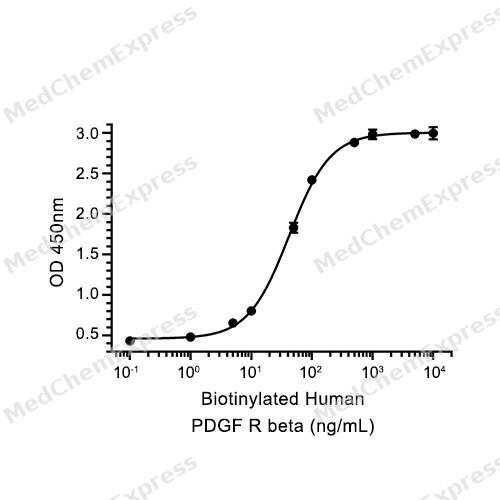
Bioactivity - ELISA


Technical Parameters
-
Species Human
-
Source HEK293
-
Tag C-6*His
-
Accession
NP_002600.1 (L33-K531)
-
Molecular Construction
-
N-term
-
PDGF R beta (L33-K531)
Accession # NP_002600.1 -
6*His
-
C-term
-
-
Protein Length
Partial Extracellular Domain
-
Synonyms
PDGFRB; PDGFR-Beta; Prev. PDGFR; Beta Platelet-Derived Growth Factor Receptor; PDGFR1; Activated Tyrosine Kinase PDGFRB; CD140b; CD140b Antigen; JTK12; NDEL1-PDGFRB; Platelet-Derived Growth Factor Receptor, Beta Polypeptide; IBGC4; Beta-Type Platelet-Deri
-
AA Sequence
LVVTPPGPELVLNVSSTFVLTCSGSAPVVWERMSQEPPQEMAKAQDGTFSSVLTLTNLTGLDTGEYFCTHNDSRGLETDERKRLYIFVPDPTVGFLPNDAEELFIFLTEITEITIPCRVTDPQLVVTLHEKKGDVALPVPYDHQRGFSGIFEDRSYICKTTIGDREVDSDAYYVYRLQVSSINVSVNAVQTVVRQGENITLMCIVIGNEVVNFEWTYPRKESGRLVEPVTDFLLDMPYHIRSILHIPSAELEDSGTYTCNVTESVNDHQDEKAINITVVESGYVRLLGEVGTLQFAELHRSRTLQVVFEAYPPPTVLWFKDNRTLGDSSAGEIALSTRNVSETRYVSELTLVRVKVAEAGHYTMRAFHEDAEVQLSFQLQINVPVRVLELSESHPDSGEQTVRCRGRGMPQPNIIWSACRDLKRCPRELPPTLLGNSSEEESQLETNVTYWEEEQEFEVVSTLRLQHVDRPLSVRCTLRNAVGQDTQEVIVVPHSLPFK
-
Molecular Weight
Approximately 85-130 kDa, based on SDS-PAGE under reducing conditions, due to the glycosylation.
-
Glycosylation
Yes
-
Purity
≥ 95%, as determined by reducing SDS-PAGE.


Product Properties
Lyophilized powder.
Lyophilized from a 0.22 μm filtered solution of 20 mM PB, 150 mM NaCl, pH 7.2.
<1 EU/μg, determined by LAL method.
It is not recommended to reconstitute to a concentration less than 100 μg/mL in ddH2O. For long term storage it is recommended to add a carrier protein (0.1% BSA, 5% HSA, 10% FBS or 5% Trehalose).
Stored at -20°C for 2 years from date of receipt. After reconstitution, it is stable at 4°C for 1 week or -20°C for longer (with carrier protein). It is recommended to freeze aliquots at -20°C or -80°C for extended storage.
Room temperature in continental US; may vary elsewhere.


Documentation
-
Data Sheet (239 KB)
-
SDS (252 KB)
- English - EN (252 KB)
- Français - FR (252 KB)
- Deutsch - DE (252 KB)
- Norwegian - NO (252 KB)
- Español - ES (252 KB)
- Swedish - SV (252 KB)
- Italian - IT (252 KB)
- Korean - KR (252 KB)
- Portuguese - PT (252 KB)
-
Handling Instructions (2659 KB)

Calculators
Concentration (start) × Volume (start) = Concentration (final) × Volume (final)


 Powered by Bioz

