



Periostin/OSF-2 Protein, Rat (HEK293, His)

Based on 1 Customer Validation
Periostin/OSF-2 Protein, a multifaceted regulator, induces cell attachment and spreading, participates in cell adhesion, and enhances BMP1 incorporation into the fibronectin matrix. It forms a structural homodimer and interacts with BMP1 and fibronectin. This interplay positions Periostin as a key player in regulating cellular and tissue functions, including cell adhesion, tissue architecture, and extracellular matrix modulation. Periostin/OSF-2 Protein, Rat (HEK293, His) is the recombinant rat-derived Periostin/OSF-2 protein, expressed by HEK293 , with C-6*His labeled tag.
- Species: Rat
- Source: HEK293
-
Storage:Stored at -20°C for 2 years from date of receipt. After reconstitution, it is stable at 4°C for 1 week or -20°C for longer (with carrier protein). It is recommended to freeze aliquots at -20°C or -80°C for extended storage.


To place orders, for customer services and technical support, please contact: MedChemExpress USA
Tel: 609-228-6898 E-mail: [email protected] [email protected]


-
 Biological Activity
-
Technical Parameters
-
Product Properties
- Documentation
- Help & FAQs




Biological Activity
Description
Periostin/OSF-2 Protein, a multifaceted regulator, induces cell attachment and spreading, participates in cell adhesion, and enhances BMP1 incorporation into the fibronectin matrix. It forms a structural homodimer and interacts with BMP1 and fibronectin. This interplay positions Periostin as a key player in regulating cellular and tissue functions, including cell adhesion, tissue architecture, and extracellular matrix modulation. Periostin/OSF-2 Protein, Rat (HEK293, His) is the recombinant rat-derived Periostin/OSF-2 protein, expressed by HEK293 , with C-6*His labeled tag.
Background
Periostin, a multifunctional molecule, plays a pivotal role in cellular processes by inducing cell attachment and spreading, demonstrating its significance in cell adhesion dynamics. Moreover, Periostin contributes to the structural integrity of connective tissues by enhancing the incorporation of BMP1 into the fibronectin matrix, leading to the subsequent proteolytic activation of lysyl oxidase LOX. Structurally, Periostin exists as a homodimer, and functionally, it interacts with key partners including BMP1 and fibronectin. This intricate network of interactions underscores the diverse functions of Periostin in mediating cellular adhesion and contributing to the extracellular matrix architecture of connective tissues, highlighting its essential role in maintaining tissue integrity and function[1][2].
Verified Bioactivity
Measured by its ability to induce adhesion of ATDC5 mouse chondrogenic cells. The ED50 for this effect is 44.48 ng/mL, corresponding to a specific activity is 2.248×10⁴ units/mg.
MCE Validation Data
-
Purity - SDS-PAGE
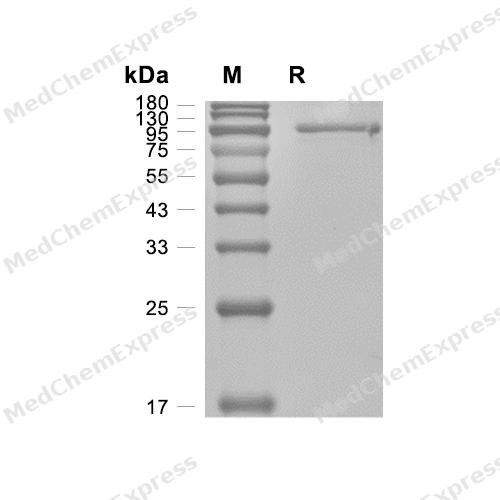
Purity - SDS-PAGE
-
Bioactivity - Cell-Based Assay
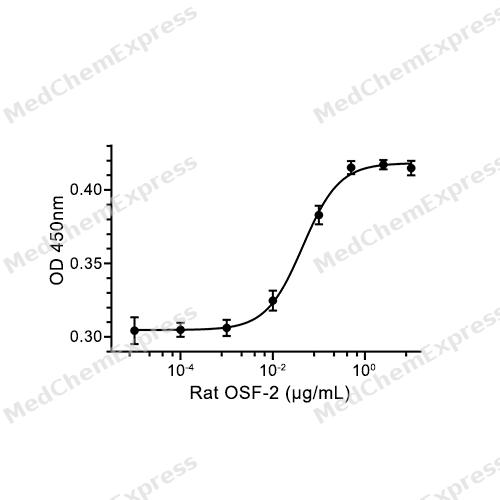
Bioactivity - Cell-Based Assay


Technical Parameters
-
Species Rat
-
Source HEK293
-
Tag C-6*His
-
Accession
D3ZAF5 (N24-S800)
-
Molecular Construction
-
N-term
-
Periostin (N24-S800)
Accession # D3ZAF5 -
6*His
-
C-term
-
-
Protein Length
Partial
-
Synonyms
POSTN; Osteoblast Specific Factor 2 (Fasciclin I-Like); Periostin; Periodontal Ligament-Specific Periostin; OSF-2; Osteoblast Specific Factor 2; PN; Osteoblast-Specific Factor 2; Periostin, Osteoblast Specific Factor; PDLPOSTN; OSF2
-
AA Sequence
NSYYDKVLAHSRIRGRDQGPNVCALQQILGTKKKYFSSCKNWYQGAICGKKTTVLYECCPGYMRMEGMKGCPAVMPIDHVYGTLGIVGATTTQHYSDVSKLREEIEGKGSYTYFAPSNEAWDNLDSDIRRGLENNVNVELLNALHSHMVNKRMLTKDLKHGMVIPSMYNNLGLFINHYPNGVVTVNCARVIHGNQIATNGVVHVIDRVLTQIGTSIQDFIEAEDELSSFRAAAITSDLLESLGRDGHFTLFAPTNEAFEKLPRGVLERIMGDKVASEALMKYHILNTLQCSEAITGGAVFETMEGNTIEIGCEGDSISINGIKMVNKKDIVTKNGVIHLIDEVLIPDSAKQVIELAGKQQTTFTDLVAQLGLASSLKPDGEYTLLAPVNNAFSDDTLSMDQRLLKLILQNHILKVKVGLSDLYNGQILETIGGKQLRVFVYRTAICIENSCMVRGSKQGRNGAIHIFREIIQPAEKSLHEKLRQDKRFSIFLSLLEAADLKDLLTQPGDWTLFAPTNDAFKGMTNEEREILIGDKNALQNIILYHLTPGVYIGKGFEPGVTNILKTTQGSKIYVKGVNETLLVNELKSKESDIMTTNGVIHVVDKLLYPADIPVGNDQLLELLNKLIKYIQIKFVRGSTFKEIPMTVYTTKIITKLVEPKIKVIQGSLQPIIKTEGPAMTKIHIEGEPDFRLIKEGETVTEVIHGEPVIKKYTKIIDGVPVEITEKETREERIITGPEIKYTRISTGGGETEETLQKFLQKDTPAKKIQANKRVQGS
-
Molecular Weight
Approximately 77-95 kDa, based on SDS-PAGE under reducing conditions.
-
Purity
≥ 95%, as determined by reducing SDS-PAGE.


Product Properties
Lyophilized powder.
Lyophilized from a 0.22 μm filtered solution of PBS, pH 7.4.
<1 EU/μg, determined by LAL method.
It is not recommended to reconstitute to a concentration less than 100 μg/mL in ddH2O. For long term storage it is recommended to add a carrier protein (0.1% BSA, 5% HSA, 10% FBS or 5% Trehalose).
Stored at -20°C for 2 years from date of receipt. After reconstitution, it is stable at 4°C for 1 week or -20°C for longer (with carrier protein). It is recommended to freeze aliquots at -20°C or -80°C for extended storage.
Room temperature in continental US; may vary elsewhere.


Documentation
-
Data Sheet (240 KB)
-
SDS (252 KB)
- English - EN (252 KB)
- Français - FR (252 KB)
- Deutsch - DE (252 KB)
- Norwegian - NO (252 KB)
- Español - ES (252 KB)
- Swedish - SV (252 KB)
- Italian - IT (252 KB)
- Korean - KR (252 KB)
- Portuguese - PT (252 KB)
-
Handling Instructions (2659 KB)

Calculators
Concentration (start) × Volume (start) = Concentration (final) × Volume (final)


 Powered by Bioz

