



PF-4/CXCL4 Protein, Human

Based on 1 Customer Validation
The PF-4/CXCL4 protein released during platelet aggregation has a crucial impact on physiological processes. It neutralizes the anticoagulant effect of heparin with higher affinity than chondroitin 4-sulfate chains. PF-4/CXCL4, Human is the recombinant human-derived PF-4/CXCL4 protein, expressed by E. coli, with C-His labeled tag.
- Species: Human
- Source: E. coli
-
Storage:Stored at -20°C for 2 years from date of receipt. After reconstitution, it is stable at 4°C for 1 week or -20°C for longer (with carrier protein). It is recommended to freeze aliquots at -20°C or -80°C for extended storage.


To place orders, for customer services and technical support, please contact: MedChemExpress USA
Tel: 609-228-6898 E-mail: [email protected] [email protected]


-
 Biological Activity
-
Technical Parameters
-
Product Properties
- Documentation
- Help & FAQs




Biological Activity
Description
The PF-4/CXCL4 protein released during platelet aggregation has a crucial impact on physiological processes. It neutralizes the anticoagulant effect of heparin with higher affinity than chondroitin 4-sulfate chains. PF-4/CXCL4, Human is the recombinant human-derived PF-4/CXCL4 protein, expressed by E. coli, with C-His labeled tag.
Background
PF-4/CXCL4 protein, released during platelet aggregation, plays a pivotal role in various physiological processes. It acts to neutralize the anticoagulant effect of heparin by exhibiting a higher binding affinity to heparin compared to the chondroitin-4-sulfate chains of the carrier molecule. Furthermore, PF-4 demonstrates chemotactic properties, attracting neutrophils and monocytes, thereby contributing to immune responses. Notably, it also functions as an inhibitor of endothelial cell proliferation, with the shorter form displaying greater potency than the longer variant. Structurally, PF-4 forms a homotetramer, as evidenced by studies. Additionally, it engages with TNFAIP6 through its Link domain, emphasizing its involvement in intricate molecular interactions. This multifaceted functionality underscores the importance of PF-4/CXCL4 in regulating hemostasis, immune responses, and vascular processes.
Verified Bioactivity
Measured by its ability to inhibit the FGF basic-dependent proliferation of HUVEC human umbilical vein endothelial cells. The ED50 for this effect is 1-5 μg/mL.
MCE Validation Data
-
Purity - SDS-PAGE
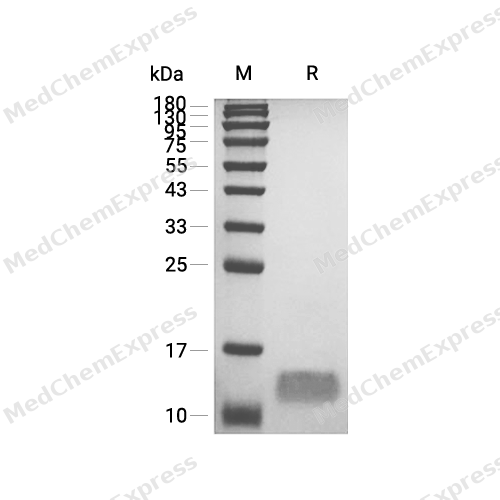
Purity - SDS-PAGE
-
Bioactivity - Cell-Based Assay
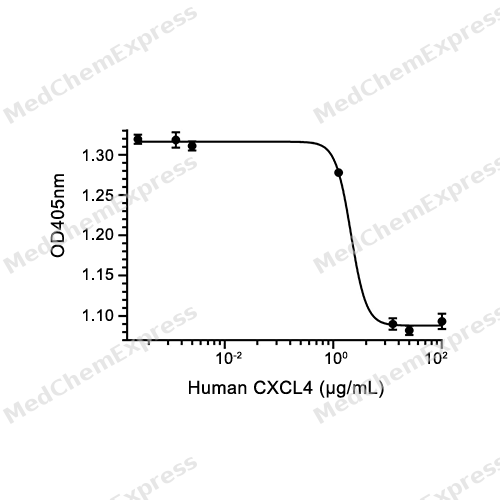
Bioactivity - Cell-Based Assay


Technical Parameters
-
Species Human
-
Source E. coli
-
Tag Tag Free
-
Accession
P02776 (E32-S101)
-
Gene ID5196
-
Molecular Construction
-
N-term
-
CXCL4 (E32-S101)
Accession # P02776 -
C-term
-
-
Protein Length
Full Length of Mature Protein
-
Synonyms
PF4; C-X-C Motif Chemokine 4; Platelet Factor 4; Oncostatin-A; SCYB4; Iroplact; CXCL4; PF-4; Chemokine (C-X-C Motif) Ligand 4
-
AA Sequence
EAEEDGDLQCLCVKTTSQVRPRHITSLEVIKAGPHCPTAQLIATLKNGRKICLDLQAPLYKKIIKKLLES
-
Predicted Molecular Mass
7.8 kDa
-
Molecular Weight
Approximately 12 kDa, based on SDS-PAGE under reducing conditions.
-
Purity
≥ 95%, as determined by reducing SDS-PAGE.


Product Properties
Lyophilized powder
Lyophilized from a 0.22 μm filtered solution of 0.1% TFA, 20% Acetonitrile, pH 2.5.
<1 EU/μg, determined by LAL method.
It is not recommended to reconstitute to a concentration less than 100 μg/mL in ddH2O. For long term storage it is recommended to add a carrier protein (0.1% BSA, 5% HSA, 10% FBS or 5% Trehalose).
Stored at -20°C for 2 years from date of receipt. After reconstitution, it is stable at 4°C for 1 week or -20°C for longer (with carrier protein). It is recommended to freeze aliquots at -20°C or -80°C for extended storage.
Room temperature in continental US; may vary elsewhere.


Documentation
-
Data Sheet (235 KB)
-
SDS (252 KB)
- English - EN (252 KB)
- Français - FR (252 KB)
- Deutsch - DE (252 KB)
- Norwegian - NO (252 KB)
- Español - ES (252 KB)
- Swedish - SV (252 KB)
- Italian - IT (252 KB)
- Korean - KR (252 KB)
- Portuguese - PT (252 KB)
-
Handling Instructions (2659 KB)

Calculators
Concentration (start) × Volume (start) = Concentration (final) × Volume (final)


 Powered by Bioz

