



PPC-DC Protein, Human (His)

Based on 1 Customer Validation
PPC-DC proteins are central players in cellular ubiquitination, covalently linking ubiquitin to target proteins. Its critical role extends to the selective degradation of misfolded membrane proteins, an important process in endoplasmic reticulum-associated degradation (ERAD). PPC-DC Protein, Human (His) is the recombinant human-derived PPC-DC protein, expressed by E. coli , with N-6*His labeled tag.
- Species: Human
- Source: E. coli
-
Storage:Stored at -20°C for 2 years from date of receipt. After reconstitution, it is stable at 4°C for 1 week or -20°C for longer (with carrier protein). It is recommended to freeze aliquots at -20°C or -80°C for extended storage.


To place orders, for customer services and technical support, please contact: MedChemExpress USA
Tel: 609-228-6898 E-mail: [email protected] [email protected]


-
 Biological Activity
-
Technical Parameters
-
Product Properties
- Documentation
- Help & FAQs




Biological Activity
Description
PPC-DC proteins are central players in cellular ubiquitination, covalently linking ubiquitin to target proteins. Its critical role extends to the selective degradation of misfolded membrane proteins, an important process in endoplasmic reticulum-associated degradation (ERAD). PPC-DC Protein, Human (His) is the recombinant human-derived PPC-DC protein, expressed by E. coli , with N-6*His labeled tag.
Background
UBE2J2 protein serves as a key player in cellular ubiquitination processes, facilitating the covalent attachment of ubiquitin to target proteins. Its functional significance extends to the selective degradation of misfolded membrane proteins, a crucial aspect of endoplasmic reticulum-associated degradation (ERAD). This involvement underscores UBE2J2's role in maintaining cellular homeostasis by actively participating in the quality control of protein folding within the endoplasmic reticulum. Additionally, in collaboration with the GATOR2 complex, UBE2J2 catalyzes the 'Lys-6'-linked ubiquitination of NPRL2, further emphasizing its regulatory influence on specific cellular pathways, particularly those related to protein quality control.
MCE Validation Data
-
Purity - SDS-PAGE
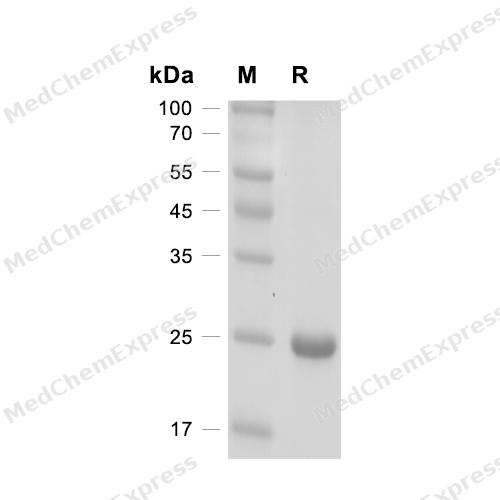
Purity - SDS-PAGE


Technical Parameters
-
Species Human
-
Source E. coli
-
Tag N-6*His
-
Accession
Q96CD2-1 (M1-S204)
-
Molecular Construction
-
N-term
-
6*His
-
PPC-DC (M1-S204)
Accession # Q96CD2-1 -
C-term
-
-
Protein Length
Full Length of Isoform-1
-
Synonyms
PPCDC; PPC-DC; Phosphopantothenoylcysteine Decarboxylase; CoaC; MDS018; COAC; FLJ14585
-
AA Sequence
MEPKASCPAAAPLMERKFHVLVGVTGSVAALKLPLLVSKLLDIPGLEVAVVTTERAKHFYSPQDIPVTLYSDADEWEIWKSRSDPVLHIDLRRWADLLLVAPLDANTLGKVASGICDNLLTCVMRAWDRSKPLLFCPAMNTAMWEHPITAQQVDQLKAFGYVEIPCVAKKLVCGDEGLGAMAEVGTIVDKVKEVLFQHSGFQQS
-
Predicted Molecular Mass
24.5 kDa
-
Molecular Weight
Approximately 27 kDa, based on SDS-PAGE under reducing conditions.
-
Purity
≥ 95%, as determined by reducing SDS-PAGE.


Product Properties
Lyophilized powder.
Lyophilized from a 0.22 μm filtered solution of 50 mM Tris, 300 mM NaCl, 5% trehalose, 5% mannitol and 0.01% Tween 80, pH 7.4.
Note: For SPR assay, please replace the buffer. Primary amine components (e.g., Tris, imidazole) can affect protein-coupled chips.
<1 EU/μg, determined by LAL method.
It is not recommended to reconstitute to a concentration less than 100 μg/mL in ddH2O.
Stored at -20°C for 2 years from date of receipt. After reconstitution, it is stable at 4°C for 1 week or -20°C for longer (with carrier protein). It is recommended to freeze aliquots at -20°C or -80°C for extended storage.
Room temperature in continental US; may vary elsewhere.


Documentation
-
Data Sheet (236 KB)
-
SDS (251 KB)
- English - EN (251 KB)
- Français - FR (251 KB)
- Deutsch - DE (251 KB)
- Norwegian - NO (251 KB)
- Español - ES (251 KB)
- Swedish - SV (251 KB)
- Italian - IT (251 KB)
- Korean - KR (251 KB)
- Portuguese - PT (251 KB)
-
Handling Instructions (2659 KB)

Calculators
Concentration (start) × Volume (start) = Concentration (final) × Volume (final)


 Powered by Bioz

