



PRNP/CD230 Protein, Human (HEK293, Fc, solution)

Based on 1 Customer Validation
Although its primary function is unknown, the PRNP/CD230 protein has been implicated in multiple neuronal processes, including neuronal development, synaptic plasticity, and myelin homeostasis. PRNP acts as an agonist of the ADGRG6 receptor and promotes the maintenance of myelin. PRNP/CD230 Protein, Human (HEK293, Fc, solution) is the recombinant human-derived PRNP/CD230 protein, expressed by HEK293 , with C-hFc labeled tag.
- Species: Human
- Source: HEK293
-
Storage:Stored at -80°C for 1 year from date of receipt. It is stable at -20°C for 3 months after opening. It is recommended to freeze aliquots at -80°C for extended storage. Avoid repeated freeze-thaw cycles.


To place orders, for customer services and technical support, please contact: MedChemExpress USA
Tel: 609-228-6898 E-mail: [email protected] [email protected]


-
 Biological Activity
-
Technical Parameters
-
Product Properties
- Documentation
- Help & FAQs




Biological Activity
Description
Although its primary function is unknown, the PRNP/CD230 protein has been implicated in multiple neuronal processes, including neuronal development, synaptic plasticity, and myelin homeostasis. PRNP acts as an agonist of the ADGRG6 receptor and promotes the maintenance of myelin. PRNP/CD230 Protein, Human (HEK293, Fc, solution) is the recombinant human-derived PRNP/CD230 protein, expressed by HEK293 , with C-hFc labeled tag.
Background
PRNP/CD230, while its primary physiological function remains unclear, is implicated in various neuronal processes, including neuronal development and synaptic plasticity. Additionally, it may play a crucial role in maintaining the myelin sheath of neurons and promoting myelin homeostasis by acting as an agonist for the ADGRG6 receptor. The protein's involvement in iron uptake and homeostasis further underscores its multifaceted functions. Soluble oligomers of PRNP exhibit toxicity to neuroblastoma cells, inducing apoptosis in vitro. Association with GPC1, facilitated by heparan sulfate chains, targets PRNP to lipid rafts and contributes to Cu(2+) or Zn(2+) availability for the ascorbate-mediated GPC1 deaminase degradation of its heparan sulfate side chains. PRNP exists both as a monomer and homodimer, with a propensity to aggregate into amyloid fibrils, possibly influenced by copper binding. Notably, PRNP interacts with various proteins, including GRB2, APP, ERI3/PRNPIP, SYN1, and ADGRG6, suggesting a complex network of molecular interactions.
Verified Bioactivity
Measured by its ability to inhibit proliferation of SH-SY5Y cells. The ED50 for this effect is 0.123 μg/mL, corresponding to a specific activity is 8.137×10^3 units/mg.
MCE Validation Data
-
Bioactivity - Cell-Based Assay
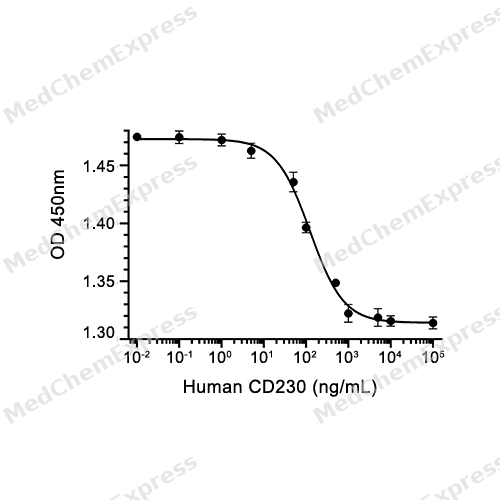
Bioactivity - Cell-Based Assay


Technical Parameters
-
Species Human
-
Source HEK293
-
Tag C-hFc
-
Accession
P04156/NP_000302.1 (K23-G229)
-
Molecular Construction
-
N-term
-
PRNP (K23-G229)
Accession # P04156/NP_000302.1 -
hFc
-
C-term
-
-
Protein Length
Full Length of Major prion protein Chain
-
Synonyms
PRNP; PrP27-30; Prev. PRIP; ASCR; Prev. CJD; Gerstmann-Strausler-Scheinker Syndrome; Prev. GSS; Creutzfeldt-Jakob Disease; AltPrP; Fatal Familial Insomnia; PRP; Prion Protein (P27-30); Alternative Prion Protein; Prion-Related Protein; Major Prion Protein;
-
AA Sequence
KKRPKPGGWNTGGSRYPGQGSPGGNRYPPQGGGGWGQPHGGGWGQPHGGGWGQPHGGGWGQPHGGGWGQGGGTHSQWNKPSKPKTNMKHMAGAAAAGAVVGGLGGYMLGSAMSRPIIHFGSDYEDRYYRENMHRYPNQVYYRPMDEYSNQNNFVHDCVNITIKQHTVTTTTKGENFTETDVKMMERVVEQMCITQYERESQAYYQRG
-
Predicted Molecular Mass
49.7 kDa
-
Molecular Weight
Approximately 57 kDa, based on SDS-PAGE under reducing conditions.
-
Glycosylation
Yes
-
Purity
≥ 90%, as determined by reducing SDS-PAGE.


Product Properties
Solution
Supplied as a 0.22 μm filtered solution of PBS, pH 7.4.
<1 EU/μg, determined by LAL method.
Stored at -80°C for 1 year from date of receipt. It is stable at -20°C for 3 months after opening. It is recommended to freeze aliquots at -80°C for extended storage. Avoid repeated freeze-thaw cycles.
Shipping with dry ice.


Documentation
-
Data Sheet (237 KB)
-
SDS (252 KB)
- English - EN (252 KB)
- Français - FR (252 KB)
- Deutsch - DE (252 KB)
- Norwegian - NO (252 KB)
- Español - ES (252 KB)
- Swedish - SV (252 KB)
- Italian - IT (252 KB)
- Korean - KR (252 KB)
- Portuguese - PT (252 KB)
-
Handling Instructions (2659 KB)

Calculators
Concentration (start) × Volume (start) = Concentration (final) × Volume (final)


 Powered by Bioz

