



SHP-2 Protein, Human (T253M, Q257L, His)
Based on 1 publication(s) in Google Scholar
The SHP-2 protein is a key player downstream of the receptor and cytoplasmic protein tyrosine kinases, facilitating signal transduction from the cell surface to the nucleus. It actively regulates the MAPK pathway and dephosphorylates key substrates, including GAB1, ARHGAP35, EGFR, ROCK2 ("Tyr-722"), and CDC73. SHP-2 Protein, Human (T253M, Q257L, His) is the recombinant human-derived SHP-2 protein, expressed by E. coli , with N-6*His labeled tag and T253M, Q257L mutation.
- Species: Human
- Source: E. coli
-
Storage:Stored at -20°C for 2 years from date of receipt. After reconstitution, it is stable at 4°C for 1 week or -20°C for longer (with carrier protein). It is recommended to freeze aliquots at -20°C or -80°C for extended storage.


To place orders, for customer services and technical support, please contact: MedChemExpress USA
Tel: 609-228-6898 E-mail: [email protected] [email protected]


-
 Biological Activity
-
Technical Parameters
-
Product Properties
- Documentation
- Help & FAQs




Biological Activity
Description
The SHP-2 protein is a key player downstream of the receptor and cytoplasmic protein tyrosine kinases, facilitating signal transduction from the cell surface to the nucleus. It actively regulates the MAPK pathway and dephosphorylates key substrates, including GAB1, ARHGAP35, EGFR, ROCK2 ("Tyr-722"), and CDC73. SHP-2 Protein, Human (T253M, Q257L, His) is the recombinant human-derived SHP-2 protein, expressed by E. coli , with N-6*His labeled tag and T253M, Q257L mutation.
Background
SHP-2 protein functions downstream of various receptor and cytoplasmic protein tyrosine kinases, participating in signal transduction from the cell surface to the nucleus. It positively regulates the MAPK signal transduction pathway and plays a crucial role in dephosphorylating key substrates, including GAB1, ARHGAP35, EGFR, ROCK2 (at 'Tyr-722'), and CDC73. Additionally, SHP-2 dephosphorylates SOX9 on tyrosine residues, leading to the inactivation of SOX9 and the promotion of ossification. Furthermore, it targets tyrosine-phosphorylated NEDD9/CAS-L for dephosphorylation, highlighting its diverse roles in modulating cellular signaling cascades.
Verified Bioactivity
Measured by its ability to dephosphorylate a tyrosine residue in a peptide EGF Receptor Substrate 2 (HY-P0320, Phospho-Tyr5 (TFA)) that incubate at 37°C for 20 min. The specific activity is 3.01 μmol/min/mg.
MCE Validation Data
-
Purity - SDS-PAGE
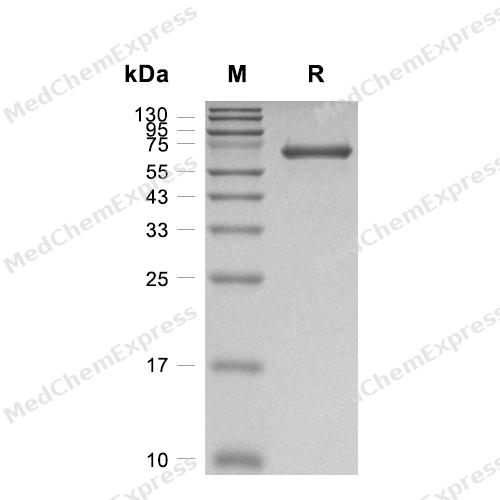
Purity - SDS-PAGE


Publications (1)
-
Journal Impact Factor
-
Most Recent
-
Nat Commun
2025 Sep 30;16(1):8684. PMID: 41028750


Technical Parameters
-
Species Human
-
Source E. coli
-
Tag N-6*His
-
Accession
Q06124-2 (T2-R593, T253M, Q257L)
-
Molecular Construction
-
N-term
-
6*His
-
SHP-2 (T2-R593, T253M, Q257L)
Accession # Q06124 -
C-term
-
-
Protein Length
Full Length of Isoform-2
-
Synonyms
PTPN11; Protein Tyrosine Phosphatase Non-Receptor Type 11 Isoform 1; Prev. NS1; Tyrosine-Protein Phosphatase Non-Receptor Type; SH-PTP2; Protein-Tyrosine-Phosphatase; PTP2C; Noonan Syndrome 1; BPTP3; CDNA, FLJ92431; SHP-2; PTPN11 Protein; SHP2; METCDS; SH
-
AA Sequence
TSRRWFHPNITGVEAENLLLTRGVDGSFLARPSKSNPGDFTLSVRRNGAVTHIKIQNTGDYYDLYGGEKFATLAELVQYYMEHHGQLKEKNGDVIELKYPLNCADPTSERWFHGHLSGKEAEKLLTEKGKHGSFLVRESQSHPGDFVLSVRTGDDKGESNDGKSKVTHVMIRCQELKYDVGGGERFDSLTDLVEHYKKNPMVETLGTVLQLKQPLNTTRINAAEIESRVRELSKLAETTDKVKQGFWEEFEMLQQLECKLLYSRKEGQRQENKNKNRYKNILPFDHTRVVLHDGDPNEPVSDYINANIIMPEFETKCNNSKPKKSYIATQGCLQNTVNDFWRMVFQENSRVIVMTTKEVERGKSKCVKYWPDEYALKEYGVMRVRNVKESAAHDYTLRELKLSKVGQGNTERTVWQYHFRTWPDHGVPSDPGGVLDFLEEVHHKQESIMDAGPVVVHCSAGIGRTGTFIVIDILIDIIREKGVDCDIDVPKTIQMVRSQRSGMVQTEAQYRFIYMAVQHYIETLQRRIEEEQKSKRKGHEYTNIKYSLADQTSGDQSPLPPCTPTPPCAEMREDSARVYENVGLMQQQKSFR
-
Molecular Weight
Approximately 70-75 kDa, based on SDS-PAGE under reducing conditions.
-
Purity
≥ 90%, as determined by reducing SDS-PAGE.


Product Properties
Lyophilized powder
1.Lyophilized from a 0.22 μm filtered solution of 40 mM Tris, 110 mM NaCl, 2.2 mM KCl, 0.04% Tween 20, 6% Trehalose.
2.Lyophilized from a 0.22 μm filtered solution of PBS, 6% trehalose.
3.Lyophilized from a 0.22 μm filtered solution of PBS, pH 8.0, 8% trehalose.
Please refer to the lot-specific COA for specific buffer information.
Note: For SPR assay, please replace the buffer. Primary amine components (e.g., Tris, imidazole) can affect protein-coupled chips.
<1 EU/μg, determined by LAL method.
It is not recommended to reconstitute to a concentration less than 100 μg/mL in ddH2O.
Stored at -20°C for 2 years from date of receipt. After reconstitution, it is stable at 4°C for 1 week or -20°C for longer (with carrier protein). It is recommended to freeze aliquots at -20°C or -80°C for extended storage.
Room temperature in continental US; may vary elsewhere.


Documentation
-
Data Sheet (239 KB)
-
SDS (252 KB)
- English - EN (252 KB)
- Français - FR (252 KB)
- Deutsch - DE (252 KB)
- Norwegian - NO (252 KB)
- Español - ES (252 KB)
- Swedish - SV (252 KB)
- Italian - IT (252 KB)
- Korean - KR (252 KB)
- Portuguese - PT (252 KB)
-
Handling Instructions (2659 KB)

Calculators
Concentration (start) × Volume (start) = Concentration (final) × Volume (final)


 Powered by Bioz

