



RELT Protein, Human (HEK293, Fc)

Based on 1 Customer Validation
RELT protein may play a role in apoptosis, suggesting its involvement in the complex cellular process of programmed cell death. When overexpressed, RELT activates the MAPK14/p38 and MAPK8/JNK MAPK cascades, affecting key signaling pathways. RELT Protein, Human (HEK293, Fc) is the recombinant human-derived RELT protein, expressed by HEK293 , with C-hFc labeled tag.
- Species: Human
- Source: HEK293
-
Storage:Stored at -80°C for 1 year from date of receipt. It is stable at -20°C for 3 months after opening. It is recommended to freeze aliquots at -80°C for extended storage. Avoid repeated freeze-thaw cycles.


To place orders, for customer services and technical support, please contact: MedChemExpress USA
Tel: 609-228-6898 E-mail: [email protected] [email protected]


-
 Biological Activity
-
Technical Parameters
-
Product Properties
- Documentation
- Help & FAQs




Biological Activity
Description
RELT protein may play a role in apoptosis, suggesting its involvement in the complex cellular process of programmed cell death. When overexpressed, RELT activates the MAPK14/p38 and MAPK8/JNK MAPK cascades, affecting key signaling pathways. RELT Protein, Human (HEK293, Fc) is the recombinant human-derived RELT protein, expressed by HEK293 , with C-hFc labeled tag.
Background
The RELT protein is implicated in potentially playing a role in apoptosis, suggesting its involvement in the complex cellular process of programmed cell death. When overexpressed, RELT induces the activation of MAPK14/p38 and MAPK8/JNK MAPK cascades, indicating its influence on key signaling pathways associated with cellular responses. Additionally, RELT is identified as having a role in dental enamel formation, contributing to the intricate processes involved in tooth development. The protein interacts with various partners, including TRAF1, RELL1, RELL2, OXSR1, PLSCR1, and STK39, underscoring its versatility in molecular interactions and suggesting its potential involvement in diverse cellular functions beyond apoptosis, including signal transduction and developmental processes.
MCE Validation Data
-
Purity - SDS-PAGE
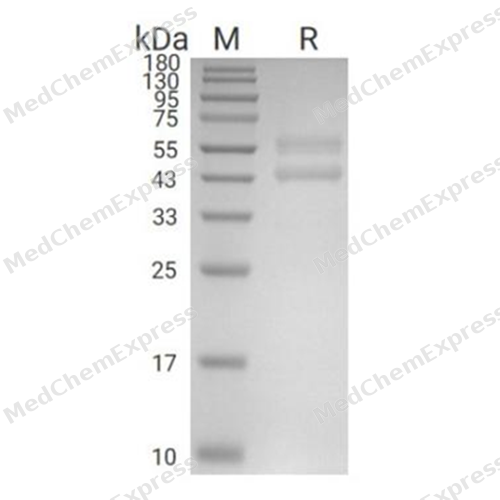
Purity - SDS-PAGE


Technical Parameters
-
Species Human
-
Source HEK293
-
Tag C-hFc
-
Accession
Q969Z4 (S26-A160)
-
Molecular Construction
-
N-term
-
RELT (S26-A160)
Accession # Q969Z4 -
hFc
-
C-term
-
-
Protein Length
Extracellular Domain
-
Synonyms
RELT; RELT Tumor Necrosis Factor Receptor; Prev. TNFRSF19L; Tumor Necrosis Factor Receptor Superfamily, Member 19-Like; Receptor Expressed In Lymphoid Tissues; AI3C; Tumor Necrosis Factor Receptor Superfamily Member 19L; TRLT; RELT TNF Receptor; FLJ14993
-
AA Sequence
STTLWQCPPGEEPDLDPGQGTLCRPCPPGTFSAAWGSSPCQPHARCSLWRRLEAQVGMATRDTLCGDCWPGWFGPWGVPRVPCQPCSWAPLGTHGCDEWGRRARRGVEVAAGASSGGETRQPGNGTRAGGPEETA
-
Predicted Molecular Mass
41.4 kDa
-
Molecular Weight
Approximately 40-60 kDa, based on SDS-PAGE under reducing conditions.
-
Glycosylation
Yes
-
Purity
≥ 90%, as determined by reducing SDS-PAGE.


Product Properties
Solution
Supplied as a 0.22 μm filtered solution of 20 mM PB, 150 mM NaCl, pH 7.2.
<1 EU/μg, determined by LAL method.
Stored at -80°C for 1 year from date of receipt. It is stable at -20°C for 3 months after opening. It is recommended to freeze aliquots at -80°C for extended storage. Avoid repeated freeze-thaw cycles.
Shipping with dry ice.


Documentation
-
Data Sheet (235 KB)
-
SDS (252 KB)
- English - EN (252 KB)
- Français - FR (252 KB)
- Deutsch - DE (252 KB)
- Norwegian - NO (252 KB)
- Español - ES (252 KB)
- Swedish - SV (252 KB)
- Italian - IT (252 KB)
- Korean - KR (252 KB)
- Portuguese - PT (252 KB)
-
Handling Instructions (2659 KB)

Calculators
Concentration (start) × Volume (start) = Concentration (final) × Volume (final)


 Powered by Bioz

