



RLN1/Relaxin-1 Protein, Human (HEK293, His)

Based on 1 Customer Validation
The RLN1/Relaxin-1 protein is an important ovarian hormone that cooperates with estrogen to induce birth canal dilation. It plays a vital role in connective tissue remodeling during pregnancy, promoting pubic ligament growth and cervical ripening. RLN1/Relaxin-1 Protein, Human (HEK293, His) is the recombinant human-derived RLN1/Relaxin-1 protein, expressed by HEK293 , with C-His labeled tag.
- Species: Human
- Source: HEK293
-
Storage:Stored at -20°C for 2 years from date of receipt. After reconstitution, it is stable at 4°C for 1 week or -20°C for longer (with carrier protein). It is recommended to freeze aliquots at -20°C or -80°C for extended storage.


To place orders, for customer services and technical support, please contact: MedChemExpress USA
Tel: 609-228-6898 E-mail: [email protected] [email protected]


-
 Biological Activity
-
Technical Parameters
-
Product Properties
- Documentation
- Help & FAQs




Biological Activity
Description
The RLN1/Relaxin-1 protein is an important ovarian hormone that cooperates with estrogen to induce birth canal dilation. It plays a vital role in connective tissue remodeling during pregnancy, promoting pubic ligament growth and cervical ripening. RLN1/Relaxin-1 Protein, Human (HEK293, His) is the recombinant human-derived RLN1/Relaxin-1 protein, expressed by HEK293 , with C-His labeled tag.
Background
RLN1, also known as Relaxin-1, is a vital ovarian hormone that collaborates with estrogen, particularly in numerous mammals, to induce the dilation of the birth canal. This hormone plays a crucial role in the remodeling of connective tissues during pregnancy, facilitating the growth of pubic ligaments and the ripening of the cervix. The functional form of RLN1 exists as a heterodimer, comprised of a B chain and an A chain, intricately linked by two disulfide bonds. Through its intricate molecular structure, RLN1 contributes significantly to the intricate processes associated with pregnancy, influencing the adaptive changes in the female reproductive system to support a successful birth.
Verified Bioactivity
Measured by its ability to induce cAMP accumulation in THP-1 human acute monocytic leukemia cells. The ED50 for this effect is 10.95 ng/mL, corresponding to a specific activity is 9.132×10⁴ U/mg.
MCE Validation Data
-
Purity - SDS-PAGE
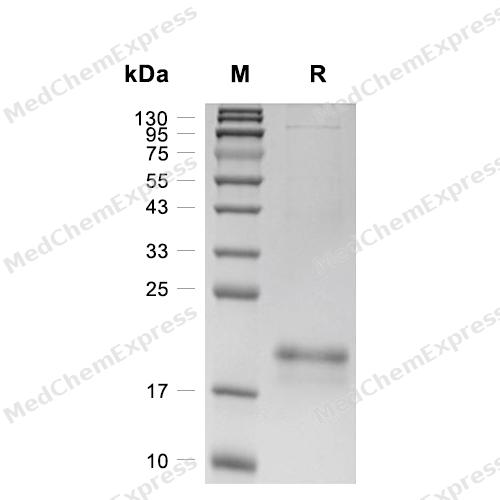
Purity - SDS-PAGE
-
Bioactivity - Cell-Based Assay
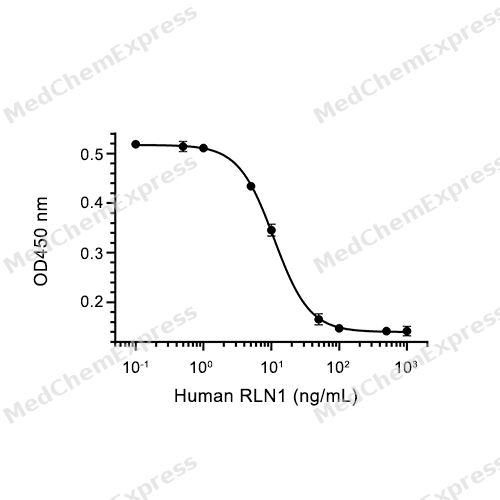
Bioactivity - Cell-Based Assay


Technical Parameters
-
Species Human
-
Source HEK293
-
Tag C-6*His
-
Accession
P04808 (V23-C185)
-
Molecular Construction
-
N-term
-
RLN1 (V23-C185)
Accession # P04808 -
His
-
C-term
-
-
Protein Length
Full Length of Mature Protein
-
Synonyms
RLN1; Relaxin 1 (H1); Relaxin 1; BA12D24.3.1; Prorelaxin H1; BA12D24.3.2; H1; H1RLX; Preprorelaxin H1; RLXH1
-
AA Sequence
VAAKWKDDVIKLCGRELVRAQIAICGMSTWSKRSLSQEDAPQTPRPVAEIVPSFINKDTETIIIMLEFIANLPPELKAALSERQPSLPELQQYVPALKDSNLSFEEFKKLIRNRQSEAADSNPSELKYLGLDTHSQKKRRPYVALFEKCCLIGCTKRSLAKYC
-
Molecular Weight
Approximately 20 kDa
-
Purity
≥ 90%, as determined by reducing SDS-PAGE.


Product Properties
Lyophilized powder.
Lyophilized from a 0.22 μm filtered solution of PBS, pH 7.4.
<1 EU/μg, determined by LAL method.
It is not recommended to reconstitute to a concentration less than 100 μg/mL in ddH2O. For long term storage it is recommended to add a carrier protein (0.1% BSA, 5% HSA, 10% FBS or 5% Trehalose).
Stored at -20°C for 2 years from date of receipt. After reconstitution, it is stable at 4°C for 1 week or -20°C for longer (with carrier protein). It is recommended to freeze aliquots at -20°C or -80°C for extended storage.
Room temperature in continental US; may vary elsewhere.


Documentation
-
Data Sheet (236 KB)
-
SDS (251 KB)
- English - EN (251 KB)
- Français - FR (251 KB)
- Deutsch - DE (251 KB)
- Norwegian - NO (251 KB)
- Español - ES (251 KB)
- Swedish - SV (251 KB)
- Italian - IT (251 KB)
- Korean - KR (251 KB)
- Portuguese - PT (251 KB)
-
Handling Instructions (2659 KB)

Calculators
Concentration (start) × Volume (start) = Concentration (final) × Volume (final)


 Powered by Bioz

