



SARS-CoV S Protein (HEK293, His-Myc)
Based on 1 Customer Validation
The SARS-CoV S protein coordinates viral entry by interacting with human ACE2 and CLEC4M/DC-SIGNR receptors to attach viral particles to the cell membrane. It downregulates host tethering protein (BST2) through lysosomal degradation, antagonizing its antiviral activity. SARS-CoV S Protein (HEK293, His-Myc) is the recombinant Virus-derived SARS-CoV S protein, expressed by HEK293 , with N-10*His, C-Myc labeled tag.
- Species: Virus
- Source: HEK293
-
Storage:Stored at -20°C for 2 years from date of receipt. After reconstitution, it is stable at 4°C for 1 week or -20°C for longer (with carrier protein). It is recommended to freeze aliquots at -20°C or -80°C for extended storage.


To place orders, for customer services and technical support, please contact: MedChemExpress USA
Tel: 609-228-6898 E-mail: [email protected] [email protected]


-
 Biological Activity
-
Technical Parameters
-
Product Properties
- Documentation
- Help & FAQs




Biological Activity
Description
The SARS-CoV S protein coordinates viral entry by interacting with human ACE2 and CLEC4M/DC-SIGNR receptors to attach viral particles to the cell membrane. It downregulates host tethering protein (BST2) through lysosomal degradation, antagonizing its antiviral activity. SARS-CoV S Protein (HEK293, His-Myc) is the recombinant Virus-derived SARS-CoV S protein, expressed by HEK293 , with N-10*His, C-Myc labeled tag.
Background
The SARS-CoV S protein is implicated in down-regulating host tetherin (BST2) through lysosomal degradation, thus counteracting its antiviral activity. In the context of infection, the S protein attaches the virion to the cell membrane by interacting with host receptors, initiating the viral entry process. The binding to human ACE2 and CLEC4M/DC-SIGNR receptors, coupled with the subsequent internalization of the virus into the endosomes of the host cell, induces conformational changes in the S glycoprotein. Additionally, proteolysis by cathepsin CTSL may unmask the fusion peptide of S2, activating membrane fusion within endosomes. These orchestrated events underscore the pivotal role of the SARS-CoV S protein in mediating viral entry and evading host antiviral defenses, shedding light on its significance in the pathogenesis of SARS-CoV infections. Further exploration is crucial to unveil the intricate molecular mechanisms underlying these processes and to identify potential targets for therapeutic interventions.
Verified Bioactivity
Measured by its binding ability in a functional ELISA. Immobilized SARS-CoV S-RBD at 2 μg/mL can bind Paguma larvata ACE2 , the EC50 is 20.83-79.47 ng/mL.
MCE Validation Data
-
Purity - SDS-PAGE
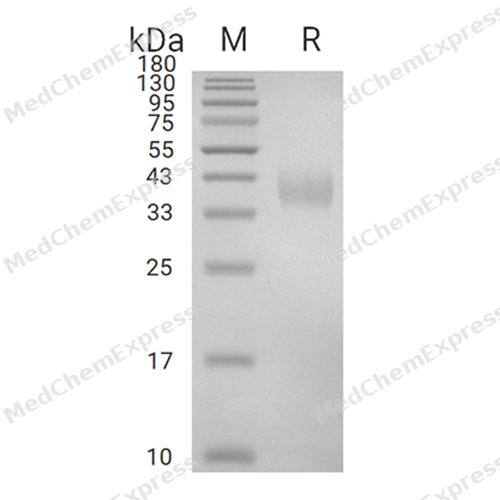
Purity - SDS-PAGE


Technical Parameters
-
Species Virus
-
Source HEK293
-
Tag N-10*His;C-Myc
-
Accession
P59594 (R306-F527)
-
Gene ID1489668 [NCBI]
-
Molecular Construction
-
N-term
-
10*His-Myc
-
SARS-CoV S (R306-F527)
Accession # P59594 -
C-term
-
-
Protein Length
Full Length of Receptor-binding domain (RBD) Domain
-
Synonyms
S glycoprotein; E2; Peplomer protein; Spike protein S1; Spike protein S2;
-
AA Sequence
RVVPSGDVVRFPNITNLCPFGEVFNATKFPSVYAWERKKISNCVADYSVLYNSTFFSTFKCYGVSATKLNDLCFSNVYADSFVVKGDDVRQIAPGQTGVIADYNYKLPDDFMGCVLAWNTRNIDATSTGNYNYKYRYLRHGKLRPFERDISNVPFSPDGKPCTPPALNCYWPLNDYGFYTTTGIGYQPYRVVVLSFELLNAPATVCGPKLSTDLIKNQCVNF
-
Predicted Molecular Mass
30 kDa
-
Molecular Weight
Approximately 37 kDa, based on SDS-PAGE under reducing conditions, due to the glycosylation.
-
Glycosylation
Yes
-
Purity
≥ 95%, as determined by reducing SDS-PAGE.


Product Properties
Lyophilized powder.
Lyophilized from a 0.22 μm filtered solution of 20 mM Tris-HCl, 0.5 M NaCl, 6% trehalose, pH 8.0.
Note: For SPR assay, please replace the buffer. Primary amine components (e.g., Tris, imidazole) can affect protein-coupled chips.
<1 EU/μg, determined by LAL method.
It is not recommended to reconstitute to a concentration less than 100 μg/mL in ddH2O.
Stored at -20°C for 2 years from date of receipt. After reconstitution, it is stable at 4°C for 1 week or -20°C for longer (with carrier protein). It is recommended to freeze aliquots at -20°C or -80°C for extended storage.
Room temperature in continental US;may vary elsewhere.


Documentation
-
Data Sheet (237 KB)
-
SDS (252 KB)
- English - EN (252 KB)
- Français - FR (252 KB)
- Deutsch - DE (252 KB)
- Norwegian - NO (252 KB)
- Español - ES (252 KB)
- Swedish - SV (252 KB)
- Italian - IT (252 KB)
- Korean - KR (252 KB)
- Portuguese - PT (252 KB)
-
Handling Instructions (2659 KB)

Calculators
Concentration (start) × Volume (start) = Concentration (final) × Volume (final)


 Powered by Bioz

