



SCN3B Protein, Human (HEK293, His)

Based on 1 Customer Validation
The SCN3B protein critically affects sodium channel dynamics, inducing unique sustained currents and slower inactivation rates compared to beta-1. Its interaction with NFASC is shown to guide sodium channels to the nodes of Ranvier during axonal development and retain them in mature myelinated axons. SCN3B Protein, Human (HEK293, His) is the recombinant human-derived SCN3B protein, expressed by HEK293 , with C-His labeled tag.
- Species: Human
- Source: HEK293
-
Storage:Stored at -20°C for 2 years from date of receipt. After reconstitution, it is stable at 4°C for 1 week or -20°C for longer (with carrier protein). It is recommended to freeze aliquots at -20°C or -80°C for extended storage.


To place orders, for customer services and technical support, please contact: MedChemExpress USA
Tel: 609-228-6898 E-mail: [email protected] [email protected]


-
 Biological Activity
-
Technical Parameters
-
Product Properties
- Documentation
- Help & FAQs




Biological Activity
Description
The SCN3B protein critically affects sodium channel dynamics, inducing unique sustained currents and slower inactivation rates compared to beta-1. Its interaction with NFASC is shown to guide sodium channels to the nodes of Ranvier during axonal development and retain them in mature myelinated axons. SCN3B Protein, Human (HEK293, His) is the recombinant human-derived SCN3B protein, expressed by HEK293 , with C-His labeled tag.
Background
SCN3B protein plays a crucial role in modulating the kinetics of channel gating, resulting in distinctive persistent sodium currents. In comparison to the beta-1 subunit, SCN3B induces a slower inactivation of sodium channels, influencing their opening dynamics. The interaction of SCN3B with NFASC suggests its potential involvement in directing sodium channels to the nodes of Ranvier during axonal development and retaining them at these nodes in mature myelinated axons. The voltage-sensitive sodium channel, comprising an ion-conducting pore-forming alpha-subunit, is intricately regulated by beta-1, beta-2, beta-3, and/or beta-4 subunits. Notably, beta-1 and beta-3 associate non-covalently with alpha, while beta-2 and beta-4 form covalent bonds through disulfide linkages, contributing to the functional complexity of the sodium channel complex.
MCE Validation Data
-
Purity - SDS-PAGE
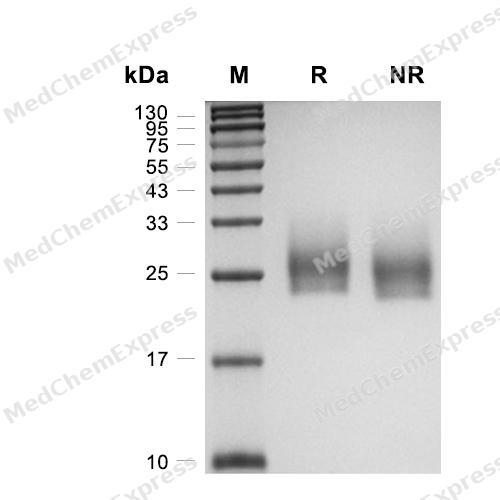
Purity - SDS-PAGE


Technical Parameters
-
Species Human
-
Source HEK293
-
Tag C-6*His
-
Accession
Q9NY72 (F23-E159)
-
Molecular Construction
-
N-term
-
SCN3B (F23-E159)
Accession # Q9NY72 -
His
-
C-term
-
-
Protein Length
Extracellular Domain
-
Synonyms
SCN3B; Sodium Channel, Voltage-Gated, Type III, Beta; Sodium Voltage-Gated Channel Beta Subunit 3; Voltage-Gated Sodium Channel Beta-3 Subunit; Sodium Channel Regulatory Subunit Beta-3; Sodium Channel Subunit Beta-3; HSA243396; KIAA1158; SCNB3; ATFB16; So
-
AA Sequence
FPVCVEVPSETEAVQGNPMKLRCISCMKREEVEATTVVEWFYRPEGGKDFLIYEYRNGHQEVESPFQGRLQWNGSKDLQDVSITVLNVTLNDSGLYTCNVSREFEFEAHRPFVKTTRLIPLRVTEEAGEDFTSVVSE
-
Molecular Weight
Approximately 29 and34 kDa, based on SDS-PAGE under reducing conditions, due to the glycosylation.
-
Glycosylation
Yes
-
Purity
≥ 95%, as determined by reducing SDS-PAGE.


Product Properties
Lyophilized powder.
Lyophilized from a 0.22 μm filtered solution of PBS, pH 7.4.
<1 EU/μg, determined by LAL method.
It is not recommended to reconstitute to a concentration less than 100 μg/mL in ddH2O. For long term storage it is recommended to add a carrier protein (0.1% BSA, 5% HSA, 10% FBS or 5% Trehalose).
Stored at -20°C for 2 years from date of receipt. After reconstitution, it is stable at 4°C for 1 week or -20°C for longer (with carrier protein). It is recommended to freeze aliquots at -20°C or -80°C for extended storage.
Room temperature in continental US; may vary elsewhere.


Documentation
-
Data Sheet (236 KB)
-
SDS (251 KB)
- English - EN (251 KB)
- Français - FR (251 KB)
- Deutsch - DE (251 KB)
- Norwegian - NO (251 KB)
- Español - ES (251 KB)
- Swedish - SV (251 KB)
- Italian - IT (251 KB)
- Korean - KR (251 KB)
- Portuguese - PT (251 KB)
-
Handling Instructions (2659 KB)

Calculators
Concentration (start) × Volume (start) = Concentration (final) × Volume (final)


 Powered by Bioz

