



Semaphorin-7A/SEMA7A Protein, Mouse (HEK293, His)

Based on 1 Customer Validation
Semaphorin-7A/SEMA7A proteins critically regulate integrin-mediated signaling, affecting cell migration and immune responses. It promotes focal adhesion complex formation, activates PTK2/FAK1, and leads to the phosphorylation of MAPK1 and MAPK3. Semaphorin-7A/SEMA7A Protein, Mouse (HEK293, His) is the recombinant mouse-derived Semaphorin-7A/SEMA7A, expressed by HEK293, with C-6*His labeled tag.
- Species: Mouse
- Source: HEK293
-
Storage:Stored at -20°C for 2 years from date of receipt. After reconstitution, it is stable at 4°C for 1 week or -20°C for longer (with carrier protein). It is recommended to freeze aliquots at -20°C or -80°C for extended storage.


To place orders, for customer services and technical support, please contact: MedChemExpress USA
Tel: 609-228-6898 E-mail: [email protected] [email protected]


-
 Biological Activity
-
Technical Parameters
-
Product Properties
- Documentation
- Help & FAQs




Biological Activity
Description
Semaphorin-7A/SEMA7A proteins critically regulate integrin-mediated signaling, affecting cell migration and immune responses. It promotes focal adhesion complex formation, activates PTK2/FAK1, and leads to the phosphorylation of MAPK1 and MAPK3. Semaphorin-7A/SEMA7A Protein, Mouse (HEK293, His) is the recombinant mouse-derived Semaphorin-7A/SEMA7A, expressed by HEK293, with C-6*His labeled tag.
Background
The Semaphorin-7A/SEMA7A protein plays a crucial role in integrin-mediated signaling, contributing to the regulation of cell migration and immune responses. It facilitates the formation of focal adhesion complexes and activates the protein kinase PTK2/FAK1, leading to the subsequent phosphorylation of MAPK1 and MAPK3. Moreover, it enhances the production of pro-inflammatory cytokines by monocytes and macrophages. This protein also plays a significant role in modulating inflammation and T-cell-mediated immune responses. Additionally, it promotes axon growth in the embryonic olfactory bulb and aids in the attachment, spreading, and dendrite outgrowth in melanocytes. It interacts with PLXNC1 and the integrins ITGA1 and ITGB1.
Verified Bioactivity
Measured by the ability of the immobilized protein to support the adhesion of THP‑1 human acute monocytic leukemia cells. When 5×10⁴ cells/well are added to coated plates, cell adhesion is enhanced in a dose dependent manner after 60 minutes at 37 °C. The ED50 for this effect is 0.2644 μg/mL, corresponding to a specific activity is 3.782×10³ U/mg.
MCE Validation Data
-
Purity - SDS-PAGE
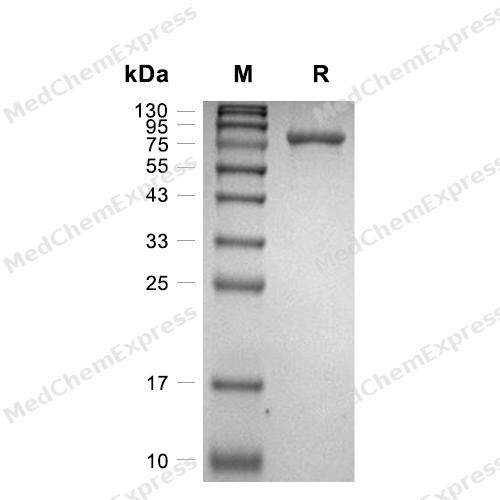
Purity - SDS-PAGE
-
Bioactivity - Cell-Based Assay
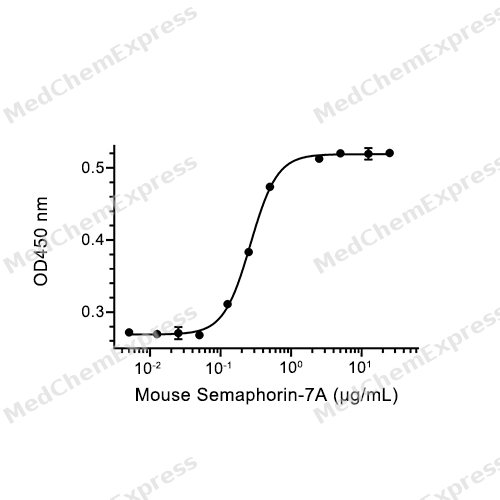
Bioactivity - Cell-Based Assay


Technical Parameters
-
Species Mouse
-
Source HEK293
-
Tag C-6*His
-
Accession
Q9QUR8 (Q45-A646)
-
Gene ID20361
-
Protein Length
Full Length of Mature Protein
-
Synonyms
SEMA7A; CDw108; Prev. SEMAL; Sema Domain, Immunoglobulin Domain (Ig), And GPI Membrane Anchor, (Semaphorin) 7A; CD108; Sema Domain, Immunoglobulin Domain (Ig), And GPI Membrane Anchor, 7A; Semaphorin-7A; Semaphorin 7A (John Milton Hagen Blood Group); Sema
-
AA Sequence
QGHSRSGPRISAVWKGQDHVDFSQPEPHTVLFHEPGSFSVWVGGRGKVYHFNFPEGKNASVRTVNIGSTKGSCQDKQDCGNYITLLERRGNGLLVCGTNARKPSCWNLVNDSVVMSLGEMKGYAPFSPDENSLVLFEGDEVYSTIRKQEYNGKIPRFRRIRGESELYTSDTVMQNPQFIKATIVHQDQAYDDKIYYFFREDNPDKNPEAPLNVSRVAQLCRGDQGGESSLSVSKWNTFLKAMLVCSDAATNRNFNRLQDVFLLPDPSGQWRDTRVYGVFSNPWNYSAVCVYSLGDIDRVFRTSSLKGYHMGLPNPRPGMCLPKKQPIPTETFQVADSHPEVAQRVEPMGPLKTPLFHSKYHYQKVVVHRMQASNGETFHVLYLTTDRGTIHKVVESGDQDHSFVFNIMEIQPFHRAAAIQAISLDADRRKLYVTSQWEVSQVPLDMCEVYSGGCHGCLMSRDPYCGWDQDRCVSIYSSQRSVLQSINPAEPHRECPNPKPDEAPLQKVSLARNSRYYLTCPMESRHATYLWRHEENVEQSCEPGHQSPSCILFIENLTARQYGHYRCEAQEGSYLREAQHWELLPEDRALAEQLMGHARALA
-
Predicted Molecular Mass
68.4 kDa
-
Molecular Weight
Approximately 75-90 kDa, based on SDS-PAGE under reducing conditions, due to the glycosylation.
-
Purity
≥ 95%, as determined by reducing SDS-PAGE.


Product Properties
Lyophilized powder.
Lyophilized from a 0.22 μm filtered solution of PBS, pH 7.4.
<1 EU/μg, determined by LAL method.
It is not recommended to reconstitute to a concentration less than 100 μg/mL in ddH2O. For long term storage it is recommended to add a carrier protein (0.1% BSA, 5% HSA, 10% FBS or 5% Trehalose).
Stored at -20°C for 2 years from date of receipt. After reconstitution, it is stable at 4°C for 1 week or -20°C for longer (with carrier protein). It is recommended to freeze aliquots at -20°C or -80°C for extended storage.
Room temperature in continental US; may vary elsewhere.


Documentation
-
Data Sheet (240 KB)
-
SDS (251 KB)
- English - EN (251 KB)
- Français - FR (251 KB)
- Deutsch - DE (251 KB)
- Norwegian - NO (251 KB)
- Español - ES (251 KB)
- Swedish - SV (251 KB)
- Italian - IT (251 KB)
- Korean - KR (251 KB)
- Portuguese - PT (251 KB)
-
Handling Instructions (2659 KB)

Calculators
Concentration (start) × Volume (start) = Concentration (final) × Volume (final)


 Powered by Bioz

