



Serpin B5/Maspin Protein, Human (His)

Based on 1 Customer Validation
Serpin B5/Maspin Protein is a tumor suppressor and a unique member of the serpin family. Maspin inhibits cancer cell invasion, attachment to the extracellular matrix, increases sensitivity to apoptosis, and inhibits angiogenesis. Maspin interacting with diverse group of intercellular and extracellular proteins, regulating cell adhesion, motility, apoptosis, and critically involved in mammary gland development. Maspin acts as an endogenous inhibitor of histone deacetylase (HDAC1). Serpin B5/Maspin Protein, Human (His) is the recombinant human-derived Serpin B5/Maspin protein, expressed by E. coli , with C-6*His labeled tag.
- Species: Human
- Source: E. coli
-
Storage:Stored at -20°C for 2 years from date of receipt. After reconstitution, it is stable at 4°C for 1 week or -20°C for longer (with carrier protein). It is recommended to freeze aliquots at -20°C or -80°C for extended storage.


To place orders, for customer services and technical support, please contact: MedChemExpress USA
Tel: 609-228-6898 E-mail: [email protected] [email protected]


-
 Biological Activity
-
Technical Parameters
-
Product Properties
- Documentation
- Help & FAQs




Biological Activity
Description
Serpin B5/Maspin Protein is a tumor suppressor and a unique member of the serpin family. Maspin inhibits cancer cell invasion, attachment to the extracellular matrix, increases sensitivity to apoptosis, and inhibits angiogenesis. Maspin interacting with diverse group of intercellular and extracellular proteins, regulating cell adhesion, motility, apoptosis, and critically involved in mammary gland development. Maspin acts as an endogenous inhibitor of histone deacetylase (HDAC1). Serpin B5/Maspin Protein, Human (His) is the recombinant human-derived Serpin B5/Maspin protein, expressed by E. coli , with C-6*His labeled tag.
Background
Maspin is a unique member of the serpin family that shares extensive homology with monocyte-neutrophil elastase inhibitor, PAI-2 and other serpins. Among the established anti-tumor effects of Maspin are the inhibition of cancer cell invasion, attachment to extracellular matrices, increased sensitivity to apoptosis, and inhibition of angiogenesis. Maspin interacting with diverse group of intercellular and extracellular proteins, regulating cell adhesion, motility, apoptosis, and angiogenesis and critically involved in mammary gland development. Maspin is an endogenous inhibitor of histone deacetylase (HDAC1) and reprograms tumor cells toward better differentiated phenotypes by inhibiting HDAC1.It stimulates an antitumor immune response in prostate tumor cells , leading to tumor elimination in vivo. Maspin may function as a modulator of the immune system in the tumor microenvironment[1][2].
Verified Bioactivity
Measured by its binding ability in a functional ELISA. Immobilized Human Maspin at 2μg/mL (100 μL/Well) can bind Anti- Maspin Antibody. The ED50 for this effect is 0.1551 μg/mL.
MCE Validation Data
-
Purity - SDS-PAGE
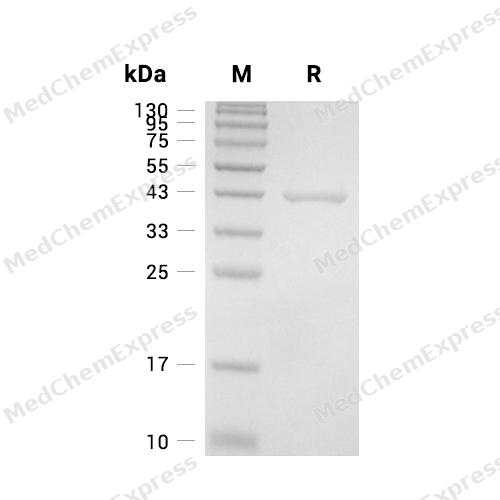
Purity - SDS-PAGE
-
Bioactivity - ELISA
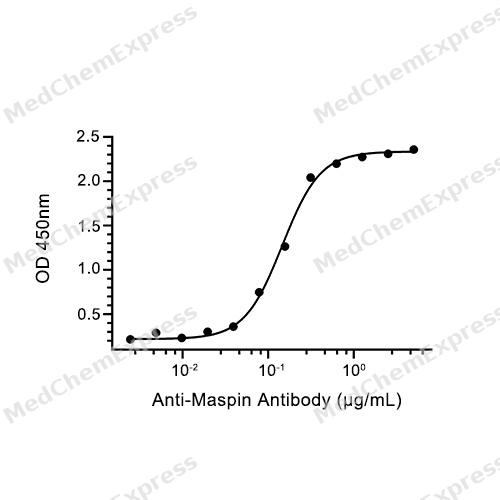
Bioactivity - ELISA


Technical Parameters
-
Species Human
-
Source E. coli
-
Tag C-6*His
-
Accession
P36952-1 (M1-P375)
-
Gene ID5268
-
Molecular Construction
-
N-term
-
Serpin B5 (M1-P375)
Accession # P36952-1 -
6*His
-
C-term
-
-
Protein Length
Full Length of Isoform-1
-
Synonyms
SERPINB5; Serpin Peptidase Inhibitor, Clade B (Ovalbumin), Member 5; Prev. PI5; Peptidase Inhibitor 5; Maspin; Serpin B5; Serine (Or Cysteine) Proteinase Inhibitor, Clade B (Ovalbumin), Member 5; PI-5; Serpin Family B Member 5; Protease Inhibitor 5 (Maspi
-
AA Sequence
MDALQLANSAFAVDLFKQLCEKEPLGNVLFSPICLSTSLSLAQVGAKGDTANEIGQVLHFENVKDVPFGFQTVTSDVNKLSSFYSLKLIKRLYVDKSLNLSTEFISSTKRPYAKELETVDFKDKLEETKGQINNSIKDLTDGHFENILADNSVNDQTKILVVNAAYFVGKWMKKFSESETKECPFRVNKTDTKPVQMMNMEATFCMGNIDSINCKIIELPFQNKHLSMFILLPKDVEDESTGLEKIEKQLNSESLSQWTNPSTMANAKVKLSIPKFKVEKMIDPKACLENLGLKHIFSEDTSDFSGMSETKGVALSNVIHKVCLEITEDGGDSIEVPGARILQHKDELNADHPFIYIIRHNKTRNIIFFGKFCSP
-
Molecular Weight
Approximately 43 kDa, based on SDS-PAGE under reducing conditions.
-
Purity
≥ 95%, as determined by reducing SDS-PAGE.


Product Properties
Lyophilized powder
Lyophilized from a 0.22 μm filtered solution of PBS, pH 7.4 or PBS, pH 7.4, 8% trehalose.
<1 EU/mL, determined by LAL method.
It is not recommended to reconstitute to a concentration less than 100 μg/mL in ddH2O. For long term storage it is recommended to add a carrier protein (0.1% BSA, 5% HSA, 10% FBS or 5% Trehalose).
Stored at -20°C for 2 years from date of receipt. After reconstitution, it is stable at 4°C for 1 week or -20°C for longer (with carrier protein). It is recommended to freeze aliquots at -20°C or -80°C for extended storage.
Room temperature in continental US; may vary elsewhere.


Documentation
-
Data Sheet (238 KB)
-
SDS (252 KB)
- English - EN (252 KB)
- Français - FR (252 KB)
- Deutsch - DE (252 KB)
- Norwegian - NO (252 KB)
- Español - ES (252 KB)
- Swedish - SV (252 KB)
- Italian - IT (252 KB)
- Korean - KR (252 KB)
- Portuguese - PT (252 KB)
-
Handling Instructions (2659 KB)

Calculators
Concentration (start) × Volume (start) = Concentration (final) × Volume (final)


 Powered by Bioz

