



TAFA5/FAM19A5 Protein, Mouse (His)

Based on 1 Customer Validation
As a chemokine-like molecule, TAFA5/FAM19A5 protein activates GPCRs such as S1PR2 and FPR2 to regulate cell proliferation and migration. It induces macrophage chemotactic migration through MAPK3/ERK1 and AKT1 pathways and inhibits TNFSF11/RANKL-induced osteoclast formation. TAFA5/FAM19A5 Protein, Mouse (His) is the recombinant mouse-derived TAFA5/FAM19A5 protein, expressed by E. coli , with N-His labeled tag.
- Species: Mouse
- Source: E. coli
-
Storage:Stored at -80°C for 1 year from date of receipt. It is stable at -20°C for 3 months after opening. It is recommended to freeze aliquots at -80°C for extended storage. Avoid repeated freeze-thaw cycles.


To place orders, for customer services and technical support, please contact: MedChemExpress USA
Tel: 609-228-6898 E-mail: [email protected] [email protected]


-
 Biological Activity
-
Technical Parameters
-
Product Properties
- Documentation
- Help & FAQs




Biological Activity
Description
As a chemokine-like molecule, TAFA5/FAM19A5 protein activates GPCRs such as S1PR2 and FPR2 to regulate cell proliferation and migration. It induces macrophage chemotactic migration through MAPK3/ERK1 and AKT1 pathways and inhibits TNFSF11/RANKL-induced osteoclast formation. TAFA5/FAM19A5 Protein, Mouse (His) is the recombinant mouse-derived TAFA5/FAM19A5 protein, expressed by E. coli , with N-His labeled tag.
Background
TAFA5/FAM19A5, functioning as a chemokine-like protein, orchestrates cell proliferation and migration by activating G protein-coupled receptors (GPCRs), notably S1PR2 and FPR2. It stimulates the chemotactic migration of macrophages through the MAPK3/ERK1 and AKT1 pathway while concurrently inhibiting TNFSF11/RANKL-induced osteoclast formation by impeding the up-regulation of osteoclast fusogenic and differentiation genes, a process mediated by the GPCR FPR2. Acting as an adipokine, TAFA5/FAM19A5 negatively regulates vascular smooth muscle cell (VSMC) proliferation and migration in response to platelet-derived growth factor stimulation via GPCR S1PR2 and G protein GNA12/GNA13-transmitted RHOA signaling. This multifaceted role extends to inhibiting injury-induced cell proliferation and neointima formation in the femoral arteries, underscoring its regulatory impact on diverse cellular processes.
MCE Validation Data
-
Purity - SDS-PAGE
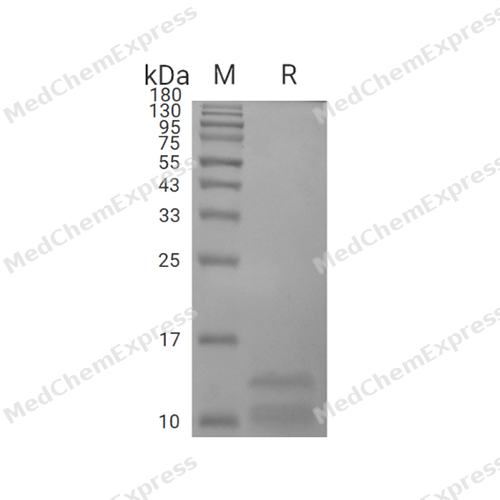
Purity - SDS-PAGE


Technical Parameters
-
Species Mouse
-
Source E. coli
-
Tag N-8*His
-
Accession
Q91WE9-1 (T44-S132)
-
Gene ID/
-
Molecular Construction
-
N-term
-
8*His
-
TAFA5 (T44-S132)
Accession # Q91WE9-1 -
C-term
-
-
Protein Length
Full Length of Isoform-1
-
Synonyms
PRO34524; UNQ5208; FAM19A5; TAFA5; Chemokine-like protein TAFA-5
-
AA Sequence
TCEIVTLDRDSSQPRRTIARQTARCACRKGQIAGTTRARPACVDARIIKTKQWCDMLPCLEGEGCDLLINRSGWTCTQPGGRIKTTTVS
-
Predicted Molecular Mass
10.9 kDa
-
Molecular Weight
Approximately 13-14 kDa, based on SDS-PAGE under reducing conditions.
-
Purity
≥ 95%, as determined by Bis-Tris PAGE.


Product Properties
Solution
Supplied as a 0.22 μm filtered solution of 20 mM Tris, 300 mM NaCl, 10% Glycerol, pH 7.4.
Note: For SPR assay, please replace the buffer. Primary amine components (e.g., Tris, imidazole) can affect protein-coupled chips.
<1 EU/μg, determined by LAL method.
Stored at -80°C for 1 year from date of receipt. It is stable at -20°C for 3 months after opening. It is recommended to freeze aliquots at -80°C for extended storage. Avoid repeated freeze-thaw cycles.
Shipping with dry ice.


Documentation
-
Data Sheet (235 KB)
-
SDS (251 KB)
- English - EN (251 KB)
- Français - FR (251 KB)
- Deutsch - DE (251 KB)
- Norwegian - NO (251 KB)
- Español - ES (251 KB)
- Swedish - SV (251 KB)
- Italian - IT (251 KB)
- Korean - KR (251 KB)
- Portuguese - PT (251 KB)
-
Handling Instructions (2659 KB)

Calculators
Concentration (start) × Volume (start) = Concentration (final) × Volume (final)


 Powered by Bioz

