



TGF beta 1/TGFB1 LAP Protein, Human (HEK293)
Based on 1 publication(s) in Google Scholar
TGF beta 1/TGFB1 is a polypeptide member of the transforming growth factor beta superfamily of cytokines. TGF beta 1 is a secreted protein that performs many cellular functions, including the control of cell growth, cell proliferation, cell differentiation, apoptosis, and can regulate the expression and activation of other growth factors, including interferon gamma and tumor necrosis factor alpha. TGF beta 1/TGFB1 LAP Protein, Human (HEK293) is the recombinant human-derived TGF beta 1/TGFB1 LAP protein, expressed by HEK293 , with tag free. and C33S mutation.
- Species: Human
- Source: HEK293
-
Storage:Stored at -20°C for 2 years from date of receipt. After reconstitution, it is stable at 4°C for 1 week or -20°C for longer (with carrier protein). It is recommended to freeze aliquots at -20°C or -80°C for extended storage.


To place orders, for customer services and technical support, please contact: MedChemExpress USA
Tel: 609-228-6898 E-mail: [email protected] [email protected]


-
 Biological Activity
-
Technical Parameters
-
Product Properties
- Documentation
- Help & FAQs


-
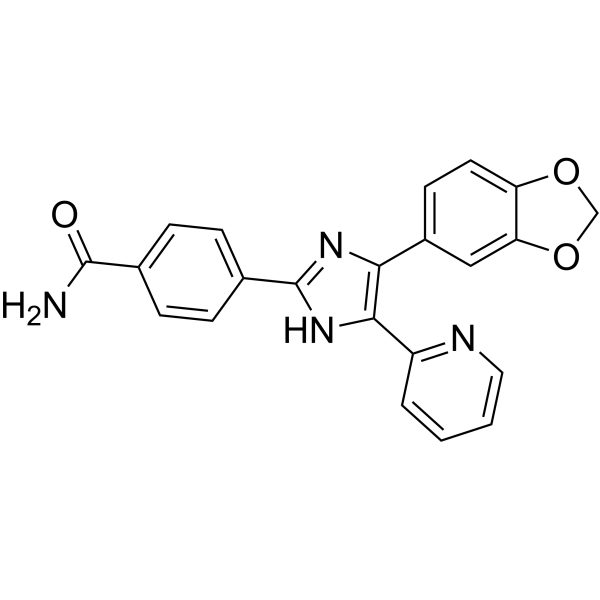
HY-10431
SB-431542TGF-β Receptor Kinase Inhibitor -
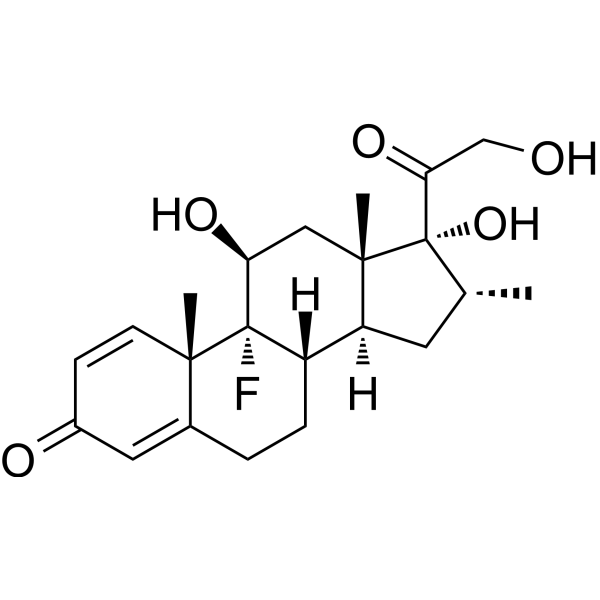
HY-14648
DexamethasoneGR Agonist -

HY-P7109
EGF Protein, Human -
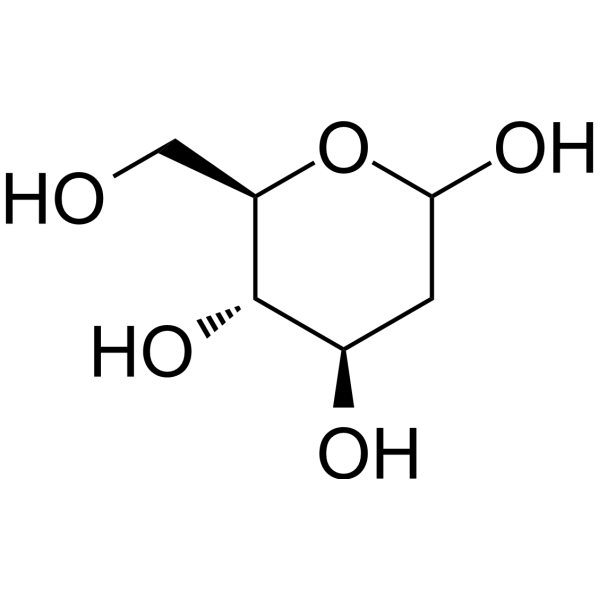
HY-13966
2-Deoxy-D-glucoseGlycolysis Inhibitor -
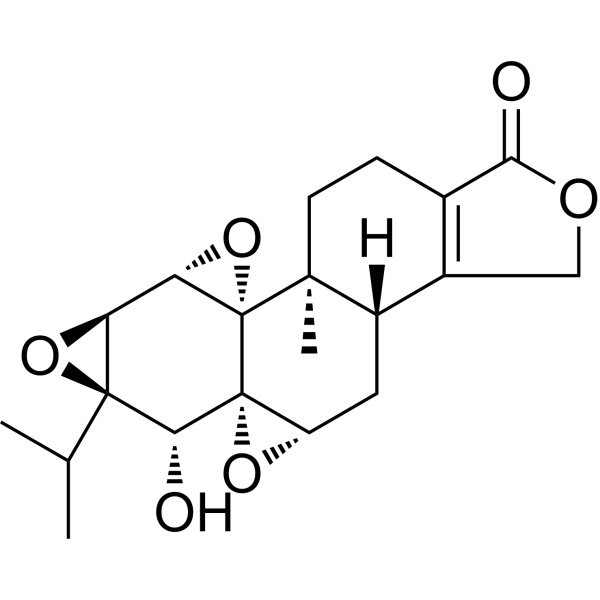
HY-32735
TriptolideImmunosuppressive Agent -
HY-P7073
IL-1 beta Protein, Mouse -
HY-N0830
Palmitic acidEndogenous Metabolite -
HY-P73193
IL-23 Protein, Human (HEK293, His) -
HY-P70445
IL-4 Protein, Human -
HY-P7058
TNF-alpha/TNFSF2 Protein, Human -
HY-P70543
TGF beta 1/TGFB1 Protein, Human (HEK293) -
HY-P7182
GDNF Protein, Human


Biological Activity
Description
TGF beta 1/TGFB1 is a polypeptide member of the transforming growth factor beta superfamily of cytokines. TGF beta 1 is a secreted protein that performs many cellular functions, including the control of cell growth, cell proliferation, cell differentiation, apoptosis, and can regulate the expression and activation of other growth factors, including interferon gamma and tumor necrosis factor alpha. TGF beta 1/TGFB1 LAP Protein, Human (HEK293) is the recombinant human-derived TGF beta 1/TGFB1 LAP protein, expressed by HEK293 , with tag free. and C33S mutation.
Background
Transforming growth factor (TGF) beta 1 is a polypeptide member of the transforming growth factor beta superfamily of cytokines. TGF beta 1 is a secreted protein that performs many cellular functions, including the control of cell growth, cell proliferation, cell differentiation, apoptosis, and can regulate the expression and activation of other growth factors, including interferon gamma and tumor necrosis factor alpha. In humans, TGF-β1 is encoded by the TGFB1 gene. TGF beta 1 activates CREB3L1 by regulating intramembranous proteolysis, stimulating sustained collagen production. TGF beta 1 mediates SMAD2/3 activation by inducing SMAD2/3 phosphorylation and subsequent translocation to the nucleus and regulates dental papilla cells by promoting IPO7-mediated translocation of phosphorylated SMAD2 to the nucleus and subsequent transcription of target genes. TGF beta 1 induces epithelial-to-mesenchymal transition (EMT) and cell migration in various cell types.TGF beta 1 plays an important role in controlling the immune system, and shows different activities on different types of cell, or cells at different developmental stages[1][2][3][4][5][6].
Verified Bioactivity
1.Measured by its ability to inhibit TGF-β1 activity on HT-2 mouse T cells. The ED50 this effect is 20-150 ng/mL in the presence of 1 ng/mL TGF-β1.
2.Measured by its ability to inhibit the IL-4-dependent proliferation of HT-2 mouse T cells.The ED50 for this effect is 0.01185 ng/ml, corresponding to a specific activity is 8.43×10⁴ units/mg.
MCE Validation Data
-
Purity - SDS-PAGE
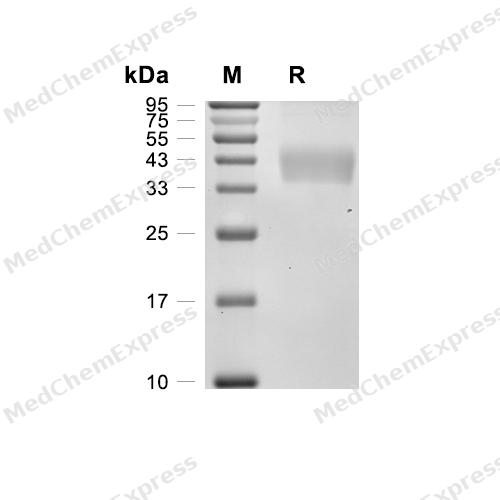
Purity - SDS-PAGE
-
Bioactivity - Cell-Based Assay
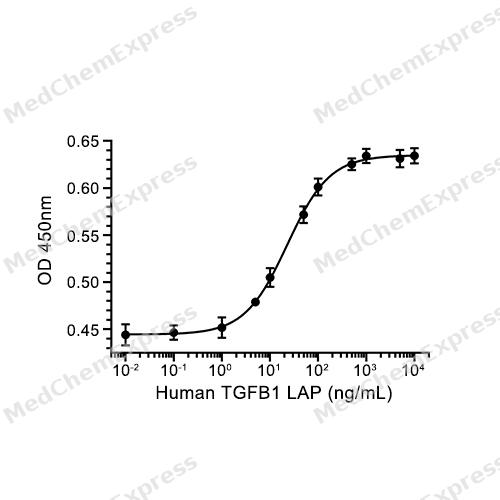
Bioactivity - Cell-Based Assay


Publications (1)
-
Journal Impact Factor
-
Most Recent


Technical Parameters
-
Species Human
-
Source HEK293
-
Tag Tag Free
-
Accession
P01137 (L30-R278, C33S)
-
Molecular Construction
-
N-term
-
TGFB1 (L30-R278, C33S)
Accession # P01137 -
C-term
-
-
Protein Length
Full Length of Latency-associated Peptide
-
Synonyms
TGFB1; Transforming Growth Factor Beta1; Prev. TGFB; Camurati-Engelmann Disease; Prev. DPD1; Latency-Associated Peptide; TGFbeta; TGF-Beta-1; CED; TGF-Beta1; Transforming Growth Factor Beta-1 Proprotein; IBDIMDE; Prepro-Transforming Growth Factor Beta-1;
-
AA Sequence
LSTSKTIDMELVKRKRIEAIRGQILSKLRLASPPSQGEVPPGPLPEAVLALYNSTRDRVAGESAEPEPEPEADYYAKEVTRVLMVETHNEIYDKFKQSTHSIYMFFNTSELREAVPEPVLLSRAELRLLRLKLKVEQHVELYQKYSNNSWRYLSNRLLAPSDSPEWLSFDVTGVVRQWLSRGGEIEGFRLSAHCSCDSRDNTLQVDINGFTTGRRGDLATIHGMNRPFLLLMATPLERAQHLQSSRHRR
-
Predicted Molecular Mass
28.5 kDa
-
Molecular Weight
Approximately 20-30 kDa, based on SDS-PAGE under reducing conditions.
-
Glycosylation
Yes
-
Purity
≥ 95%, as determined by reducing SDS-PAGE.


Product Properties
Lyophilized powder
1.Lyophilized from a 0.22 μm filtered solution of PBS, pH 7.4.
2.Lyophilized from a 0.22 μm filtered solution of PBS, pH 7.4, 8% trehalose.
Please refer to the lot-specific COA for specific buffer information.
<1 EU/μg, determined by LAL method.
It is not recommended to reconstitute to a concentration less than 100 μg/mL in PBS. For long term storage it is recommended to add a carrier protein (0.1% BSA, 5% HSA, 10% FBS or 5% Trehalose).
Stored at -20°C for 2 years from date of receipt. After reconstitution, it is stable at 4°C for 1 week or -20°C for longer (with carrier protein). It is recommended to freeze aliquots at -20°C or -80°C for extended storage.
Room temperature in continental US; may vary elsewhere.


Documentation
-
Data Sheet (262 KB)
-
SDS (252 KB)
- English - EN (252 KB)
- Français - FR (252 KB)
- Deutsch - DE (252 KB)
- Norwegian - NO (252 KB)
- Español - ES (252 KB)
- Swedish - SV (252 KB)
- Italian - IT (252 KB)
- Korean - KR (252 KB)
- Portuguese - PT (252 KB)
-
Handling Instructions (2659 KB)

Calculators
Concentration (start) × Volume (start) = Concentration (final) × Volume (final)


 Powered by Bioz

