



TINAGL1 Protein, Human (HEK293, His)

Based on 1 Customer Validation
TINAGL1 Protein, implicated in adrenocortical zonation, may regulate distinct adrenal cortex zones and repress CYP11B1 gene expression in adrenocortical cells. As a member of the non-catalytic peptidase C1 family, its distinctive function does not involve enzymatic activity. Unraveling TINAGL1's molecular pathways could offer insights into its role in adrenal physiology, shedding light on its potential to manipulate adrenal function. TINAGL1 Protein, Human (HEK293, His) is the recombinant human-derived TINAGL1 protein, expressed by HEK293 , with C-6*His labeled tag.
- Species: Human
- Source: HEK293
-
Storage:Stored at -80°C for 1 year from date of receipt. It is stable at -20°C for 3 months after opening. It is recommended to freeze aliquots at -80°C for extended storage. Avoid repeated freeze-thaw cycles.


To place orders, for customer services and technical support, please contact: MedChemExpress USA
Tel: 609-228-6898 E-mail: [email protected] [email protected]


-
 Biological Activity
-
Technical Parameters
-
Product Properties
- Documentation
- Help & FAQs




Biological Activity
Description
TINAGL1 Protein, implicated in adrenocortical zonation, may regulate distinct adrenal cortex zones and repress CYP11B1 gene expression in adrenocortical cells. As a member of the non-catalytic peptidase C1 family, its distinctive function does not involve enzymatic activity. Unraveling TINAGL1's molecular pathways could offer insights into its role in adrenal physiology, shedding light on its potential to manipulate adrenal function. TINAGL1 Protein, Human (HEK293, His) is the recombinant human-derived TINAGL1 protein, expressed by HEK293 , with C-6*His labeled tag.
Background
TINAGL1 Protein emerges as a potential player in adrenocortical zonation, suggesting its involvement in the intricate regulation of distinct zones within the adrenal cortex. Additionally, it may participate in mechanisms that repress the expression of the CYP11B1 gene in adrenocortical cells, indicating a role in modulating key genes associated with adrenal function. Notably, TINAGL1 belongs to the non-catalytic peptidase C1 family, indicating a distinctive function that does not involve enzymatic activity. Unraveling the specific molecular pathways through which TINAGL1 influences adrenocortical zonation and gene expression could provide valuable insights into its role in adrenal physiology and potentially open avenues for understanding and manipulating adrenal function.
MCE Validation Data
-
Purity - SDS-PAGE
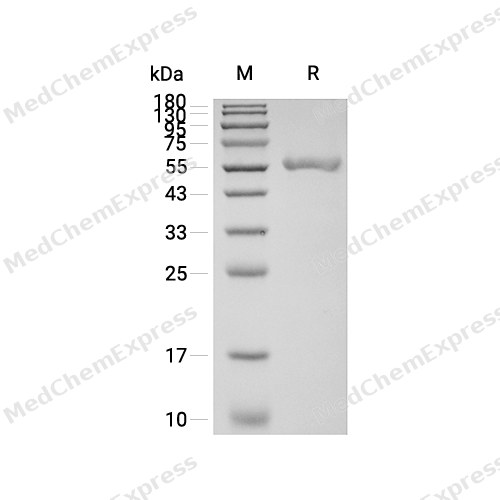
Purity - SDS-PAGE


Technical Parameters
-
Species Human
-
Source HEK293
-
Tag C-6*His
-
Accession
Q9GZM7-1 (A22-H467)
-
Molecular Construction
-
N-term
-
TINAGL1 (A22-H467)
Accession # Q9GZM7-1 -
6*His
-
C-term
-
-
Protein Length
Full Length of Isoform-1
-
Synonyms
TINAGL1; Lipocalin 7; Prev. LCN7; OLRG-2; TINAGRP; Tubulointerstitial Nephritis Antigen-Like 1, Isoform CRA_a; P3ECSL; Oxidized LDL-Responsive Gene 2 Protein; LIECG3; Oxidized-LDL Responsive Gene 2; ARG1; Androgen Regulated Gene 1; Tubulointerstitial Neph
-
AA Sequence
AQQGRGRRELAPGLHLRGIRDAGGRYCQEQDLCCRGRADDCALPYLGAICYCDLFCNRTVSDCCPDFWDFCLGVPPPFPPIQGCMHGGRIYPVLGTYWDNCNRCTCQENRQWQCDQEPCLVDPDMIKAINQGNYGWQAGNHSAFWGMTLDEGIRYRLGTIRPSSSVMNMHEIYTVLNPGEVLPTAFEASEKWPNLIHEPLDQGNCAGSWAFSTAAVASDRVSIHSLGHMTPVLSPQNLLSCDTHQQQGCRGGRLDGAWWFLRRRGVVSDHCYPFSGRERDEAGPAPPCMMHSRAMGRGKRQATAHCPNSYVNNNDIYQVTPVYRLGSNDKEIMKELMENGPVQALMEVHEDFFLYKGGIYSHTPVSLGRPERYRRHGTHSVKITGWGEETLPDGRTLKYWTAANSWGPAWGERGHFRIVRGVNECDIESFVLGVWGRVGMEDMGHH
-
Predicted Molecular Mass
51.1 kDa
-
Molecular Weight
Approximately 55-60 kDa, based on SDS-PAGE under reducing conditions.
-
Glycosylation
Yes
-
Purity
≥ 95%, as determined by reducing SDS-PAGE.


Product Properties
Solution
Supplied as a 0.22 μm filtered solution of 20 mM Tris-HCl, 150 mM NaCl, 10% Glycerol, 0.05% Brij35, pH 7.5.
Note: For SPR assay, please replace the buffer. Primary amine components (e.g., Tris, imidazole) can affect protein-coupled chips.
<1 EU/μg, determined by LAL method.
Stored at -80°C for 1 year from date of receipt. It is stable at -20°C for 3 months after opening. It is recommended to freeze aliquots at -80°C for extended storage. Avoid repeated freeze-thaw cycles.
Shipping with dry ice.


Documentation
-
Data Sheet (238 KB)
-
SDS (252 KB)
- English - EN (252 KB)
- Français - FR (252 KB)
- Deutsch - DE (252 KB)
- Norwegian - NO (252 KB)
- Español - ES (252 KB)
- Swedish - SV (252 KB)
- Italian - IT (252 KB)
- Korean - KR (252 KB)
- Portuguese - PT (252 KB)
-
Handling Instructions (2659 KB)

Calculators
Concentration (start) × Volume (start) = Concentration (final) × Volume (final)


 Powered by Bioz

