



TNF-alpha/TNFSF2 Protein, Mouse (His)
Based on 4 publication(s) in Google Scholar
TNF-alpha/TNFSF2 Protein, Mouse (His) is recombinant mouse tumor necrosis factor alpha (TNF-α) with his tag.TNF-alpha/TNFSF2 Protein, a major mediator of inflammation, is involved in a number of infectious and parasitic diseases.
- Species: Mouse
- Source: E. coli
-
Storage:Stored at -20°C for 2 years from date of receipt. After reconstitution, it is stable at 4°C for 1 week or -20°C for longer (with carrier protein). It is recommended to freeze aliquots at -20°C or -80°C for extended storage.


To place orders, for customer services and technical support, please contact: MedChemExpress USA
Tel: 609-228-6898 E-mail: [email protected] [email protected]


-
 Biological Activity
-
Technical Parameters
-
Product Properties
- Documentation
- References
- Help & FAQs




Biological Activity
Description
TNF-alpha/TNFSF2 Protein, Mouse (His) is recombinant mouse tumor necrosis factor alpha (TNF-α) with his tag.TNF-alpha/TNFSF2 Protein, a major mediator of inflammation, is involved in a number of infectious and parasitic diseases.
Background
Tumor necrosis factor-α (TNF-α) is a pleiotropic cytokine produced by a wide variety of cell types of mostly hematopoietic, but also of nonhematopoietic, origin. TNFα is instrumental in the immune elimination of various infectious agents such as Candida albicans, Listeria monocytogenes, or mycobacteria and exerts potent proinflammatory effects, e.g. by inducing the expression of adhesion molecules such as VCAM-1, intercellular adhesion molecule 1 (ICAM-1), or E-selectin on endothelial cells and other cell types[1][2].
Verified Bioactivity
The ED50 is ≤0.06 ng/mL as measured by L-929 mouse fibrosarcoma cells, corresponding to a specific activity of ≥1.7 × 10⁷ units/mg.
MCE Validation Data
-
Purity - SDS-PAGE
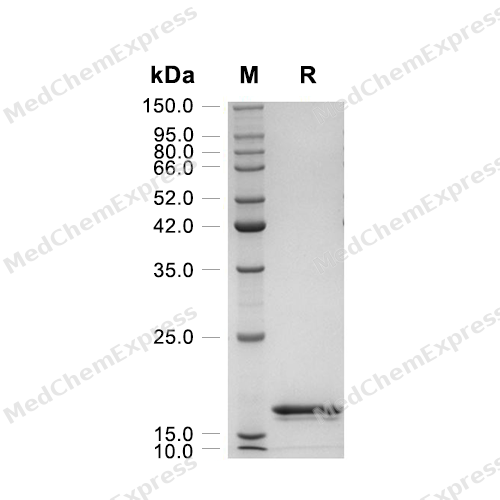
Purity - SDS-PAGE
-
Bioactivity - Cell-Based Assay
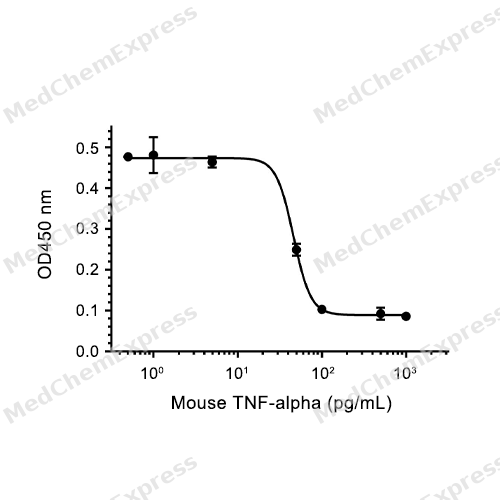
Bioactivity - Cell-Based Assay


Publications (4)
-
Journal Impact Factor
-
Most Recent
-
ACS Appl Mater Interfaces
Multifunctional Inorganic-Nanosheets-Based Nanohydrogel for Periodontal Bone Regeneration via Antibacterial and Anti-Ferroptotic Immunomodulation. [Abstract]2025 Nov 26;17(47):64149-64167. PMID: 41250788 -
Cancer Cell Int
Tetrahydropalmatine has analgesic role in mouse model of bone cancer pain by inactivating the TNF-α/uPA/PAR2/TRPV1 pathway in dorsal root ganglia. [Abstract]2025 Oct 3;25(1):328. PMID: 41044542 -
-
Foods
Anti-Inflammatory, Anti-Obesity, and Insulin-Sensitizing Effects of Chamaecrista nomame (Siebold) H. Ohashi Extract in Cellular Models, Including TNF-α-Induced Adipocyte Dysfunction. [Abstract]2026 May 24;15(11):1858. PMID: 42279645


Technical Parameters
-
Species Mouse
-
Source E. coli
-
Tag N-6*His
-
Accession
P06804 (L80-L235)
-
Molecular Construction
-
N-term
-
6*His
-
TGF-α (L80-L235)
Accession # P06804 -
C-term
-
-
Protein Length
Full Length of TNF, soluble form
-
Synonyms
TNF; Tumor Necrosis Factor (TNF Superfamily, Member 2); Prev. TNFA; Tumor Necrosis Factor-Alpha; TNF-Alpha; Tumor Necrotic Factor Alpha; TNFSF2; TNF Superfamily, Member 2; Tumor Necrosis Factor Ligand Superfamily Member 2; TNF, Macrophage-Derived; TNF-A;
-
AA Sequence
LRSSSQNSSDKPVAHVVANHQVEEQLEWLSQRANALLANGMDLKDNQLVVPADGLYLVYSQVLFKGQGCPDYVLLTHTVSRFAISYQEKVNLLSAVKSPCPKDTPEGAELKPWYEPIYLGGVFQLEKGDQLSAEVNLPKYLDFAESGQVYFGVIAL
-
Predicted Molecular Mass
18.1 kDa
-
Molecular Weight
Approximately 18 kDa, based on SDS-PAGE under reducing conditions.
-
Purity
≥ 95%, as determined by reducing SDS-PAGE.


Product Properties
Lyophilized powder.
1.Lyophilized from a 0.22 μm filtered solution of 20 mM PB, 150 mM NaCl, pH 7.4.
2.Lyophilized from a 0.22 μm filtered solution of 50 mM Tris-HCl, 300 mM NaCl, pH 7.4, 5% trehalose, 5% mannitol and 0.01% Tween 80.
Please refer to the lot-specific COA for specific buffer information.
Note: For SPR assay, please replace the buffer. Primary amine components (e.g., Tris, imidazole) can affect protein-coupled chips.
<1.0 EU/μg, determined by LAL method.
It is not recommended to reconstitute to a concentration less than 100 μg/mL in ddH2O. For long term storage it is recommended to add a carrier protein (0.1% BSA, 5% HSA, 10% FBS or 5% Trehalose).
Stored at -20°C for 2 years from date of receipt. After reconstitution, it is stable at 4°C for 1 week or -20°C for longer (with carrier protein). It is recommended to freeze aliquots at -20°C or -80°C for extended storage.
Room temperature in continental US; may vary elsewhere.


Documentation
-
Data Sheet (262 KB)
-
SDS (251 KB)
- English - EN (251 KB)
- Français - FR (251 KB)
- Deutsch - DE (251 KB)
- Norwegian - NO (251 KB)
- Español - ES (251 KB)
- Swedish - SV (251 KB)
- Italian - IT (251 KB)
- Korean - KR (251 KB)
- Portuguese - PT (251 KB)
-
Handling Instructions (2659 KB)


References
[1]. de Kossodo S, et al. Tumor necrosis factor alpha is involved in mouse growth and lymphoid tissue development. J Exp Med. 1992 Nov 1;176(5):1259-64. [Content Brief]
[2]. Mueller C, et al. Noncleavable transmembrane mouse tumor necrosis factor-alpha (TNFalpha) mediates effectsdistinct from those of wild-type TNFalpha in vitro and in vivo. J Biol Chem. 1999 Dec 31;274(53):38112-8. [Content Brief]

Calculators
Concentration (start) × Volume (start) = Concentration (final) × Volume (final)


 Powered by Bioz

