



TNFRSF11B/OPG Protein, Rhesus Macaque (HEK293, hFc)

Based on 1 Customer Validation
Osteoprotegerin (OPG), a TNF receptor superfamily, is expressed in many tissues including heart, kidney, liver, spleen, and bone marrow. Osteoprotegerin has osteoprotective effect and is critical in bone remodeling. Osteoprotegerin can bind to RANKL and inhibit the binding between TNFSF11 and RANKL, thereby neutralizing the RANKL function in osteoclastogenesis. OPG is also involved in multiple biological processes of cancers. TNFRSF11B/OPG Protein, Rhesus Macaque (HEK293, hFc) is a recombinant Rhesus Macaque TNFRSF11B/OPG (M28-L428) with C-terminal hFc tag, which is produced in HEK293 cell.
- Species: Rhesus Macaque
- Source: HEK293
-
Storage:Stored at -20°C for 2 years from date of receipt. After reconstitution, it is stable at 4°C for 1 week or -20°C for longer (with carrier protein). It is recommended to freeze aliquots at -20°C or -80°C for extended storage.


To place orders, for customer services and technical support, please contact: MedChemExpress USA
Tel: 609-228-6898 E-mail: [email protected] [email protected]


-
 Biological Activity
-
Technical Parameters
-
Product Properties
- Documentation
- References
- Help & FAQs




Biological Activity
Description
Osteoprotegerin (OPG), a TNF receptor superfamily, is expressed in many tissues including heart, kidney, liver, spleen, and bone marrow. Osteoprotegerin has osteoprotective effect and is critical in bone remodeling. Osteoprotegerin can bind to RANKL and inhibit the binding between TNFSF11 and RANKL, thereby neutralizing the RANKL function in osteoclastogenesis[1]. OPG is also involved in multiple biological processes of cancers. TNFRSF11B/OPG Protein, Rhesus Macaque (HEK293, hFc) is a recombinant Rhesus Macaque TNFRSF11B/OPG (M28-L428) with C-terminal hFc tag, which is produced in HEK293 cell[1][2].
Background
Osteoprotegerin (OPG), a glycoprotein, belongs to TNF receptor superfamily. OPG is expressed in many tissues besides osteoblasts, including heart, kidney, liver, spleen, and bone marrow. Human osteoprotegerin shares <85% aa sequence identity with mouse and rat. Mouse OX40 shares 94.5% aa sequence identity with rat[1].
Osteoprotegerin can bind to RANKL and inhibit the binding between TNFSF11 and RANKL, thereby neutralizing the RANKL function in osteoclastogenesis. Osteoprotegerin also protects large blood vessels from medial calcification. Increased osteoprotegerin levels have been consistently associated with the incidence and prevalence of coronary artery disease[1][3]. Osteoprotegerin is also involved in multiple processes of cancers, such as tumor survival, epithelial to mesenchymal transition (EMT), neo-angiogenesis, invasion, and metastasis[2].
Osteoprotegerin plays a critical role in bone remodeling, and has osteoprotective effect[1].
In Vitro
RANKL (human, -1 pg/mL, 36 h) promotes the proliferation of VSMC[5].
In Vivo
Osteoprotegerin (human, 5 mg/kg, i.v.) shows antiresorptive effects in rats[4].
Verified Bioactivity
Measured by its ability to inhibit TRAIL-mediated cytotoxicity using L 929 mouse fibroblast cells treated with TRAIL. The ED50 for this effect is 6.472 ng/mL in the presence of 20 ng/mL of recombinant human TRAIL, corresponding to a specific activity is 1.545×10[5] units/mg.
MCE Validation Data
-
Purity - SDS-PAGE
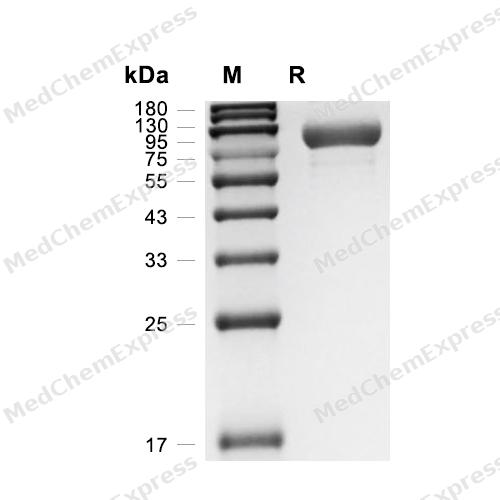
Purity - SDS-PAGE
-
Bioactivity - Cell-Based Assay
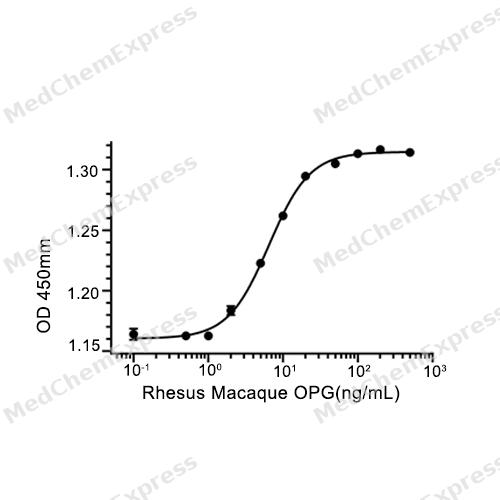
Bioactivity - Cell-Based Assay


Technical Parameters
-
Species Rhesus Macaque
-
Source HEK293
-
Tag C-hFc
-
Accession
XP_001096915 (M28-L428)
-
Molecular Construction
-
N-term
-
TNFRSF11B (M28-L428)
Accession # XP_001096915 -
hFc
-
C-term
-
-
Protein Length
Partial
-
Synonyms
TNFRSF11B; Osteoprotegerin; Prev. OPG; Tumor Necrosis Factor Receptor Superfamily, Member 11b; OCIF; Tumor Necrosis Factor Receptor Superfamily Member 11B; Osteoclastogenesis Inhibitory Factor; PDB5; TNF Receptor Superfamily Member 11b; TR1
-
AA Sequence
MNKLLCCALVFLDISIKWTTQETFPPKYLHYDQETSHQLLCDKCPPGTYLKQHCTAKWKTVCAPCPDHYYTDSWHTSDECLYCSPVCKELQYVKQECNRTHNRVCECKEGRYLEIEFCLKHRSCPPGFGVVQAGTPERNTVCKRCPDGFFSNETSSKAPCRKHTNCSVFGLLLTQKGNATHDNICSGNSESTQKCGIDVTLCEEAFFRFAVPTKFTPNWLSVLVDNLPGTKVNAESVERIKRRHSSQEQTFQLLKLWKHQNKDQDIVKKIIQDIDLCENSVQRHIGHANLTFEQLRSLMESLPGKKVGAEDIEKTTKACKPSDQILKLLSLWRIKNGDQDTLKGLMHALKHSKTYHFPKTVTQSLKKTIRFLHSFTMYKLYQKLFLEMIGNQVQSVKISCL
-
Predicted Molecular Mass
72.1 kDa
-
Molecular Weight
Approximately 80-95 kDa, based on SDS-PAGE under reducing conditions, due to the glycosylation.
-
Glycosylation
Yes
-
Purity
≥ 90%, as determined by reducing SDS-PAGE.


Product Properties
Lyophilized powder.
Lyophilized from a 0.2 μm filtered solution of PBS, pH 7.4. Normally 5 % - 8 % trehalose, mannitol and 0.01% Tween 80 are added as protectants before lyophilization.
<1 EU/μg, determined by LAL method.
It is not recommended to reconstitute to a concentration less than 100 μg/mL in ddH2O.
Stored at -20°C for 2 years from date of receipt. After reconstitution, it is stable at 4°C for 1 week or -20°C for longer (with carrier protein). It is recommended to freeze aliquots at -20°C or -80°C for extended storage.
Room temperature in continental US; may vary elsewhere.


Documentation
-
Data Sheet (266 KB)
-
SDS (251 KB)
- English - EN (251 KB)
- Français - FR (251 KB)
- Deutsch - DE (251 KB)
- Norwegian - NO (251 KB)
- Español - ES (251 KB)
- Swedish - SV (251 KB)
- Italian - IT (251 KB)
- Korean - KR (251 KB)
- Portuguese - PT (251 KB)
-
Handling Instructions (2659 KB)


References
[1]. Boyce BF, et al. Biology of RANK, RANKL, and osteoprotegerin. Arthritis Res Ther. 2007;9 Suppl 1(Suppl 1):S1. [Content Brief]
[2]. Wang Y, et al. The roles of osteoprotegerin in cancer, far beyond a bone player. Cell Death Discov. 2022 May 6;8(1):252. [Content Brief]
[3]. Venuraju SM, et al. Osteoprotegerin as a predictor of coronary artery disease and cardiovascular mortality and morbidity. J Am Coll Cardiol. 2010 May 11;55(19):2049-61. [Content Brief]
[4]. Capparelli C, et al. Sustained antiresorptive effects after a single treatment with human recombinant osteoprotegerin (OPG): a pharmacodynamic and pharmacokinetic analysis in rats. J Bone Miner Res. 2003 May;18(5):852-8. [Content Brief]
[5]. Candido R, et al. Human full-length osteoprotegerin induces the proliferation of rodent vascular smooth muscle cells both in vitro and in vivo. J Vasc Res. 2010;47(3):252-61. [Content Brief]

Calculators
Concentration (start) × Volume (start) = Concentration (final) × Volume (final)


 Powered by Bioz

