



Transglutaminase 3/TGM3 Protein, Human (sf9, His)

Based on 1 Customer Validation
Transglutaminase 3 (TGM3) acts as a catalyst in the formation of calcium-dependent isopeptide cross-links between glutamine and lysine residues in a variety of proteins, while mediating the conjugation of polyamines to proteins. Transglutaminase 3/TGM3 Protein, Human (sf9, His) is the recombinant human-derived Transglutaminase 3/TGM3 protein, expressed by Sf9 insect cells , with N-His labeled tag.
- Species: Human
- Source: Sf9 insect cells
-
Storage:Stored at -80°C for 1 year from date of receipt. It is stable at -20°C for 3 months after opening. It is recommended to freeze aliquots at -80°C for extended storage. Avoid repeated freeze-thaw cycles.


To place orders, for customer services and technical support, please contact: MedChemExpress USA
Tel: 609-228-6898 E-mail: [email protected] [email protected]


-
 Biological Activity
-
Technical Parameters
-
Product Properties
- Documentation
- Help & FAQs




Biological Activity
Description
Transglutaminase 3 (TGM3) acts as a catalyst in the formation of calcium-dependent isopeptide cross-links between glutamine and lysine residues in a variety of proteins, while mediating the conjugation of polyamines to proteins. Transglutaminase 3/TGM3 Protein, Human (sf9, His) is the recombinant human-derived Transglutaminase 3/TGM3 protein, expressed by Sf9 insect cells , with N-His labeled tag.
Background
Transglutaminase 3 (TGM3) is a multifunctional protein that facilitates the calcium-dependent formation of isopeptide cross-links between glutamine and lysine residues in various proteins. Furthermore, TGM3 is instrumental in the conjugation of polyamines to proteins. The protein is prominently engaged in the creation of the cornified envelope (CE), a specialized structure characterized by covalent cross-links of proteins beneath the plasma membrane in terminally differentiated keratinocytes. TGM3 catalyzes the cross-linking of small proline-rich proteins (SPRR1 and SPRR2) and LOR, leading to the formation of small interchain oligomers. These oligomers are subsequently cross-linked by TGM1 onto the growing CE scaffold, emphasizing TGM3's role in the intricate process of CE assembly. Additionally, TGM3 participates in hair follicles by cross-linking structural proteins, contributing to the reinforcement and hardening of the inner root sheath. This comprehensive functionality underscores TGM3 as a key player in protein cross-linking and structural organization within cellular contexts.
Verified Bioactivity
Measured by its ability to cleave a synthetic peptide Benzvloxvcarbonvl-GIn-Glvand NH2OH.The specific activity is 1018.3 pmol/min/μg, as measured under the described conditions.
MCE Validation Data
-
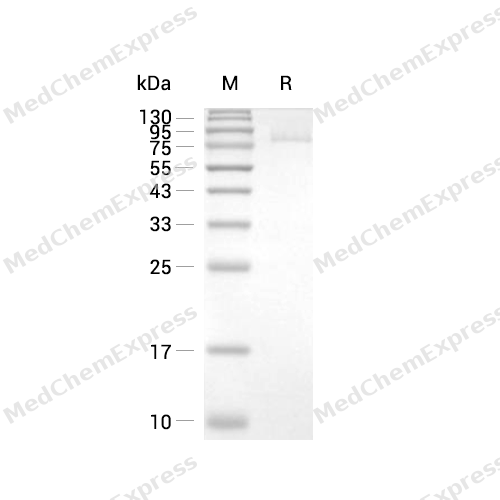
Purity - SDS-PAGE
Purity - SDS-PAGE


Technical Parameters
-
Species Human
-
Source Sf9 insect cells
-
Tag N-His
-
Accession
Q08188 (A2-E693)
-
Molecular Construction
-
N-term
-
His
-
TGM3 (A2-E693)
Accession # Q08188 -
C-term
-
-
Protein Length
Full Length
-
Synonyms
TGM3; TGase-3; Transglutaminase 3; TG(E); TGE; Transglutaminase 3 (E Polypeptide, Protein-Glutamine-Gamma-Glutamyltransferase); E Polypeptide, Protein-Glutamine-Gamma-Glutamyltransferase; Alternative Protein TGM3; Protein-Glutamine Gamma-Glutamyltransfera
-
AA Sequence
AALGVQSINWQTAFNRQAHHTDKFSSQELILRRGQNFQVLMIMNKGLGSNERLEFIVSTGPYPSESAMTKAVFPLSNGSSGGWSAVLQASNGNTLTISISSPASAPIGRYTMALQIFSQGGISSVKLGTFILLFNPWLNVDSVFMGNHAEREEYVQEDAGIIFVGSTNRIGMIGWNFGQFEEDILSICLSILDRSLNFRRDAATDVASRNDPKYVGRVLSAMINSNDDNGVLAGNWSGTYTGGRDPRSWNGSVEILKNWKKSGFSPVRYGQCWVFAGTLNTALRSLGIPSRVITNFNSAHDTDRNLSVDVYYDPMGNPLDKGSDSVWNFHVWNEGWFVRSDLGPSYGGWQVLDATPQERSQGVFQCGPASVIGVREGDVQLNFDMPFIFAEVNADRITWLYDNTTGKQWKNSVNSHTIGRYISTKAVGSNARMDVTDKYKYPEGSDQERQVFQKALGKLKPNTPFAATSSMGLETEEQEPSIIGKLKVAGMLAVGKEVNLVLLLKNLSRDTKTVTVNMTAWTIIYNGTLVHEVWKDSATMSLDPEEEAEHPIKISYAQYEKYLKSDNMIRITAVCKVPDESEVVVERDIILDNPTLTLEVLNEARVRKPVNVQMLFSNPLDEPVRDCVLMVEGSGLLLGNLKIDVPTLGPKEGSRVRFDILPSRSGTKQLLADFSCNKFPAIKAMLSIDVAE
-
Predicted Molecular Mass
78.2 kDa
-
Molecular Weight
Approximately 70-78 kDa, based on SDS-PAGE under reducing conditions, due to the glycosylation.
-
Purity
≥ 95%, as determined by reducing SDS-PAGE.


Product Properties
Solution
Supplied as a 0.22 μm filtered solution of 20 mM Tris, 500 mM NaCl, pH 8.5, 10% glycerol.
Note: For SPR assay, please replace the buffer. Primary amine components (e.g., Tris, imidazole) can affect protein-coupled chips.
<1 EU/μg, determined by LAL method.
Stored at -80°C for 1 year from date of receipt. It is stable at -20°C for 3 months after opening. It is recommended to freeze aliquots at -80°C for extended storage. Avoid repeated freeze-thaw cycles.
Shipping with dry ice.


Documentation
-
Data Sheet (240 KB)
-
SDS (251 KB)
- English - EN (251 KB)
- Français - FR (251 KB)
- Deutsch - DE (251 KB)
- Norwegian - NO (251 KB)
- Español - ES (251 KB)
- Swedish - SV (251 KB)
- Italian - IT (251 KB)
- Korean - KR (251 KB)
- Portuguese - PT (251 KB)
-
Handling Instructions (2659 KB)

Calculators
Concentration (start) × Volume (start) = Concentration (final) × Volume (final)


 Powered by Bioz

