



PLAU/uPA Protein, Human (HEK293, His, solution)
Based on 2 publication(s) in Google Scholar
uPA chain A Protein, a key player in the plasminogen activation system, selectively cleaves plasminogen, initiating fibrinolysis and contributing to tissue remodeling. Its precision underscores its role in regulating proteolytic activity, emphasizing its significance in the cascade of events leading to fibrinolysis and extracellular matrix remodeling in various physiological processes. PLAU/uPA Protein, Human (HEK293, His, solution) is the recombinant human-derived PLAU/uPA protein, expressed by HEK293 , with C-6*His labeled tag.
- Species: Human
- Source: HEK293
-
Storage:Stored at -80°C for 1 year from date of receipt. It is stable at -20°C for 3 months after opening. It is recommended to freeze aliquots at -80°C for extended storage. Avoid repeated freeze-thaw cycles.


To place orders, for customer services and technical support, please contact: MedChemExpress USA
Tel: 609-228-6898 E-mail: [email protected] [email protected]


-
 Biological Activity
-
Technical Parameters
-
Product Properties
- Documentation
- Help & FAQs




Biological Activity
Description
uPA chain A Protein, a key player in the plasminogen activation system, selectively cleaves plasminogen, initiating fibrinolysis and contributing to tissue remodeling. Its precision underscores its role in regulating proteolytic activity, emphasizing its significance in the cascade of events leading to fibrinolysis and extracellular matrix remodeling in various physiological processes. PLAU/uPA Protein, Human (HEK293, His, solution) is the recombinant human-derived PLAU/uPA protein, expressed by HEK293 , with C-6*His labeled tag.
Background
uPA chain A, a key player in the plasminogen activation system, performs a critical role as it selectively cleaves the zymogen plasminogen to generate the enzymatically active form known as plasmin. This proteolytic activation is a pivotal step in fibrinolysis, where plasmin functions to degrade fibrin clots and contribute to tissue remodeling and repair. uPA chain A's precision in cleaving plasminogen underscores its significance in regulating the delicate balance of proteolytic activity, emphasizing its role as a key initiator in the cascade of events leading to fibrinolysis and other physiological processes involving extracellular matrix remodeling.
Verified Bioactivity
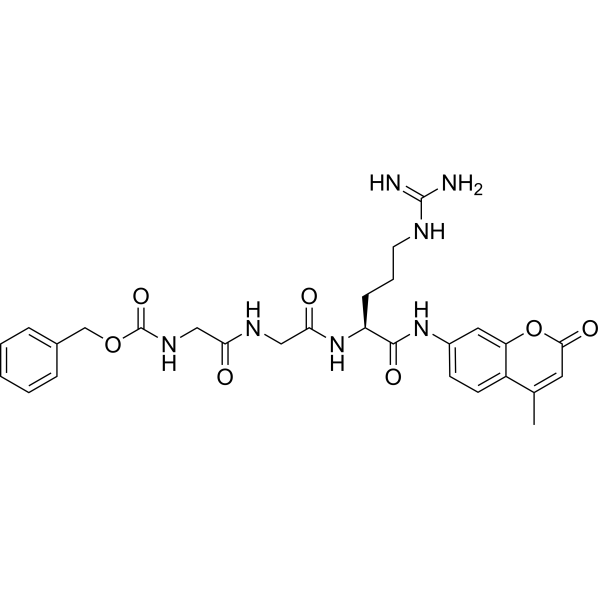
Measured by its ability to cleave a peptide substrate, N-carbobenzyloxy-Gly-Gly-Arg-7-amido-4-methylcoumarin. Read at excitation and emission wavelengths of 380 nm and 460 nm (top read). The specific activity is ≥1120.66 pmol/min/µg, as measured under the described conditions.
MCE Validation Data
-
Purity - SDS-PAGE
Purity - SDS-PAGE


Publications (2)
-
Journal Impact Factor
-
Most Recent
-
Cell Rep Med
High-fat diet increases circulating palmitic acid produced by gut Bacteroides thetaiotaomicron to promote thrombosis. [Abstract]2025 Aug 19;6(8):102260. PMID: 40749683 -


Technical Parameters
-
Species Human
-
Source HEK293
-
Tag C-6*His
-
Accession
P00749-1 (S21-L431)
-
Molecular Construction
-
N-term
-
PLAU (S21-L431)
Accession # P00749-1 -
6*His
-
C-term
-
-
Protein Length
Full Length of Isoform-1 Mature Protein
-
Synonyms
PLAU; Plasminogen Activator, Urinary; Plasminogen Activator, Urokinase; PLAU Protein; UPA; BDPLT5; Urokinase-Type Plasminogen Activator; U-PA; URK; ATF; U-Plasminogen Activator; QPD
-
AA Sequence
SNELHQVPSNCDCLNGGTCVSNKYFSNIHWCNCPKKFGGQHCEIDKSKTCYEGNGHFYRGKASTDTMGRPCLPWNSATVLQQTYHAHRSDALQLGLGKHNYCRNPDNRRRPWCYVQVGLKLLVQECMVHDCADGKKPSSPPEELKFQCGQKTLRPRFKIIGGEFTTIENQPWFAAIYRRHRGGSVTYVCGGSLISPCWVISATHCFIDYPKKEDYIVYLGRSRLNSNTQGEMKFEVENLILHKDYSADTLAHHNDIALLKIRSKEGRCAQPSRTIQTICLPSMYNDPQFGTSCEITGFGKENSTDYLYPEQLKMTVVKLISHRECQQPHYYGSEVTTKMLCAADPQWKTDSCQGDSGGPLVCSLQGRMTLTGIVSWGRGCALKDKPGVYTRVSHFLPWIRSHTKEENGLAL
-
Molecular Weight
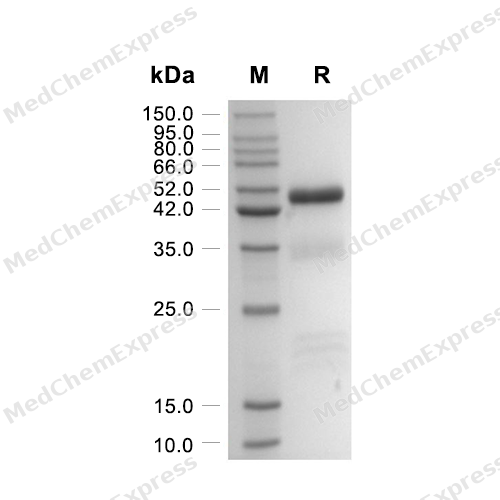
Approximately 45-55 kDa, based on SDS-PAGE under reducing conditions.
-
Glycosylation
Yes
-
Purity
≥ 95%, as determined by reducing SDS-PAGE.


Product Properties
Solution
Supplied as a 0.2 μm filtered solution of 20 mM HEPES, 2 mM CaCl2, 10% Glycerol, pH 7.4.
<1 EU/μg, determined by LAL method.
Stored at -80°C for 1 year from date of receipt. It is stable at -20°C for 3 months after opening. It is recommended to freeze aliquots at -80°C for extended storage. Avoid repeated freeze-thaw cycles.
Shipping with dry ice.


Documentation
-
Data Sheet (238 KB)
-
SDS (252 KB)
- English - EN (252 KB)
- Français - FR (252 KB)
- Deutsch - DE (252 KB)
- Norwegian - NO (252 KB)
- Español - ES (252 KB)
- Swedish - SV (252 KB)
- Italian - IT (252 KB)
- Korean - KR (252 KB)
- Portuguese - PT (252 KB)
-
Handling Instructions (2659 KB)

Calculators
Concentration (start) × Volume (start) = Concentration (final) × Volume (final)


 Powered by Bioz

