



UbcH5b/UBE2D2 Protein, Human
Based on 4 publication(s) in Google Scholar
The UbcH5b/UBE2D2 protein is an important cellular mediator that accepts ubiquitin from the E1 complex and catalyzes multifunctional “Lys-48”-linked polyubiquitination on target proteins. In addition to its catalytic role, it also concentrates and selectively degrades short-lived proteins and contributes to E6/E6-AP-induced ubiquitination of p53/TP53. UbcH5b/UBE2D2 Protein, Human is the recombinant human-derived UbcH5b/UBE2D2 protein, expressed by E. coli , with tag free.
- Species: Human
- Source: E. coli
-
Storage:Stored at -20°C for 2 years from date of receipt. After reconstitution, it is stable at 4°C for 1 week or -20°C for longer (with carrier protein). It is recommended to freeze aliquots at -20°C or -80°C for extended storage.


To place orders, for customer services and technical support, please contact: MedChemExpress USA
Tel: 609-228-6898 E-mail: [email protected] [email protected]


-
 Biological Activity
-
Technical Parameters
-
Product Properties
- Documentation
- Help & FAQs




Biological Activity
Description
The UbcH5b/UBE2D2 protein is an important cellular mediator that accepts ubiquitin from the E1 complex and catalyzes multifunctional “Lys-48”-linked polyubiquitination on target proteins. In addition to its catalytic role, it also concentrates and selectively degrades short-lived proteins and contributes to E6/E6-AP-induced ubiquitination of p53/TP53. UbcH5b/UBE2D2 Protein, Human is the recombinant human-derived UbcH5b/UBE2D2 protein, expressed by E. coli , with tag free.
Background
The UbcH5b/UBE2D2 protein serves as a crucial mediator in cellular processes, accepting ubiquitin from the E1 complex and catalyzing its covalent attachment to various proteins. With a pronounced preference for 'Lys-48'-linked polyubiquitination, UbcH5b/UBE2D2 demonstrates its versatility in modifying target proteins. Beyond its catalytic role, it plays a central part in the selective degradation of short-lived and aberrant proteins. UbcH5b/UBE2D2 is instrumental in the E6/E6-AP-induced ubiquitination of p53/TP53 and is involved in the ubiquitination of PEX5, as well as the autoubiquitination of STUB1 and TRAF6. Its engagement extends to signal-induced processes, including the conjugation and subsequent degradation of NFKBIA, FBXW2-mediated GCM1 ubiquitination and degradation, MDM2-dependent degradation of p53/TP53, and the activation of MAVS in the mitochondria by RIGI in response to viral infection. Moreover, UbcH5b/UBE2D2 proves to be essential for the viral activation of IRF3.
Verified Bioactivity
Recombinant Human UbcH5b/UBE2D2 is a member of the Ubiquitin-conjugating (E2) enzyme family that receives Ubiquitin from a Ubiquitin-activating (E1) enzyme and subsequently interacts with a Ubiquitin ligase (E3) to conjugate Ubiquitin to substrate proteins.
MCE Validation Data
-
Purity - SDS-PAGE
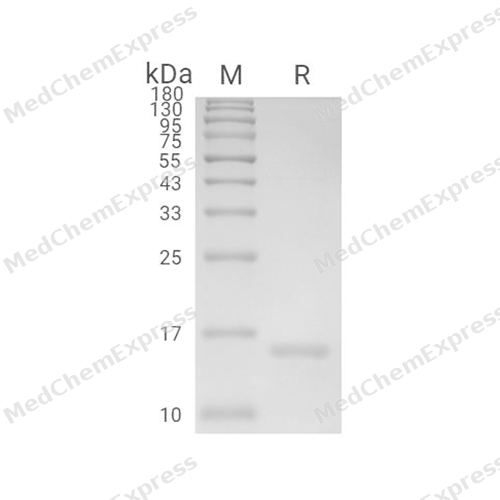
Purity - SDS-PAGE
-
Bioactivity - Enzymatic Activity Assay
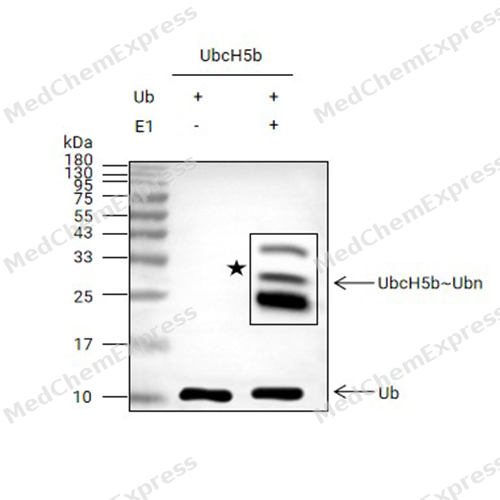
Bioactivity - Enzymatic Activity Assay


Publications (4)
-
Journal Impact Factor
-
Most Recent
-
Nat Plants
Tomato ripening regulator SlSAD8 disturbs nuclear gene transcription and chloroplast-associated protein degradation. [Abstract]2025 Nov;11(11):2230-2239. PMID: 41107469 -
New Phytol
Degradation of PbrDGK4 impairs pollen tube endocytosis in pear self-incompatibility by reducing PbrAP1/2β phosphorylation. [Abstract]2026 May;250(3):1669-1688. PMID: 41735043 -
Virulence
FGF8-mediated TRIM16 regulation promotes K48-linked ubiquitination and degradation of RIG-I to facilitate Influenza a virus immune evasion. [Abstract]2026 Dec;17(1):2677346. PMID: 42171628 -


Technical Parameters
-
Species Human
-
Source E. coli
-
Tag Tag Free
-
Accession
P62837-1 (M1-M147)
-
Molecular Construction
-
N-term
-
UbcH5b (M1-M147)
Accession # P62837 -
C-term
-
-
Protein Length
Full Length of Isoform-1
-
Synonyms
UBE2D2; Ubiquitin Conjugating Enzyme E2 D2; UBC4; UbcH5B; Ubiquitin-Conjugating Enzyme E2D 2 (Homologous To Yeast UBC4/5); (E3-Independent) E2 Ubiquitin-Conjugating Enzyme D2; P53-Regulated Ubiquitin-Conjugating Enzyme 1; Ubiquitin-Conjugating Enzyme E2-1
-
AA Sequence
MALKRIHKELNDLARDPPAQCSAGPVGDDMFHWQATIMGPNDSPYQGGVFFLTIHFPTDYPFKPPKVAFTTRIYHPNINSNGSICLDILRSQWSPALTISKVLLSICSLLCDPNPDDPLVPEIARIYKTDREKYNRIAREWTQKYAM
-
Predicted Molecular Mass
16.7 kDa
-
Molecular Weight
Approximately 16 kDa, based on SDS-PAGE under reducing conditions.
-
Purity
≥ 95%, as determined by reducing SDS-PAGE.


Product Properties
Lyophilized powder
Lyophilized from a 0.22 μm filtered solution of 20 mM HEPES, 50 mM NaCl, pH 7.4.
<1 EU/μg, determined by LAL method.
It is not recommended to reconstitute to a concentration less than 100 μg/mL in ddH2O. For long term storage it is recommended to add a carrier protein (0.1% BSA, 5% HSA, 10% FBS or 5% Trehalose).
Stored at -20°C for 2 years from date of receipt. After reconstitution, it is stable at 4°C for 1 week or -20°C for longer (with carrier protein). It is recommended to freeze aliquots at -20°C or -80°C for extended storage.
Room temperature in continental US; may vary elsewhere.


Documentation
-
Data Sheet (236 KB)
-
SDS (251 KB)
- English - EN (251 KB)
- Français - FR (251 KB)
- Deutsch - DE (251 KB)
- Norwegian - NO (251 KB)
- Español - ES (251 KB)
- Swedish - SV (251 KB)
- Italian - IT (251 KB)
- Korean - KR (251 KB)
- Portuguese - PT (251 KB)
-
Handling Instructions (2659 KB)

Calculators
Concentration (start) × Volume (start) = Concentration (final) × Volume (final)


 Powered by Bioz

