



uPAR Protein, Mouse (HEK293, His-Fc)
Based on 1 Customer Validation
uPAR (urokinase plasminogen activator receptor) possesses enzyme, protein, and receptor binding activities.It regulates apoptotic signaling, epidermal growth factor signaling, and cytochrome c release.uPAR is widely expressed in structures like decidua and spleen.Its human ortholog, PLAUR, is linked to rheumatoid arthritis.Investigating uPAR can reveal its role in cellular processes and shed light on diseases like rheumatoid arthritis.uPAR Protein, Mouse (HEK293, His-Fc) is the recombinant mouse-derived uPAR protein, expressed by HEK293 , with C-hFc, C-His labeled tag.
- Species: Mouse
- Source: HEK293
-
Storage:Stored at -20°C for 2 years from date of receipt. After reconstitution, it is stable at 4°C for 1 week or -20°C for longer (with carrier protein). It is recommended to freeze aliquots at -20°C or -80°C for extended storage.


To place orders, for customer services and technical support, please contact: MedChemExpress USA
Tel: 609-228-6898 E-mail: [email protected] [email protected]


-
 Biological Activity
-
Technical Parameters
-
Product Properties
- Documentation
- Help & FAQs




Biological Activity
Description
uPAR (urokinase plasminogen activator receptor) possesses enzyme, protein, and receptor binding activities.It regulates apoptotic signaling, epidermal growth factor signaling, and cytochrome c release.uPAR is widely expressed in structures like decidua and spleen.Its human ortholog, PLAUR, is linked to rheumatoid arthritis.Investigating uPAR can reveal its role in cellular processes and shed light on diseases like rheumatoid arthritis.uPAR Protein, Mouse (HEK293, His-Fc) is the recombinant mouse-derived uPAR protein, expressed by HEK293 , with C-hFc, C-His labeled tag.
Background
uPAR (urokinase plasminogen activator receptor), a multifaceted protein, is predicted to possess enzyme binding activity, protein domain-specific binding activity, and signaling receptor binding activity. It is anticipated to play a role in various processes, including the negative regulation of the apoptotic signaling pathway, positive regulation of the epidermal growth factor receptor signaling pathway, and positive regulation of the release of cytochrome c from mitochondria. As an integral component of the plasma membrane, uPAR exhibits broad expression in diverse structures such as decidua, early conceptus, and spleen. The human ortholog of this gene, PLAUR (plasminogen activator, urokinase receptor), has implications in conditions like rheumatoid arthritis, highlighting the potential significance of uPAR in physiological and pathological contexts. Studies on uPAR may unveil its intricate involvement in cellular processes and contribute to our understanding of diseases like rheumatoid arthritis.
Verified Bioactivity
Immobilized Recombinant rmuPAR/Fc at 5 μg/mL (100 μL/well) can bind Biotinylated Recombinant rhuPA Protein. The ED50 for this effect is <50.73 ng/mL.
MCE Validation Data
-
Purity - SDS-PAGE
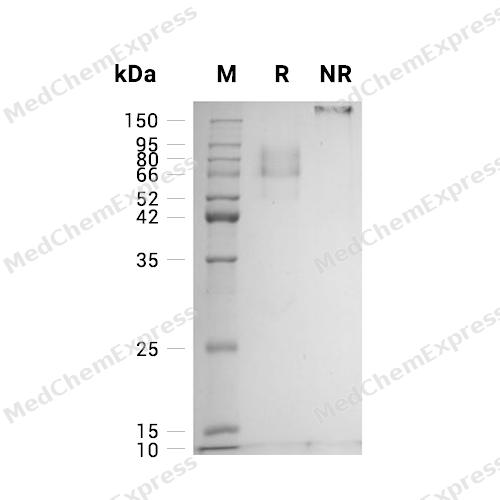
Purity - SDS-PAGE
-
Bioactivity - ELISA
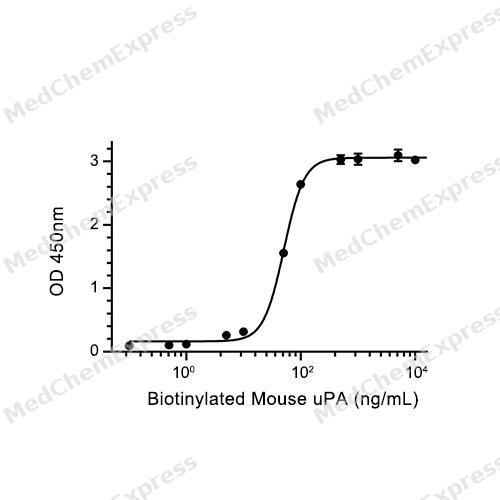
Bioactivity - ELISA


Technical Parameters
-
Species Mouse
-
Source HEK293
-
Tag C-hFc;C-His
-
Accession
P35456-1/NP_035243.1 (L24-T297)
-
Molecular Construction
-
N-term
-
uPAR (L24-T297)
Accession # P35456-1/NP_035243.1 -
hFc-His
-
C-term
-
-
Protein Length
Full Length of Partial Extracellular Domain
-
Synonyms
PLAUR; Monocyte Activation Antigen Mo3; Plasminogen Activator, Urokinase Receptor; U-PAR; Urokinase Plasminogen Activator Surface Receptor; Urokinase Plasminogen Activator Receptor; UPAR; U-Plasminogen Activator Receptor Form 2; URKR; CD87 Antigen; CD87;
-
AA Sequence
LQCMQCESNQSCLVEECALGQDLCRTTVLREWQDDRELEVVTRGCAHSEKTNRTMSYRMGSMIISLTETVCATNLCNRPRPGARGRAFPQGRYLECASCTSLDQSCERGREQSLQCRYPTEHCIEVVTLQSTERSLKDEDYTRGCGSLPGCPGTAGFHSNQTFHFLKCCNYTHCNGGPVLDLQSFPPNGFQCYSCEGNNTLGCSSEEASLINCRGPMNQCLVATGLDVLGNRSYTVRGCATASWCQGSHVADSFPTHLNVSVSCCHGSGCNSPT
-
Molecular Weight
Approximately 80-90 kDa, based on SDS-PAGE under reducing conditions, due to the glycosylation.
-
Glycosylation
Yes
-
Purity
≥ 95%, as determined by reducing SDS-PAGE.


Product Properties
Lyophilized powder
Lyophilized from a 0.2 μm filtered solution of 20 mM PB, 150 mM NaCl, pH 7.4.
<1 EU/μg, determined by LAL method.
It is not recommended to reconstitute to a concentration less than 100 μg/mL in ddH2O.
Stored at -20°C for 2 years from date of receipt. After reconstitution, it is stable at 4°C for 1 week or -20°C for longer (with carrier protein). It is recommended to freeze aliquots at -20°C or -80°C for extended storage.
Room temperature in continental US; may vary elsewhere.


Documentation
-
Data Sheet (237 KB)
-
SDS (254 KB)
- English - EN (254 KB)
- Français - FR (254 KB)
- Deutsch - DE (254 KB)
- Norwegian - NO (254 KB)
- Español - ES (254 KB)
- Swedish - SV (254 KB)
- Italian - IT (254 KB)
- Korean - KR (254 KB)
- Portuguese - PT (254 KB)
-
Handling Instructions (2659 KB)

Calculators
Concentration (start) × Volume (start) = Concentration (final) × Volume (final)


 Powered by Bioz

