



USP5 Protein, Human (sf9, His, solution)

Based on 1 Customer Validation
USP5 protein selectively cleaves branched multiubiquitin polymers, favoring 'Lys-48'-linked polyubiquitin disassembly. It exhibits lower affinity for linear and 'Lys-63'-linked polyubiquitin. USP5 knockdown leads to p53/TP53 accumulation, enhancing p53/TP53 transcriptional activity, as unanchored polyubiquitin competes with ubiquitinated p53/TP53 for proteasomal recognition, unlike MDM2. USP5 Protein, Human (sf9, His, solution) is the recombinant human-derived USP5 protein, expressed by Sf9 insect cells , with C-His labeled tag.
- Species: Human
- Source: Sf9 insect cells
-
Storage:Stored at -80°C for 1 year from date of receipt. It is stable at -20°C for 3 months after opening. It is recommended to freeze aliquots at -80°C for extended storage. Avoid repeated freeze-thaw cycles.


To place orders, for customer services and technical support, please contact: MedChemExpress USA
Tel: 609-228-6898 E-mail: [email protected] [email protected]


-
 Biological Activity
-
Technical Parameters
-
Product Properties
- Documentation
- Help & FAQs




Biological Activity
Description
USP5 protein selectively cleaves branched multiubiquitin polymers, favoring 'Lys-48'-linked polyubiquitin disassembly. It exhibits lower affinity for linear and 'Lys-63'-linked polyubiquitin. USP5 knockdown leads to p53/TP53 accumulation, enhancing p53/TP53 transcriptional activity, as unanchored polyubiquitin competes with ubiquitinated p53/TP53 for proteasomal recognition, unlike MDM2. USP5 Protein, Human (sf9, His, solution) is the recombinant human-derived USP5 protein, expressed by Sf9 insect cells , with C-His labeled tag.
Background
USP5, a deubiquitinating enzyme, demonstrates a marked preference for cleaving both linear and branched multiubiquitin polymers, with a particular affinity for branched structures. It is actively involved in the disassembly of unanchored 'Lys-48'-linked polyubiquitin chains. While USP5 binds linear and 'Lys-63'-linked polyubiquitin with a comparatively lower affinity, its knockdown results in the accumulation of p53/TP53 and an elevation in p53/TP53 transcriptional activity. This effect is attributed to the ability of the unanchored polyubiquitin accumulating in the absence of USP5 to compete with ubiquitinated p53/TP53, but not with MDM2, for recognition by the proteasome.
Verified Bioactivity
Measured by the hydrolysis of Ub-AMC. Reaction was incubated at 37°C for 15 min. The specific activity is 1540.40 pmol/min/μg.
MCE Validation Data
-
Purity - SDS-PAGE
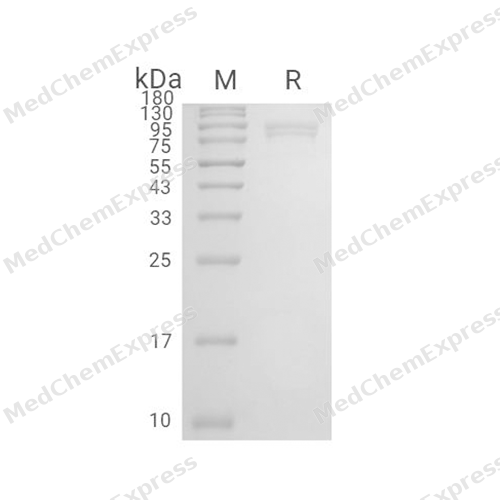
Purity - SDS-PAGE


Technical Parameters
-
Species Human
-
Source Sf9 insect cells
-
Tag C-10*His
-
Accession
P45974-2 (M1-S835)
-
Gene ID8078
-
Molecular Construction
-
N-term
-
USP5 (M1-S835)
Accession # P45974-2 -
10*His
-
C-term
-
-
Protein Length
Full Length of Isoform-2
-
Synonyms
USP5; Ubiquitin Specific Peptidase 5; Isopeptidase T; IsoT; Ubiquitin-Specific-Processing Protease 5; Ubiquitin Carboxyl-Terminal Hydrolase 5; Deubiquitinating Enzyme 5; Ubiquitin Thioesterase 5; Ubiquitin-Specific Protease-5 (Ubiquitin Isopeptidase T); U
-
AA Sequence
MAELSEEALLSVLPTIRVPKAGDRVHKDECAFSFDTPESEGGLYICMNTFLGFGKQYVERHFNKTGQRVYLHLRRTRRPKEEDPATGTGDPPRKKPTRLAIGVEGGFDLSEEKFELDEDVKIVILPDYLEIARDGLGGLPDIVRDRVTSAVEALLSADSASRKQEVQAWDGEVRQVSKHAFSLKQLDNPARIPPCGWKCSKCDMRENLWLNLTDGSILCGRRYFDGSGGNNHAVEHYRETGYPLAVKLGTITPDGADVYSYDEDDMVLDPSLAEHLSHFGIDMLKMQKTDKTMTELEIDMNQRIGEWELIQESGVPLKPLFGPGYTGIRNLGNSCYLNSVVQVLFSIPDFQRKYVDKLEKIFQNAPTDPTQDFSTQVAKLGHGLLSGEYSKPVPESGDGERVPEQKEVQDGIAPRMFKALIGKGHPEFSTNRQQDAQEFFLHLINMVERNCRSSENPNEVFRFLVEEKIKCLATEKVKYTQRVDYIMQLPVPMDAALNKEELLEYEEKKRQAEEEKMALPELVRAQVPFSSCLEAYGAPEQVDDFWSTALQAKSVAVKTTRFASFPDYLVIQIKKFTFGLDWVPKKLDVSIEMPEELDISQLRGTGLQPGEEELPDIAPPLVTPDEPKAPMLDESVIIQLVEMGFPMDACRKAVYYTGNSGAEAAMNWVMSHMDDPDFANPLILPGSSGPGSTSAAADPPPEDCVTTIVSMGFSRDQALKALRATNNSLERAVDWIFSHIDDLDAEAAMDISEGRSAADSISESVPVGPKVRDGPGKYQLFAFISHMGTSTMCGHYVCHIKKEGRWVIYNDQKVCASEKPPKDLGYIYFYQRVAS
-
Predicted Molecular Mass
94.7 kDa
-
Molecular Weight
Approximately 85-94 kDa, based on SDS-PAGE under reducing conditions.
-
Purity
≥ 90%, as determined by reducing SDS-PAGE.


Product Properties
Solution
Supplied as a 0.22 μm filtered solution in PBS, pH 7.4.
<1 EU/μg, determined by LAL method.
Stored at -80°C for 1 year from date of receipt. It is stable at -20°C for 3 months after opening. It is recommended to freeze aliquots at -80°C for extended storage. Avoid repeated freeze-thaw cycles.
Shipping with dry ice.


Documentation
-
Data Sheet (240 KB)
-
SDS (252 KB)
- English - EN (252 KB)
- Français - FR (252 KB)
- Deutsch - DE (252 KB)
- Norwegian - NO (252 KB)
- Español - ES (252 KB)
- Swedish - SV (252 KB)
- Italian - IT (252 KB)
- Korean - KR (252 KB)
- Portuguese - PT (252 KB)
-
Handling Instructions (2659 KB)

Calculators
Concentration (start) × Volume (start) = Concentration (final) × Volume (final)


 Powered by Bioz

