



WWP2 Protein, Human (sf9, His-GST)

Based on 1 Customer Validation
The WWP2 protein is an E3 ubiquitin protein ligase that coordinates multiple ubiquitination events, including “Lys-63”-linked polyubiquitination of POU5F1, targeting it for proteasomal degradation in embryonic stem cells (ESCs). WWP2 also ubiquitinates EGR2, inhibits activation-induced cell death in T cells, and targets SLC11A2, which is enhanced by NDFIP1 and NDFIP2. WWP2 Protein, Human (sf9, His-GST) is the recombinant human-derived WWP2 protein, expressed by Sf9 insect cells , with N-His, N-GST labeled tag.
- Species: Human
- Source: Sf9 insect cells
-
Storage:Stored at -80°C for 1 year from date of receipt. It is stable at -20°C for 3 months after opening. It is recommended to freeze aliquots at -80°C for extended storage. Avoid repeated freeze-thaw cycles.


To place orders, for customer services and technical support, please contact: MedChemExpress USA
Tel: 609-228-6898 E-mail: [email protected] [email protected]


-
 Biological Activity
-
Technical Parameters
-
Product Properties
- Documentation
- Help & FAQs




Biological Activity
Description
The WWP2 protein is an E3 ubiquitin protein ligase that coordinates multiple ubiquitination events, including “Lys-63”-linked polyubiquitination of POU5F1, targeting it for proteasomal degradation in embryonic stem cells (ESCs). WWP2 also ubiquitinates EGR2, inhibits activation-induced cell death in T cells, and targets SLC11A2, which is enhanced by NDFIP1 and NDFIP2. WWP2 Protein, Human (sf9, His-GST) is the recombinant human-derived WWP2 protein, expressed by Sf9 insect cells , with N-His, N-GST labeled tag.
Background
WWP2 Protein, functioning as an E3 ubiquitin-protein ligase, facilitates the transfer of ubiquitin from an E2 ubiquitin-conjugating enzyme to its targeted substrates. Notably, WWP2 engages in the polyubiquitination of POU5F1 through 'Lys-63'-linked conjugation, leading to the proteasomal degradation of POU5F1. In embryonic stem cells (ESCs), this ubiquitination is proposed to play a regulatory role in controlling the protein levels of POU5F1. Additionally, WWP2 ubiquitinates EGR2, promoting its proteasomal degradation, and in T-cells, this ubiquitination is implicated in inhibiting activation-induced cell death. Moreover, WWP2 targets SLC11A2 for ubiquitination, a process enhanced in the presence of NDFIP1 and NDFIP2. Furthermore, WWP2 ubiquitinates RPB1, leading to its proteasomal degradation. These diverse ubiquitination events underscore the regulatory versatility of WWP2 in modulating the stability and abundance of key proteins involved in various cellular processes.
Verified Bioactivity
The enzyme activity of this recombinant protein is testing in progress, we cannot offer a guarantee yet.
MCE Validation Data
-
Purity - SDS-PAGE
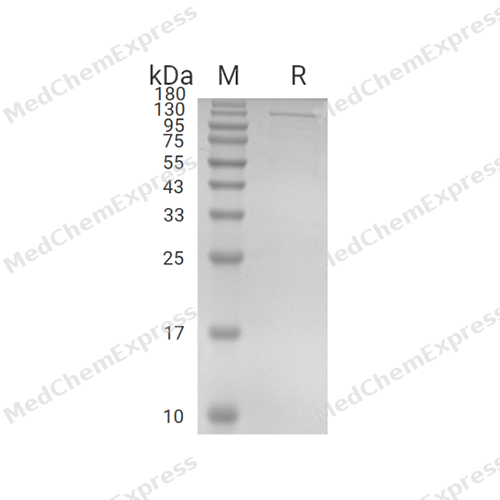
Purity - SDS-PAGE


Technical Parameters
-
Species Human
-
Source Sf9 insect cells
-
Tag N-His;N-GST
-
Accession
O00308-1 (M1-E870)
-
Molecular Construction
-
N-term
-
His-GST
-
WWP2 (M1-E870)
Accession # O00308-1 -
C-term
-
-
Protein Length
Full Length of Isoform-1
-
Synonyms
WWP2; WW Domain Containing E3 Ubiquitin Protein Ligase 2; AIP2; NEDD4-Like E3 Ubiquitin-Protein Ligase WWP2; HECT-Type E3 Ubiquitin Transferase WWP2; Atrophin-1-Interacting Protein 2; Atrophin-1 Interacting Protein 2; WW Domain-Containing Protein 2; WWP2-
-
AA Sequence
MASASSSRAGVALPFEKSQLTLKVVSAKPKVHNRQPRINSYVEVAVDGLPSETKKTGKRIGSSELLWNEIIILNVTAQSHLDLKVWSCHTLRNELLGTASVNLSNVLKNNGGKMENMQLTLNLQTENKGSVVSGGELTIFLDGPTVDLGNVPNGSALTDGSQLPSRDSSGTAVAPENRHQPPSTNCFGGRSRTHRHSGASARTTPATGEQSPGARSRHRQPVKNSGHSGLANGTVNDEPTTATDPEEPSVVGVTSPPAAPLSVTPNPNTTSLPAPATPAEGEEPSTSGTQQLPAAAQAPDALPAGWEQRELPNGRVYYVDHNTKTTTWERPLPPGWEKRTDPRGRFYYVDHNTRTTTWQRPTAEYVRNYEQWQSQRNQLQGAMQHFSQRFLYQSSSASTDHDPLGPLPPGWEKRQDNGRVYYVNHNTRTTQWEDPRTQGMIQEPALPPGWEMKYTSEGVRYFVDHNTRTTTFKDPRPGFESGTKQGSPGAYDRSFRWKYHQFRFLCHSNALPSHVKISVSRQTLFEDSFQQIMNMKPYDLRRRLYIIMRGEEGLDYGGIAREWFFLLSHEVLNPMYCLFEYAGKNNYCLQINPASSINPDHLTYFRFIGRFIAMALYHGKFIDTGFTLPFYKRMLNKRPTLKDLESIDPEFYNSIVWIKENNLEECGLELYFIQDMEILGKVTTHELKEGGESIRVTEENKEEYIMLLTDWRFTRGVEEQTKAFLDGFNEVAPLEWLRYFDEKELELMLCGMQEIDMSDWQKSTIYRHYTKNSKQIQWFWQVVKEMDNEKRIRLLQFVTGTCRLPVGGFAELIGSNGPQKFCIDKVGKETWLPRSHTCFNRLDLPPYKSYEQLREKLLYAIEETEGFGQE
-
Predicted Molecular Mass
126.7 kDa
-
Molecular Weight
Approximately 120 kDa, based on SDS-PAGE under reducing conditions.
-
Purity
≥ 85%, as determined by reducing SDS-PAGE.


Product Properties
Solution
Supplied as a 0.22 μm filtered solution of 20 mM Tris, 500 mM NaCl, pH 8.0, 10% Glycerol.
Note: For SPR assay, please replace the buffer. Primary amine components (e.g., Tris, imidazole) can affect protein-coupled chips.
<1 EU/μg, determined by LAL method.
Stored at -80°C for 1 year from date of receipt. It is stable at -20°C for 3 months after opening. It is recommended to freeze aliquots at -80°C for extended storage. Avoid repeated freeze-thaw cycles.
Shipping with dry ice.


Documentation
-
Data Sheet (240 KB)
-
SDS (252 KB)
- English - EN (252 KB)
- Français - FR (252 KB)
- Deutsch - DE (252 KB)
- Norwegian - NO (252 KB)
- Español - ES (252 KB)
- Swedish - SV (252 KB)
- Italian - IT (252 KB)
- Korean - KR (252 KB)
- Portuguese - PT (252 KB)
-
Handling Instructions (2659 KB)

Calculators
Concentration (start) × Volume (start) = Concentration (final) × Volume (final)


 Powered by Bioz

