



XCL2/SCM-1 beta Protein, Human (sf9, His)

Based on 1 Customer Validation
XCL2 (also knowns as SCM1-β and SCYC-2) is a member of C chemokine sub-family that is highly related to XCL1. XCL2 binds and activates the G protein-coupled receptor, XCR1. XCL2 is mainly produced by activated T cells and natural killer cells. XCL2/SCM-1 beta Protein, Human (sf9, His) is produced in sf9 insect cells with a C-Terminal His-tag. It consists of 114 amino acids (M1-G114).
- Species: Human
- Source: Sf9 insect cells
-
Storage:Stored at -20°C for 2 years from date of receipt. After reconstitution, it is stable at 4°C for 1 week or -20°C for longer (with carrier protein). It is recommended to freeze aliquots at -20°C or -80°C for extended storage.


To place orders, for customer services and technical support, please contact: MedChemExpress USA
Tel: 609-228-6898 E-mail: [email protected] [email protected]


-
 Biological Activity
-
Technical Parameters
-
Product Properties
- Documentation
- References
- Help & FAQs




Biological Activity
Description
XCL2 (also knowns as SCM1-β and SCYC-2) is a member of C chemokine sub-family that is highly related to XCL1. XCL2 binds and activates the G protein-coupled receptor, XCR1. XCL2 is mainly produced by activated T cells and natural killer cells[1]. XCL2/SCM-1 beta Protein, Human (sf9, His) is produced in sf9 insect cells with a C-Terminal His-tag. It consists of 114 amino acids (M1-G114).
Background
An alignment of the XCL1 and XCL2 amino acid sequences illustrates their high similarity. The human proteins differ at only two sequence positions, 7DK8 and 7HR8 in XCL1 and XCL2, respectively. XCL2 is constitutively expressed by unstimulated natural killer (NK) cells and to a lesser extent by inactive CD8 + T cells[1].
Verified Bioactivity
Measured by its ability to chemoattract BaF3 mouse pro-B cells transfected with human XCR1. The ED50 for this effect is 49.31 ng/mL, corresponding to a specific activity is 2.028×10⁴ U/mg.
MCE Validation Data
-
Bioactivity - Cell-Based Assay
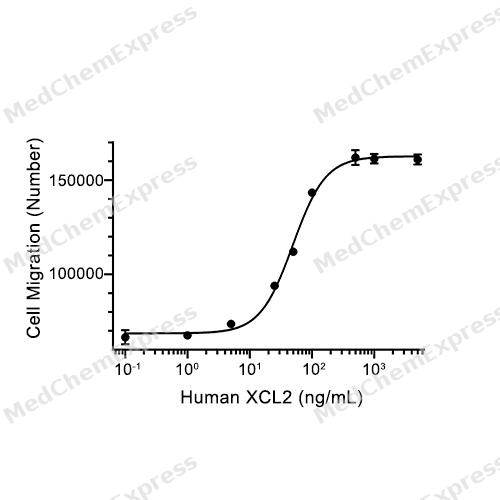
Bioactivity - Cell-Based Assay


Technical Parameters
-
Species Human
-
Source Sf9 insect cells
-
Tag C-His
-
Accession
Q9UBD3 (M1-G114)
-
Molecular Construction
-
N-term
-
XCL2 (M1-G114)
Accession # Q9UBD3 -
His
-
C-term
-
-
Protein Length
Full Length
-
Synonyms
XCL2; X-C Motif Chemokine Ligand 2; SCYC2; SCM-1b; Small Inducible Cytokine Subfamily C, Member 2; Chemokine (C Motif) Ligand 2; XC Chemokine Ligand 2; Cytokine SCM-1 Beta; C Motif Chemokine 2; SCM1B
-
AA Sequence
MRLLILALLGICSLTAYIVEGVGSEVSHRRTCVSLTTQRLPVSRIKTYTITEGSLRAVIFITKRGLKVCADPQATWVRDVVRSMDRKSNTRNNMIQTKPTGTQQSTNTAVTLTG
-
Predicted Molecular Mass
11.7 kDa
-
Molecular Weight
Approximately 18-20 kDa, based on SDS-PAGE under reducing conditions.
-
Purity
≥ 90%, as determined by reducing SDS-PAGE.


Product Properties
Lyophilized powder.
Lyophilized from a 0.22 μm filtered solution of 20 mM Tris, 500 mM NaCl, pH 7.4, 10% Glycerol, 5% trehalose, 5% mannitol and 0.01% Tween 80.
Note: For SPR assay, please replace the buffer. Primary amine components (e.g., Tris, imidazole) can affect protein-coupled chips.
<1 EU/μg, determined by LAL method.
It is not recommended to reconstitute to a concentration less than 100 μg/mL in ddH2O.
Stored at -20°C for 2 years from date of receipt. After reconstitution, it is stable at 4°C for 1 week or -20°C for longer (with carrier protein). It is recommended to freeze aliquots at -20°C or -80°C for extended storage.
Room temperature in continental US; may vary elsewhere.


Documentation
-
Data Sheet (261 KB)
-
SDS (252 KB)
- English - EN (252 KB)
- Français - FR (252 KB)
- Deutsch - DE (252 KB)
- Norwegian - NO (252 KB)
- Español - ES (252 KB)
- Swedish - SV (252 KB)
- Italian - IT (252 KB)
- Korean - KR (252 KB)
- Portuguese - PT (252 KB)
-
Handling Instructions (2659 KB)


References

Calculators
Concentration (start) × Volume (start) = Concentration (final) × Volume (final)


 Powered by Bioz

