



Risankizumab

Based on 1 Customer Validation
Risankizumab (BI 655066) is a humanised IgG monoclonal antibody, targeting IL-23 p19 subunit (Kd <10 pM) and inhibiting IL-17 production induced by human IL-23 in mouse splenocytes (IC50 = 2 pM). Risankizumab can be used to research immunological and inflammatory disorders such as psoriasis vulgaris, psoriatic arthritis, generalized pustular psoriasis and erythrodermic psoriasis.
For research use only. We do not sell to patients.
- Purity : 99.37%
- CAS No.: 1612838-76-2
- Molecular Weight:145.92 kDa
-
Storage:
Please store the product under the recommended conditions in the Certificate of Analysis.


To place orders, for customer services and technical support, please contact: MedChemExpress USA
Tel: 609-228-6898 E-mail: [email protected] [email protected]


-
 Biological Activity
-
Chemical Information
- Protocols
- Purity & Documentation
- References
-
 Help & FAQs


-

HY-P9931
GuselkumabIL-23 Neutralizing Antibody -

HY-P9909
Ustekinumab -

HY-P99737
MirikizumabIL-23 Antibody -

HY-P99256
TildrakizumabAnti-IL-23 mAb -

HY-P99025
LebrikizumabIL-13 Inhibitor -

HY-P9924
IxekizumabIL-17A Antagonist -

HY-P9956
SiltuximabAnti-IL-6 mAb -

HY-P99053
TralokinumabIL-13 Inhibitor -

HY-P99244
FezakinumabIL-22 Antibody -

HY-P99171
GevokizumabIL-1β Modulator -

HY-P990007
TulisokibartAnti-TNFSf15/TL1A Antibody -
HY-P99396
SpesolimabAnti-IL-36R Antibody


Biological Activity
Description
Isotype
Human IgG1 (L234A/L235A) kappa
Recommend Isotype Controls
Species Reactivity
Human
IC50 & Target
[3]|
IL-23 <10 pM (Kd) |
In Vitro
Risankizumab (BI 655066) has a high affinity for human and cynomolgus IL23 with Kds <10 pM[3].
Risankizumab (BI 655066) inhibits endogenous (THP-1 cell generated) human IL23-induced and recombinant cynomolgus IL23-induced IL17 production with IC50s of 2 pM and 17 pM, respectively[3].
MedChemExpress (MCE) has not independently confirmed the accuracy of these methods. They are for reference only. Further protocols information, click here.
In Vivo
MedChemExpress (MCE) has not independently confirmed the accuracy of these methods. They are for reference only.
-
Animal Model:Mice (injected with BI 655066, 1 h later injected recombinant human IL23 into the skin of the mouse ear for 4 days)[3]
-
Dosage:1 mg/kg
-
Administration:i.p.; single dosage
-
Result:Significantly inhibited IL23-induced ear swelling and cytokine production.
-
Animal Model:Cynomolgus monkeys[3]
-
Dosage:1.0 mg/kg
-
Administration:i.v. or s.c.
-
Result:Pharmacokinetic Parameters of Risankizumab (BI 655066) in cynomolgus monkeys[1].
IV (1 mg/kg) SC (1 mg/kg) AUCinf (μg·day/mL) 202 ± 33.5 142 ± 33.3 CL (mL/day/kg) 5.18 ± 0.8 / Vd, ss (mL/kg) 88.3 ± 3.12 / t1/2 (h) 12.2 ± 2.28/ 9.15 ± 1.87 Cmax (μg/mL) / 10.1 ± 3.14 Tmax (day) / 2.11 ± 1.84 F (%) / 70.4 ± 16.5
Clinical Trial
| NCT Number | Sponsor | Condition | Start Date |
Phase

|
|---|---|---|---|---|
| NCT01329991 | Plexxikon| | 2011-05 | PHASE1 |
Gene ID
Accession
Conjugated
Unconjugated
Reconsititution
The product can be reconstituted/diluted with sterile PBS or saline.
Format
-
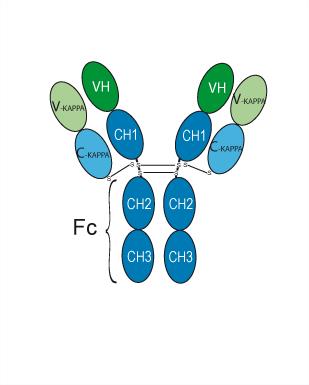
Human IgG1 kappa
Application
ELISA, FACS, Functional assay
Verified Bioactivity
-
-FACS.jpg) Flow Cytometry analysis of Raji cells labelling IL-23A (red) with Risankizumab (anti-IL-23A) (HY-P99248). Cells were fixed with 4% paraformaldehyde and permeabilised with 90% methanol. Then cells were stained with the primary antibody at 1/200 dilution for an hour at 4℃. Goat Anti-Human IgG H&L (AF488) (HY-P83776) was used as the secondary antibody at 1/1,000 dilution for 30 minutes at 4℃. Human IgG1 kappa (HY-P99001, blue) was used as the isotype control, cells without incubation with primary antibody were used as the unlabeled control (black).
Flow Cytometry analysis of Raji cells labelling IL-23A (red) with Risankizumab (anti-IL-23A) (HY-P99248). Cells were fixed with 4% paraformaldehyde and permeabilised with 90% methanol. Then cells were stained with the primary antibody at 1/200 dilution for an hour at 4℃. Goat Anti-Human IgG H&L (AF488) (HY-P83776) was used as the secondary antibody at 1/1,000 dilution for 30 minutes at 4℃. Human IgG1 kappa (HY-P99001, blue) was used as the isotype control, cells without incubation with primary antibody were used as the unlabeled control (black).


Chemical Information
-
CAS No. 1612838-76-2
-
Appearance Liquid
-
Molecular Weight 145.92 kDa
-
Color Colorless to light yellow
-
SMILES
[Risankizumab]
-
Synonyms
Risankizumab rzaa; BI 655066; ABBV-066
-
Shipping
Shipping with dry ice.
-
Formulation
Please refer to the lot-specific COA for specific buffer information.
-
Storage
Please store the product under the recommended conditions in the Certificate of Analysis.

Protocols
-
Collagen-Induced Arthritis
Collagen-induced arthritis (CIA) is an autoimmune murine model of rheumatoid arthritis in which immunization with type II collagen (CII) emulsified in an adjuvant induces a T cell- and autoantibody-driven inflammatory arthritis characterized by synovial hyperplasia, immune cell infiltration, and joint destruction. The model typically relies on genetically susceptible mouse strains (e. g. , DBA/1) and reproduces key features of human rheumatoid arthritis, including anti-collagen immune responses and progressive joint inflammation. Disease onset generally occurs within ~3-4 weeks after immunization, depending on antigen/adjuvant combinations and protocol variation. The immunopathology is driven by adaptive immune activation against CII, leading to systemic and local joint inflammation mediated by pro-inflammatory cytokines and effector immune cells, making CIA a standard preclinical platform for evaluating immunomodulatory and anti-arthritic interventions.
-
Cell Cytotoxicity Assay
Cytotoxicity assays are usually based on the assessment of cell membrane damage, which can also be indirectly detected by measuring cell viability. Detection methods include MTT assay, CKK-8 assay, LDH assay and ATP assay, etc.
-
Imiquimod-Induced Psoriasiform Dermatitis
Imiquimod (IMQ)-induced psoriasiform dermatitis is a widely used murine model in which topical application of IMQ, a Toll-like receptor 7 (TLR7) agonist, triggers innate immune activation in the skin and induces a psoriasis-like inflammatory cascade characterized by epidermal hyperplasia, immune cell infiltration, and cytokine production dominated by the IL-23/IL-17 axis. This inflammatory response is mediated through activation of dendritic cells and downstream induction of IL-23, IL-17A, IL-22, and related pro-inflammatory mediators, recapitulating key features of human plaque psoriasis and enabling mechanistic and therapeutic studies. The model is commonly induced using Aldara (5% IMQ cream) applied topically to murine skin, resulting in rapid onset of erythema, scaling, and thickening that can be quantified as disease severity indices and validated histologically.


Purity & Documentation
-
Data Sheet (262 KB)
-
SDS (252 KB)
- English - EN (252 KB)
- Français - FR (252 KB)
- Deutsch - DE (252 KB)
- Norwegian - NO (252 KB)
- Español - ES (252 KB)
- Swedish - SV (252 KB)
- Italian - IT (252 KB)
- Korean - KR (252 KB)
- Portuguese - PT (252 KB)
-
Inhibitory Antibodies User Guide (603 KB)
References

Calculators
Concentration (start) × Volume (start) = Concentration (final) × Volume (final)


Risankizumab Related Classifications
HY-P99248 Related Classifications
 Powered by Bioz