



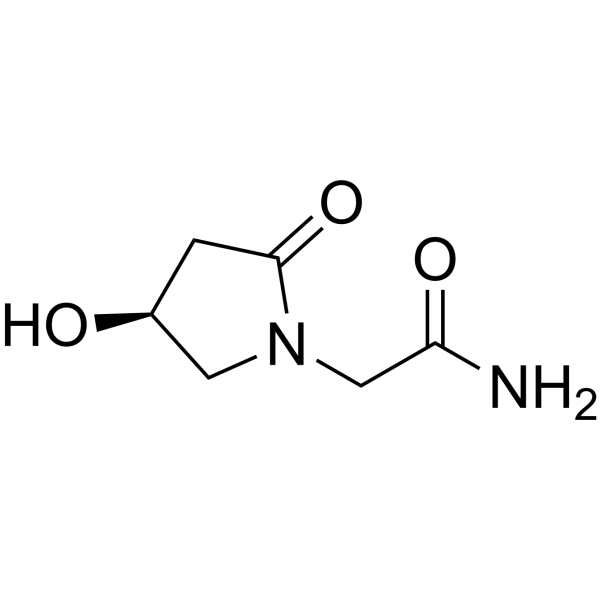
(S)-Oxiracetam

Based on 1 Customer Validation
(S)-oxiracetam (S-ORC) is an inhibitor targeting apoptosis. S-ORC reduces brain infarct size and lessens neurological dysfunction in middle cerebral artery occlusion/reperfusion (MCAO/R) models. S-ORC prevents neuronal apoptosis via activating PI3K/Akt/GSK3β signaling pathway via α7 nAChR after ischemic stroke. S-ORC can prevent neuronal death after ischemic stroke.
Nur für Forschungszwecke. Wir verkaufen nicht an Patienten.
- Reinheit : 99.56%
- CAS. Nr.: 88929-35-5
- Formel: C6H10N2O3
- Molecular Weight:158.16
-
Speicherung:
4°C, sealed storage, away from moisture
* In solvent : -80°C, 6 months; -20°C, 1 month (sealed storage, away from moisture)

To place orders, for customer services and technical support, please contact: MedChemExpress USA
Tel: 609-228-6898 E-mail: [email protected] [email protected]


-
 Biologische Aktivität
-
Chemical Information
-
Lösungsmittel & Löslichkeit
- Protokoll
- Reinheit & Dokumentation
- Verweise
-
 Help & FAQs




Biologische Aktivität
Beschreibung
In Vitro
(S)-Oxiracetam (1, 10, 100 μM; 24 h) protects fetal rat primary cortical neurons against OGD/R injury and activates PI3K/Akt/GSK3β signal pathway was α7 nAChR dependent[1].
MedChemExpress (MCE) has not independently confirmed the accuracy of these methods. They are for reference only.
-
Cell Line:fetal rat primary cortical neurons
-
Concentration:1, 10, 100 μM
-
Incubation Time:24 h
-
Result:Increased the survival of cortical neurons (58.82%, 64.82% and 79.15%, respectively) compared with the OGD/R group.
-
Cell Line:fetal rat primary cortical neurons
-
Concentration:1, 10, 100 μM
-
Incubation Time:24 h
-
Result:Decreased the LDH activity to 567.59 U/L, 484.89 U/L and 428.15 U/L at 1 μM, 10 μM and 100 μM, respectively, compared with the OGD/R group (725.22 U/L).
-
Cell Line:fetal rat primary cortical neurons
-
Concentration:1, 10, 100 μM
-
Incubation Time:24 h
-
Result:Reduced the apoptotic rate in cortical neurons dependent on α7 nAChR (34.48%, 16.15% and 10.05%, respectively) compared with the OGD/R group.
-
Cell Line:fetal rat primary cortical neurons
-
Concentration:1, 10, 100 μM
-
Incubation Time:24 h
-
Result:Increased the expression of α7 nAChR (46.95%, 58.67% and 72.97%, respectively for the 1 μM, 10 μM and 100 μM) and the phosphorylation of PI3K, Akt and GSK3β dependent on α7 nAChR compared with the OGD/R group.
In Vivo
MedChemExpress (MCE) has not independently confirmed the accuracy of these methods. They are for reference only.
-
Animal Model:scopolamine-induced amnesia models in Swiss albino mice[1].
-
Dosage:0.12, 0.24, 0.48 g/kg, once daily for 7 days
-
Administration:Intravenous injection (i.v.)
-
Result:Decreased the infarct size of rats to 26.04 ± 1.07%, 21.66 ± 2.27%, 12.26 ± 5.59% compared with the sham group at 0.12 g/kg, 0.24 g/kg, 0.48 g/kg, respectively.
Increased neurological scores compared with the MCAO/R group.
Protected neurons from apoptosis compared to sham group.
Increased the α7 nAChR and the phosphorylation of PI3K, Akt and GSK3β expression compared with MCAO/R group.
Increased of GSH-PX concentration (189.54 units, 193.07 units, and 203.98 untis, respectively).


Chemical Information
-
CAS. Nr. 88929-35-5
-
Appearance Solid
-
Molecular Weight 158.16
-
Formel C6H10N2O3
-
Color White to off-white
-
SMILES
O=C(CN1C(C[C@@H](C1)O)=O)N
-
Synonyms
(S)-(-)-Oxiracetam; (S)-ISF2522
-
Versand
Room temperature in continental US; may vary elsewhere.
-
Speicherung
4°C, sealed storage, away from moisture
* In solvent : -80°C, 6 months; -20°C, 1 month (sealed storage, away from moisture)


Lösungsmittel & Löslichkeit
In Vitro:
DMSO : 250 mg/mL (1580.68 mM; Need ultrasonic; Hygroscopic DMSO has a significant impact on the solubility of product, please use newly opened DMSO)
Please refer to the solubility information to select the appropriate solvent. Once prepared, please aliquot and store the solution to prevent product inactivation from repeated freeze-thaw cycles.
Storage method and period of stock solution: -80°C, 6 months; -20°C, 1 month (sealed storage, away from moisture). When stored at -80°C, please use it within 6 months. When stored at -20°C, please use it within 1 month.
Please refer to the solubility information to select the appropriate solvent. Once prepared, please aliquot and store the solution to prevent product inactivation from repeated freeze-thaw cycles.
Storage method and period of stock solution: -80°C, 6 months; -20°C, 1 month (sealed storage, away from moisture). When stored at -80°C, please use it within 6 months. When stored at -20°C, please use it within 1 month.
Konzentration (Stammlösung) × Volumen (Stammlösung) = Konzentration (Ziellösung) × Volumen (Ziellösung)


Reinheit & Dokumentation
-
Data Sheet (276 KB)
-
SDS (393 KB)
- English - EN (393 KB)
- Français - FR (393 KB)
- Deutsch - DE (393 KB)
- Norwegian - NO (393 KB)
- Español - ES (393 KB)
- Swedish - SV (393 KB)
- Italian - IT (393 KB)
- Korean - KR (393 KB)
- Portuguese - PT (393 KB)
-
Handling Instructions (2659 KB)
Verweise


Complete Stock Solution Preparation Table
Please refer to the solubility information to select the appropriate solvent. Once prepared, please aliquot and store the solution to prevent product inactivation from repeated freeze-thaw cycles.
Storage method and period of stock solution: -80°C, 6 months; -20°C, 1 month (sealed storage, away from moisture). When stored at -80°C, please use it within 6 months. When stored at -20°C, please use it within 1 month.
| Optional Solvent | Concentration Solvent Mass | 1 mg | 5 mg | 10 mg | 25 mg |
|---|---|---|---|---|---|
| DMSO | 1 mM | 6.3227 mL | 31.6136 mL | 63.2271 mL | 158.0678 mL |
| 5 mM | 1.2645 mL | 6.3227 mL | 12.6454 mL | 31.6136 mL | |
| 10 mM | 0.6323 mL | 3.1614 mL | 6.3227 mL | 15.8068 mL | |
| 15 mM | 0.4215 mL | 2.1076 mL | 4.2151 mL | 10.5379 mL | |
| 20 mM | 0.3161 mL | 1.5807 mL | 3.1614 mL | 7.9034 mL | |
| 25 mM | 0.2529 mL | 1.2645 mL | 2.5291 mL | 6.3227 mL | |
| 30 mM | 0.2108 mL | 1.0538 mL | 2.1076 mL | 5.2689 mL | |
| 40 mM | 0.1581 mL | 0.7903 mL | 1.5807 mL | 3.9517 mL | |
| 50 mM | 0.1265 mL | 0.6323 mL | 1.2645 mL | 3.1614 mL | |
| 60 mM | 0.1054 mL | 0.5269 mL | 1.0538 mL | 2.6345 mL | |
| 80 mM | 0.0790 mL | 0.3952 mL | 0.7903 mL | 1.9758 mL | |
| 100 mM | 0.0632 mL | 0.3161 mL | 0.6323 mL | 1.5807 mL |


(S)-Oxiracetam Related Classifications
HY-126049 Related Classifications
 Powered by Bioz