



Salazopyridazine

Based on 1 Customer Validation
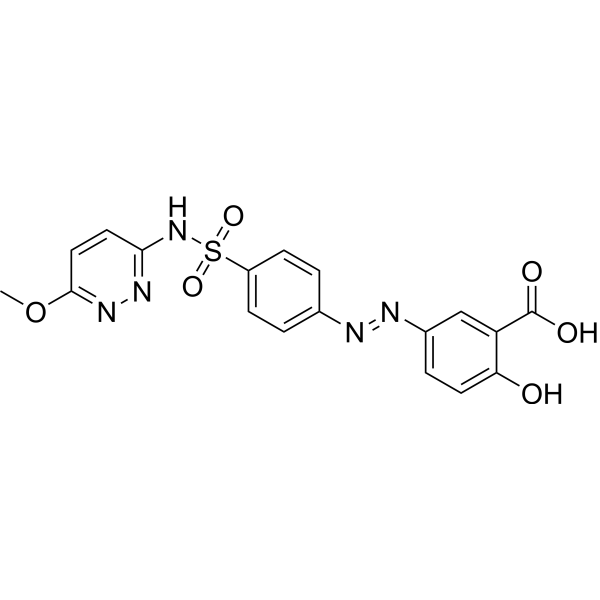
Salazopyridazine is an antibacterial agent. Salazopyridazine shows activities against ulcerative colitis. Salazopyridazine can be used for the research of rheumatic diseases.
For research use only. We do not sell to patients.
- Purity : 97.03%
- CAS No.: 22933-72-8
- Formula: C18H15N5O6S
- Molecular Weight:429.41
-
Storage:Powder -20°C, 3 years , 4°C, 2 years ; In solvent -80°C, 6 months , -20°C, 1 month

To place orders, for customer services and technical support, please contact: MedChemExpress USA
Tel: 609-228-6898 E-mail: [email protected] [email protected]


-
 Biological Activity
-
Chemical Information
-
Solvent & Solubility
- Protocols
- Purity & Documentation
- References
-
 Help & FAQs




Biological Activity
Description


Chemical Information
-
CAS No. 22933-72-8
-
Appearance Solid
-
Molecular Weight 429.41
-
Formula C18H15N5O6S
-
Color Yellow to orange
-
SMILES
O=C(C1=CC(/N=N/C2=CC=C(S(=O)(NC3=NN=C(C=C3)OC)=O)C=C2)=CC=C1O)O
-
Shipping
Room temperature in continental US; may vary elsewhere.
-
Storage
Powder -20°C 3 years 4°C 2 years In solvent -80°C 6 months -20°C 1 month


Solvent & Solubility
In Vitro:
DMSO : 125 mg/mL (291.10 mM; Need ultrasonic; Hygroscopic DMSO has a significant impact on the solubility of product, please use newly opened DMSO)
Please refer to the solubility information to select the appropriate solvent. Once prepared, please aliquot and store the solution to prevent product inactivation from repeated freeze-thaw cycles.
Storage method and period of stock solution: -80°C, 6 months; -20°C, 1 month. When stored at -80°C, please use it within 6 months. When stored at -20°C, please use it within 1 month.
Please refer to the solubility information to select the appropriate solvent. Once prepared, please aliquot and store the solution to prevent product inactivation from repeated freeze-thaw cycles.
Storage method and period of stock solution: -80°C, 6 months; -20°C, 1 month. When stored at -80°C, please use it within 6 months. When stored at -20°C, please use it within 1 month.
Concentration (start) × Volume (start) = Concentration (final) × Volume (final)

Protocols
-
Research Protocol for Infectious Diseases
Infectious-disease experiments test how pathogens interact with host barriers, innate immune receptors, inflammatory signaling, pathogen replication, and tissue injury; pattern-recognition receptors such as TLRs, RIG-I-like receptors, NOD-like receptors, and inflammasomes detect microbial molecules and activate NF-κB, interferon, and cytokine responses. The central hypothesis is that infection severity reflects the balance between pathogen burden and host response: protective inflammation restricts pathogen growth, whereas excessive or mislocalized inflammation contributes to tissue damage and disease phenotype. Unresolved questions include which host pathways are protective versus pathogenic, why some infection models fail to translate to human disease, and which combined readouts best predict clinically relevant infection outcomes.
-
DSS-Induced Colitis
Dextran sulfate sodium (DSS)-induced colitis is generated by administering DSS in mouse drinking water, producing epithelial injury, barrier disruption, weight loss, diarrhea, fecal blood, colon shortening, histologic mucosal damage, and inflammatory mediator changes; the model is mainly used to study acute or chronic intestinal inflammation resembling selected features of ulcerative colitis. DSS injury is interpreted through clinical and tissue readouts rather than a single molecular endpoint: daily body weight, stool consistency, and bleeding are combined into a disease activity index, while colon length, histology, cytokines, myeloperoxidase activity, intestinal permeability, and tight-junction markers provide complementary measures of inflammation and barrier damage.
-
TNBS-Induced Colitis
TNBS-induced colitis is produced by intrarectal delivery of 2,4,6-trinitrobenzene sulfonic acid in ethanol, where ethanol disrupts the mucosal barrier and TNBS haptenates colonic proteins, generating immune-mediated colonic inflammation with weight loss, diarrhea, ulceration, transmural injury, inflammatory-cell infiltration, and cytokine responses. The model is used as an experimental intestinal inflammation model with Crohn’s disease–like features, especially when Th1-type responses, IL-12–dependent inflammation, chronic relapsing inflammation, or fibrosis-related endpoints are studied.


Purity & Documentation
-
Data Sheet (270 KB)
-
SDS (251 KB)
- English - EN (251 KB)
- Français - FR (251 KB)
- Deutsch - DE (251 KB)
- Norwegian - NO (251 KB)
- Español - ES (251 KB)
- Swedish - SV (251 KB)
- Italian - IT (251 KB)
- Korean - KR (251 KB)
- Portuguese - PT (251 KB)
-
Handling Instructions (2659 KB)
References
[1]. Sigidin IaA. Institut Revmatizma RAMN i progress antirevmaticheskoĭ terapii [Institute of Rheumatology and progress of antirheumatic therapy]. Vestn Ross Akad Med Nauk. 1998;(12):7-9. [Content Brief]
[2]. Belohlavek D, et al. Entzündliche Darmerkrankungen Colitis ulcerose und M. Crohn. Frühdiagnose und Behandlung [Inflammatory intestinal diseases: ulcerative colitis and Crohn's disease. Early diagnosis and treatment]. Fortschr Med. 1976 Mar 4;94(7):358-62. [Content Brief]


Complete Stock Solution Preparation Table
Please refer to the solubility information to select the appropriate solvent. Once prepared, please aliquot and store the solution to prevent product inactivation from repeated freeze-thaw cycles.
Storage method and period of stock solution: -80°C, 6 months; -20°C, 1 month. When stored at -80°C, please use it within 6 months. When stored at -20°C, please use it within 1 month.
| Optional Solvent | Concentration Solvent Mass | 1 mg | 5 mg | 10 mg | 25 mg |
|---|---|---|---|---|---|
| DMSO | 1 mM | 2.3288 mL | 11.6439 mL | 23.2878 mL | 58.2194 mL |
| 5 mM | 0.4658 mL | 2.3288 mL | 4.6576 mL | 11.6439 mL | |
| 10 mM | 0.2329 mL | 1.1644 mL | 2.3288 mL | 5.8219 mL | |
| 15 mM | 0.1553 mL | 0.7763 mL | 1.5525 mL | 3.8813 mL | |
| 20 mM | 0.1164 mL | 0.5822 mL | 1.1644 mL | 2.9110 mL | |
| 25 mM | 0.0932 mL | 0.4658 mL | 0.9315 mL | 2.3288 mL | |
| 30 mM | 0.0776 mL | 0.3881 mL | 0.7763 mL | 1.9406 mL | |
| 40 mM | 0.0582 mL | 0.2911 mL | 0.5822 mL | 1.4555 mL | |
| 50 mM | 0.0466 mL | 0.2329 mL | 0.4658 mL | 1.1644 mL | |
| 60 mM | 0.0388 mL | 0.1941 mL | 0.3881 mL | 0.9703 mL | |
| 80 mM | 0.0291 mL | 0.1455 mL | 0.2911 mL | 0.7277 mL | |
| 100 mM | 0.0233 mL | 0.1164 mL | 0.2329 mL | 0.5822 mL |


Salazopyridazine Related Classifications
HY-145455 Related Classifications
 Powered by Bioz