



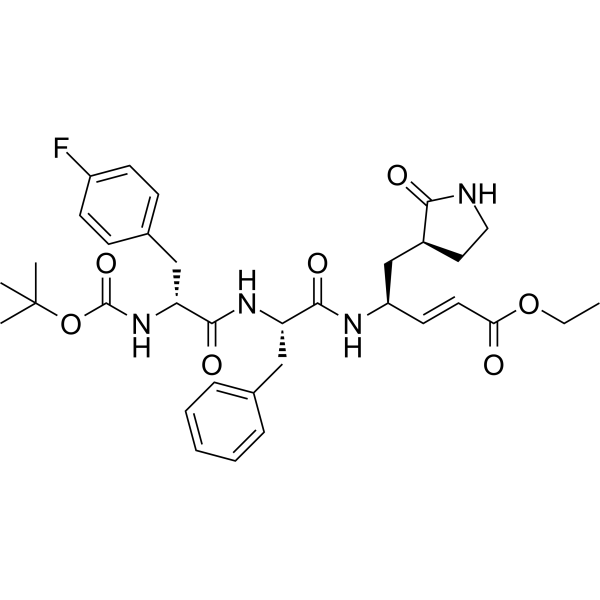
SARS-CoV-2 Mpro-IN-5
SARS-CoV-2 Mpro-IN-5 is a dual Inhibitor of Main Protease (MPro) and Cathepsin L (CatL), with IC50s of 1800 nM and 145 nM respectively. SARS-CoV-2 Mpro-IN-5 has antiviral activity against SARS-CoV2. SARS-CoV-2 Mpro-IN-5 blocks SARS-CoV2 replication in hACE2 expressing A549 cells with IC50 value of 14.7 nM.
Nur für Forschungszwecke. Wir verkaufen nicht an Patienten.
- CAS. Nr.: 3023276-79-8
- Formel: C34H43FN4O7
- Molecular Weight:638.73
-
Speicherung:
Please store the product under the recommended conditions in the Certificate of Analysis.

To place orders, for customer services and technical support, please contact: MedChemExpress USA
Tel: 609-228-6898 E-mail: [email protected] [email protected]


-
 Biologische Aktivität
-
Chemical Information
- Protokoll
- Reinheit & Dokumentation
- Verweise
-
 Help & FAQs




Biologische Aktivität
Beschreibung
IC50 & Target
MPro/CatL[1]
In Vitro
SARS-CoV-2 Mpro-IN-5 (SM142) blocks SARS-CoV2 replication in A549-hACE2 cells with IC50 value of 14.7 nM[1].
SARS-CoV-2 Mpro-IN-5 (0-50 μM, 24 h) cause cytotoxicity in A549-hACE2 cells[1].
SARS-CoV-2 Mpro-IN-5 inhibits OC-43 virus mRNA expression A549 cells[1].
SARS-CoV-2 Mpro-IN-5 inhibits SARS-CoV2 infection by inhibiting both MPro and CatL[1].
MedChemExpress (MCE) has not independently confirmed the accuracy of these methods. They are for reference only. Further protocols information, click here.
-
Cell Line:A549-hACE2 cells
-
Concentration:0, 0.1, 0.2, 2, 20, 50 μM
-
Incubation Time:24 h
-
Result:Dose-dependently inhibited cell viability, reduce by 15% at 50 μM.
In Vivo
SARS-CoV-2 Mpro-IN-5 (3 mg/kg, i.v.) shows a half-life of 2.1 h and high clearance of 18490 mL/min/kg in in male C57Bl/6 mice[1].
SARS-CoV-2 Mpro-IN-5 (10 mg/kg, p.o.) shows oral bioavailability of 37.5%[1].
MedChemExpress (MCE) has not independently confirmed the accuracy of these methods. They are for reference only.
-
Animal Model:K18-hACE2 transgenic mice[1]
-
Dosage:10 mg/kg (i.n.) or 25 mg/kg (i.p.)
-
Administration:Intranasal inhalation (i.n.), once daily for 3 days, prior to the infection; or Intraperitoneal injection (i.p.), twice daily for 5 days, postinfection administration.
-
Result:Prevented weight loss and prolonged survival.


Chemical Information
-
CAS. Nr. 3023276-79-8
-
Molecular Weight 638.73
-
Formel C34H43FN4O7
-
SMILES
O=C([C@H](NC(OC(C)(C)C)=O)CC1=CC=C(F)C=C1)N[C@H](C(N[C@@H](C[C@@H]2CCNC2=O)/C=C/C(OCC)=O)=O)CC3=CC=CC=C3
-
Versand
Room temperature in continental US; may vary elsewhere.
-
Speicherung
Please store the product under the recommended conditions in the Certificate of Analysis.

Protokoll
-
Research Protocol for Infectious Diseases
Infectious-disease experiments test how pathogens interact with host barriers, innate immune receptors, inflammatory signaling, pathogen replication, and tissue injury; pattern-recognition receptors such as TLRs, RIG-I-like receptors, NOD-like receptors, and inflammasomes detect microbial molecules and activate NF-κB, interferon, and cytokine responses. The central hypothesis is that infection severity reflects the balance between pathogen burden and host response: protective inflammation restricts pathogen growth, whereas excessive or mislocalized inflammation contributes to tissue damage and disease phenotype. Unresolved questions include which host pathways are protective versus pathogenic, why some infection models fail to translate to human disease, and which combined readouts best predict clinically relevant infection outcomes.
-
Cell Cytotoxicity Assay
Cytotoxicity assays are usually based on the assessment of cell membrane damage, which can also be indirectly detected by measuring cell viability. Detection methods include MTT assay, CKK-8 assay, LDH assay and ATP assay, etc.


Reinheit & Dokumentation
Verweise

Calculators
Konzentration (Stammlösung) × Volumen (Stammlösung) = Konzentration (Ziellösung) × Volumen (Ziellösung)


SARS-CoV-2 Mpro-IN-5 Related Classifications
HY-151901 Related Classifications
 Powered by Bioz