



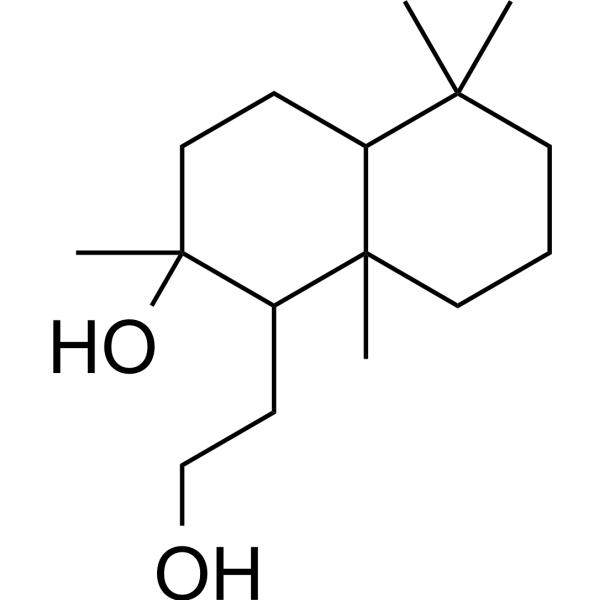
Sclareol glycol

Based on 1 Customer Validation
Sclareol glycol is a blood-brain barrier-permeable, reversible adenylate cyclase (AC) activator. Sclareol glycol induces dose-dependent changes in body temperature, regulates convulsive seizures and spontaneous activity. Sclareol glycol interacts with GABAergic transmission, thereby affecting dopamine-related behaviors. Sclareol glycol can be used in studies related to convulsive seizures, aggressive responses, thermoregulation, etc.
For research use only. We do not sell to patients.
- Purity : 98.0%
- CAS No.: 55881-96-4
- Formula: C16H30O2
- Molecular Weight:254.41
-
Storage:
4°C, protect from light
* In solvent : -80°C, 6 months; -20°C, 1 month (protect from light)

To place orders, for customer services and technical support, please contact: MedChemExpress USA
Tel: 609-228-6898 E-mail: [email protected] [email protected]


-
 Biological Activity
-
Chemical Information
-
Solvent & Solubility
- Purity & Documentation
- References
-
 Help & FAQs




Biological Activity
Description
In Vitro
Sclareol glycol (1 μM) reversibly activates adenylate cyclase in rat brain tissue slices, increasing brain 3',5'-AMP availability[3].
Sclareol glycol (1 μM) increases 3',5'-AMP availability in rat anterior pituitary monolayer tissue cultures[3].
MedChemExpress (MCE) has not independently confirmed the accuracy of these methods. They are for reference only.
In Vivo
Sclareol glycol (5-100 mg/kg; i.p.; single administration) stimulates spontaneous activities in healthy mice. At the dose of 25 mg/kg, it exerts the strongest antagonistic effect on Reserpine (HY-N0480)-induced hypoactivity, and also produces the optimal enhancing effect on Apomorphine (HY-12723)-reduced motor capacity[4].
Sclareol glycol (5-100 mg/kg; intraperitoneal injection; single administration) enhances Apomorphine-induced stereotyped behaviors in mice[4].
Sclareol glycol (50 mg/kg; i.p.; once daily; for 7 consecutive days) significantly enhances the sensitivity of rats to Apomorphine-induced stereotyped behaviors[4].
Sclareol glycol (5-100 mg/kg; intraperitoneal injection; single administration) reduces Haloperidol (HY-14538)-induced catalepsy in rats at a dose of 5 mg/kg, exacerbates catalepsy at 50 mg/kg, and does not induce catalepsy when administered alone at any tested dose[4].
MedChemExpress (MCE) has not independently confirmed the accuracy of these methods. They are for reference only.
-
Animal Model:albino mice (male, 22-25 g, clonidine-induced aggressive behavior)[3]
-
Dosage:1 mg/kg; 5 mg/kg; 25 mg/kg; 50 mg/kg; 100 mg/kg
-
Administration:i.p.; single injection 10 minutes prior to clonidine
-
Result:Significantly reduced aggressive scores at 20, 30, and 40 minutes at 1 mg/kg.
Recorded total number of attacks as 26.0 at 1 mg/kg.
Recorded latency to first attack as 6.5 minutes at 1 mg/kg.
Significantly reduced aggressive scores at 10 minutes, 20 minutes, 30 minutes, and 40 minutes at 5 mg/kg.
Significantly reduced total number of attacks to 22.0 at 5 mg/kg.
Recorded latency to first attack as 7.2 minutes at 5 mg/kg.
Abolished aggressive responses at 50 minutes at 5 mg/kg.
Significantly increased latency to first attack to 9.2 minutes at 25 mg/kg.
Significantly reduced aggressive scores at 10 minutes, 20 minutes, and 30 minutes at 25 mg/kg.
Significantly reduced total number of attacks to 16.0 at 25 mg/kg.
Abolished aggressive responses at 40 and 50 minutes at 25 mg/kg.
Completely abolished all clonidine-induced aggressive responses at 50 mg/kg and 100 mg/kg.
Decreased spontaneous animal activity at 50 mg/kg and 100 mg/kg.
-
Animal Model:Male albino mice (20-25 g)[4]
-
Dosage:5 mg/kg; 25 mg/kg; 50 mg/kg; 100 mg/kg
-
Administration:i.p.; single dose
-
Result:Increased locomotor activity by 100% at 5 mg/kg over controls.
Increased locomotor activity at 25 and 50 mg/kg over controls.
Produced a significantly less pronounced stimulatory effect on locomotor activity at 100 mg/kg.
Increased locomotor activity by 25% in reserpine-pretreated mice at 25 mg/kg.
Produced a smaller increase in locomotor activity in reserpine-pretreated mice at 5 mg/kg.
Enhanced apomorphine-decreased motility by 25% at 25 mg/kg vs apomorphine-only controls.
Enhanced apomorphine-decreased motility by 8% at 5 mg/kg vs apomorphine-only controls.
-
Animal Model:Male albino mice (20-25 g)[4]
-
Dosage:5 mg/kg; 50 mg/kg; 100 mg/kg
-
Administration:i.p.; single dose
-
Result:Potentiated apomorphine-induced stereotypy at 5 mg/kg, with scores reaching 2 at 20-30 minutes, 2.17 at 40 minutes, and a maximum score of 3 after 30 minutes.
Produced the strongest potentiation of apomorphine-induced stereotypy at 50 mg/kg, with peak effects at 20-40 minutes.
Produced the strongest potentiation of apomorphine-induced stereotypy in both score intensity and duration at 100 mg/kg compared to controls.
-
Animal Model:Male Wistar rats (140-150 g)[4]
-
Dosage:50 mg/kg
-
Administration:i.p.; once daily; 7 days
-
Result:Augmented rats' sensitivity to apomorphine-induced stereotypy, with mean stereotypy scores reaching up to 3 by 50-60 minutes, which was significantly higher than control scores.
-
Animal Model:Male Wistar rats (140-150 g)[4]
-
Dosage:5 mg/kg; 25 mg/kg; 50 mg/kg; 100 mg/kg
-
Administration:i.p.; single dose
-
Result:Decreased haloperidol-induced catalepsy at 5 mg/kg compared to controls.
Did not significantly change haloperidol-induced catalepsy at 25 mg/kg.
Significantly increased haloperidol-induced catalepsy at 50 mg/kg at 120 minutes.
Did not induce catalepsy when administered alone at 5, 50, or 100 mg/kg.


Chemical Information
-
CAS No. 55881-96-4
-
Appearance Solid
-
Molecular Weight 254.41
-
Formula C16H30O2
-
Color White to off-white
-
SMILES
OCCC1C(C)(O)CCC2C(C)(C)CCCC12C
-
Structure Classification
-
Initial Source
Hyphozyma roseonigra ATCC 20624
-
Shipping
Room temperature in continental US; may vary elsewhere.
-
Storage
4°C, protect from light
* In solvent : -80°C, 6 months; -20°C, 1 month (protect from light)


Solvent & Solubility
In Vitro:
DMSO : 16.67 mg/mL (65.52 mM; Need ultrasonic; Hygroscopic DMSO has a significant impact on the solubility of product, please use newly opened DMSO)
Please refer to the solubility information to select the appropriate solvent. Once prepared, please aliquot and store the solution to prevent product inactivation from repeated freeze-thaw cycles.
Storage method and period of stock solution: -80°C, 6 months; -20°C, 1 month (protect from light). When stored at -80°C, please use it within 6 months. When stored at -20°C, please use it within 1 month.
Please refer to the solubility information to select the appropriate solvent. Once prepared, please aliquot and store the solution to prevent product inactivation from repeated freeze-thaw cycles.
Storage method and period of stock solution: -80°C, 6 months; -20°C, 1 month (protect from light). When stored at -80°C, please use it within 6 months. When stored at -20°C, please use it within 1 month.
Concentration (start) × Volume (start) = Concentration (final) × Volume (final)
In Vivo:
Select the appropriate dissolution method based on your experimental animal and administration route.
- For the following dissolution methods, please ensure to first prepare a clear stock solution using an In Vitro approach and then sequentially add co-solvents:
- To ensure reliable experimental results, the clarified stock solution can be appropriately stored based on storage conditions. As for the working solution for In Vivo experiments, it is recommended to prepare freshly and use it on the same day.
- The percentages shown for the solvents indicate their volumetric ratio in the final prepared solution. If precipitation or phase separation occurs during preparation, heat and/or sonication can be used to aid dissolution.
Add each solvent one by one: 10% DMSO 40% PEG300 5% Tween-80 45% Saline
Solubility: ≥ 1.67 mg/mL (6.56 mM); Clear solution
This protocol yields a clear solution of ≥ 1.67 mg/mL (saturation unknown).
Taking 1 mL working solution as an example, add 100 μL DMSO stock solution (16.7 mg/mL) to 400 μL PEG300, and mix evenly; then add 50 μL Tween-80 and mix evenly; then add 450 μL Saline to adjust the volume to 1 mL.
Preparation of Saline: Dissolve 0.9 g sodium chloride in ddH₂O and dilute to 100 mL to obtain a clear Saline solution.
Add each solvent one by one: 10% DMSO 90% (20% SBE-β-CD in Saline)
Solubility: ≥ 1.67 mg/mL (6.56 mM); Clear solution
This protocol yields a clear solution of ≥ 1.67 mg/mL (saturation unknown).
Taking 1 mL working solution as an example, add 100 μL DMSO stock solution (16.7 mg/mL) to 900 μL 20% SBE-β-CD in Saline, and mix evenly.
Preparation of 20% SBE-β-CD in Saline (4°C, storage for one week): 2 g SBE-β-CD powder is dissolved in 10 mL Saline, completely dissolve until clear.
In Vivo Dissolution Calculator
Please enter the basic information of animal experiments:
-
-
-
-
Recommended: Prepare an additional quantity of animals to account for potential losses during experiments.
Please enter your animal formula composition:
-
%DMSO +
Recommended: Keep the proportion of DMSO in working solution below 2% if your animal is weak.
-
%+
-
+%Tween-80 + +
-
%Saline +
The co-solvents required include: DMSO, . All of co-solvents are available by MedChemExpress (MCE). , Tween 80. All of co-solvents are available by MedChemExpress (MCE).
Working solution concentration: 0.22 mg/mL
Method for preparing stock solution: mg drug dissolved in μL DMSO. Stock solution concentration: mg/mL. * In solvent : -80°C, 6 months; -20°C, 1 month (protect from light)
1. Take μL DMSO stock solution;
2. Add μL .
μL , mix evenly;
3. Then add μL Tween 80, mix evenly;
4. Then add μL
Please ensure that the stock solution in the first step is dissolved to a clear state, and add co-solvents in sequence. You can use ultrasonic heating (ultrasonic cleaner, recommended frequency 20-40 kHz), vortexing, etc. to assist dissolution.


Purity & Documentation
-
Data Sheet (293 KB)
-
SDS (393 KB)
- English - EN (393 KB)
- Français - FR (393 KB)
- Deutsch - DE (393 KB)
- Norwegian - NO (393 KB)
- Español - ES (393 KB)
- Swedish - SV (393 KB)
- Italian - IT (393 KB)
- Korean - KR (393 KB)
- Portuguese - PT (393 KB)
-
Handling Instructions (2659 KB)
References
[1]. Georgieva J, et al. Effects of the diterpene sclareol glycol on body temperature in rats. Methods and findings in experimental and clinical pharmacology. 1989 Apr;11(4):277-80. [Content Brief]
[2].
Georgieva J. Effects of the diterpene sclareol glycol on convulsive seizures. Methods Find Exp Clin Pharmacol. 1989 May;11(5):335-40.
[Content Brief]
[3]. Georgieva JV, et al. Diterpene sclareol glycol inhibits clonidine-induced aggressive responses in mice. Pharmacology, biochemistry, and behavior. 1989 Nov;34(3):503-5. [Content Brief]
[4]. Georgieva JV, et al. Influences of diterpene sclareol glycol on some dopamine related behavior. General pharmacology. 1991;22(2):331-5. [Content Brief]


Complete Stock Solution Preparation Table
Please refer to the solubility information to select the appropriate solvent. Once prepared, please aliquot and store the solution to prevent product inactivation from repeated freeze-thaw cycles.
Storage method and period of stock solution: -80°C, 6 months; -20°C, 1 month (protect from light). When stored at -80°C, please use it within 6 months. When stored at -20°C, please use it within 1 month.
| Optional Solvent | Concentration Solvent Mass | 1 mg | 5 mg | 10 mg | 25 mg |
|---|---|---|---|---|---|
| DMSO | 1 mM | 3.9307 mL | 19.6533 mL | 39.3066 mL | 98.2666 mL |
| 5 mM | 0.7861 mL | 3.9307 mL | 7.8613 mL | 19.6533 mL | |
| 10 mM | 0.3931 mL | 1.9653 mL | 3.9307 mL | 9.8267 mL | |
| 15 mM | 0.2620 mL | 1.3102 mL | 2.6204 mL | 6.5511 mL | |
| 20 mM | 0.1965 mL | 0.9827 mL | 1.9653 mL | 4.9133 mL | |
| 25 mM | 0.1572 mL | 0.7861 mL | 1.5723 mL | 3.9307 mL | |
| 30 mM | 0.1310 mL | 0.6551 mL | 1.3102 mL | 3.2756 mL | |
| 40 mM | 0.0983 mL | 0.4913 mL | 0.9827 mL | 2.4567 mL | |
| 50 mM | 0.0786 mL | 0.3931 mL | 0.7861 mL | 1.9653 mL | |
| 60 mM | 0.0655 mL | 0.3276 mL | 0.6551 mL | 1.6378 mL |


Sclareol glycol Related Classifications
HY-N7007 Related Classifications
 Powered by Bioz
Keywords
- Sclareol glycol
- 55881-96-4
- Adenylate Cyclase
- dopamine autoreceptors
- clonidine-induced aggressive responses
- adenylate cyclase catalytic subunit
- male albino mice
- GABAergic transmission
- rat brain tissue slices
- dopamine receptors
- postsynaptic dopamine receptors
- rat anterior pituitary monolayer tissue cultures
- convulsive seizures
- Inhibitor
- inhibitor
- inhibit