



MB05032
Based on 7 publication(s) in Google Scholar
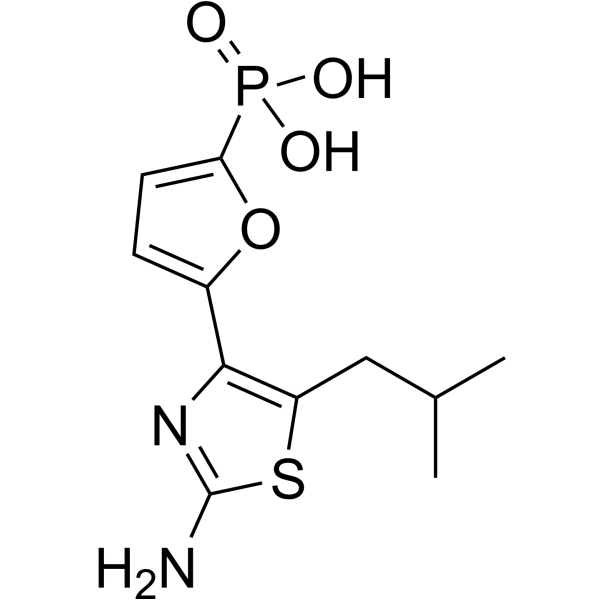
MB05032 is a fructose-1,6-bisphosphatase (FBP1/FBPase) inhibitor with an IC50 value of 16 nM. MB05032 blocks FBP1-mediated glycolysis inhibition in NK cells, restores NK cell glucose uptake, lactate production, degranulation, perforin production, and cytotoxicity against gastric cancer cells. MB05032 elevates ATP/ADP ratios, increases glucose utilization, and enhances insulin secretion in pancreatic β-cells. MB05032 increases neutrophil adhesion, phagocytosis, and mRNA abundance of HKII, ITGA9, CD36 in subclinically hypocalcemic dairy cows. MB05032 inhibits gluconeogenesis in hepatocytes, acts as the active metabolite of prodrug Managlinat dialanetil (MB06322) (HY-14955). MB05032 can be used for the research of gastric cancer, type 2 diabetes, subclinical hypocalcemia, and insulin resistance.
For research use only. We do not sell to patients.
- Purity : 99.63%
- CAS No.: 261365-11-1
- Formula: C11H15N2O4PS
- Molecular Weight:302.29
-
Storage:Powder -20°C, 3 years , 4°C, 2 years ; In solvent -80°C, 2 years , -20°C, 1 year

To place orders, for customer services and technical support, please contact: MedChemExpress USA
Tel: 609-228-6898 E-mail: [email protected] [email protected]


-
 Biological Activity
-
Chemical Information
-
Solvent & Solubility
- Protocols
- Purity & Documentation
- References
-
 Help & FAQs


Publications Citing Use of MedChemExpress (MCE) MB05032
More- Nat Med. 2018 Sep;24(9):1395-1406. [Abstract]
- Cell Metab. 2018 Aug 7;28(2):243-255.e5. [Abstract]
- EMBO Rep. 2024 Dec;25(12):5383-5407. [Abstract]
- Int Immunopharmacol. 2026 Jan 15:169:116012. [Abstract]
- J Dairy Sci. 2023 Oct;106(10):7131-7146. [Abstract]
- Mol Divers. 2026 May 14. [Abstract]
- Mol Cell Endocrinol. 2024 May 15:586:112195. [Abstract]


Biological Activity
Description
IC50 & Target
IC50: 16 nM (Human Liver FBPase)[1]
In Vitro
MB05032 (5 μM; 48 h) restores lactate production in NK92 cells exposed to GCMSCs-CM to levels comparable to untreated control NK92 cells[1].
MB05032 (100-500 μM; 60 min) enhances both basal insulin secretion at 1.1 mM glucose and glucose-stimulated insulin secretion at 11 mM glucose in MIN6 cells, with significant effects observed at concentrations of 100 μM and higher[2].
MB05032 (50-250 μM; 60 min) enhances both basal insulin secretion at 3.3 mM glucose and glucose-stimulated insulin secretion at 25 mM glucose in freshly isolated mouse pancreatic islets, with significant effects observed at concentrations of 100 μM and higher[2].
MB05032 (250 μM; 60 min) significantly enhances glucose utilization in freshly isolated mouse pancreatic islets at both 3.3 mM and 25 mM glucose[2].
MB05032 (range of concentrations) potently and selectively inhibits human liver FBPase (IC50 = 16 nM), human muscle FBPase (IC50 = 29 nM), and rat liver FBPase (IC50 = 61 nM), while showing no activity against multiple other AMP-binding enzymes[4].
MB05032 (range of concentrations; 15-30 min preincubation, 30-60 min incubation with substrates) inhibits gluconeogenesis in primary Sprague-Dawley rat hepatocytes (IC50 = 7.8 μM for lactate/pyruvate) and primary human hepatocytes (IC50 = 47.5 μM for [14C]lactate)[4].
MB05032 (200 μM; 24-72 h) reverses the 1α,25(OH)2D3-induced suppression of glucose uptake in human Vδ2 T cells[5].
MB05032 (5 μM; 48 h) restores perforin production in NK92 cells exposed to GCMSCs-CM to levels comparable to untreated control NK92 cells[1].
MB05032 (200 μM; 6-24 h) reverses the 1α,25(OH)2D3-mediated dephosphorylation of Akt and p38 MAPK in human Vδ2 T cells[5].
MB05032 (200 μM; 48 h) does not significantly alter the proliferation of human Vδ2 T cells, either alone or in combination with 1α,25(OH)2D3, over a 48-hour period[5].
MedChemExpress (MCE) has not independently confirmed the accuracy of these methods. They are for reference only.
-
Cell Line:NK92 cells, human gastric cancer HGC-27 cells
-
Concentration:5 μM
-
Incubation Time:48 h (NK92 cells incubation); 6 h (co-culture with HGC-27 cells)
-
Result:Restored NK92 cell cytotoxicity against HGC-27 cells from ~12% to ~28%, which was comparable to the DMSO control group (~26%) and significantly higher than the GCMSCs-CM-only group.
-
Cell Line:human Vδ2 T cells
-
Concentration:200 μM
-
Incubation Time:6, 10, 24 h
-
Result:Reversed the 1α,25(OH)2D3-induced decrease in phosphorylation of Akt (Ser473) and p38 MAPK (Thr180/Tyr182) in Vδ2 T cells, restoring phosphorylated protein levels to those seen in vehicle-treated cells.
-
Cell Line:human Vδ2 T cells
-
Concentration:200 μM
-
Incubation Time:48 h
-
Result:Did not significantly inhibit Vδ2 T cell proliferation over 48 h when treated alone or in combination with 1α,25(OH)2D3.
In Vivo
MB05032 (300 mg/kg; p.o.) produced via oral administration of prodrug MB06322 to fasted male ZDF rats elevates upstream gluconeogenic intermediates and reduces blood glucose by 50%, confirming FBPase as the target enzyme[4].
MB05032 (3-100 mg/kg; p.o.) produced via oral administration of prodrug MB06322 to young male ZDF rats with mild type 2 diabetes produces dose-dependent glucose lowering, with maximal activity at 100 mg/kg, and improves oral glucose tolerance by reducing blood glucose AUC0-t by 65% at 30 mg/kg without altering lactate, triglyceride, or insulin levels[4].
MB05032 (6-100 mg/kg; p.o.) produced via oral administration of prodrug MB06322 to aged male ZDF rats with overt type 2 diabetes produces dose-dependent glucose lowering, with maximal activity at 100 mg/kg, improves oral glucose tolerance by reducing blood glucose AUC0-t by 35% at 30 mg/kg, and causes modest lactate elevation at higher doses without altering triglyceride or insulin levels[4].
MedChemExpress (MCE) has not independently confirmed the accuracy of these methods. They are for reference only.
-
Animal Model:Zucker Diabetic Fatty (ZDF) (male, 10 weeks old, fasted for 6 h)[4]
-
Dosage:300 mg/kg (administered as prodrug MB06322)
-
Administration:p.o.
-
Result:Elevated liver intermediates upstream of FBPase 1.5- to 3.1-fold relative to vehicle-treated rats.
Reduced glucose levels by 41%.
Reduced blood glucose by 50% during the treatment period.
-
Animal Model:Zucker Diabetic Fatty (ZDF) (male, 8-9 weeks old, mild diabetes, basal insulin 7.7 ng/mL)[4]
-
Dosage:3 mg/kg; 6 mg/kg; 10 mg/kg; 30 mg/kg; 100 mg/kg (administered as prodrug MB06322)
-
Administration:p.o.
-
Result:Produced dose-dependent glucose lowering, with minimal activity at 6 mg/kg and maximal activity at 100 mg/kg.
Showed maximal glucose lowering 2.5-5 h after dosing, with no significant glucose differences remaining by 10 h.
Caused no increases in blood lactate, triglyceride, or insulin levels.
Reduced the 0-3 h AUC of blood glucose (normalized to baseline) by 65% relative to vehicle in glucose tolerance tests at 30 mg/kg, with no significant lactate elevation.
-
Animal Model:Zucker Diabetic Fatty (ZDF) (male, 12-13 weeks old, overt diabetes, basal insulin 0.65 ng/mL)[4]
-
Dosage:6 mg/kg; 10 mg/kg; 30 mg/kg; 100 mg/kg (administered as prodrug MB06322)
-
Administration:p.o.
-
Result:Produced dose-dependent glucose lowering, with minimal activity at 30 mg/kg and maximal activity at 100 mg/kg.
Showed maximal glucose lowering 2.5-5 h after dosing, with no significant glucose differences remaining by 10 h.
Increased lactate levels by 72% at 30 mg/kg and 78% at 100 mg/kg, with no significant changes in triglyceride or insulin levels.
Reduced the 0-3 h AUC of blood glucose (normalized to baseline) by 35% relative to vehicle in glucose tolerance tests at 30 mg/kg, with a 79% elevation in lactate levels.
-
Animal Model:C57BL/6J (male, high-fat diet-induced obesity)[5]
-
Dosage:5 mg/kg
-
Administration:i.p.; 3 times at 5-day intervals
-
Result:Showed no significant difference in glucose levels during GTT or ITT compared to vehicle-treated HFD-fed mice.
Elevated serum TNF-α levels significantly compared to NC mice and HFD mice treated with 1α,25(OH)2D3, but not significantly different from vehicle-treated HFD mice.
Reversed the glucose-lowering effect of 1α,25(OH)2D3 during GTT and ITT when combined with 1α,25(OH)2D3.
Restored serum TNF-α levels to levels similar to vehicle-treated HFD mice when combined with 1α,25(OH)2D3.


Chemical Information
-
CAS No. 261365-11-1
-
Appearance Solid
-
Molecular Weight 302.29
-
Formula C11H15N2O4PS
-
Color Off-white to yellow
-
SMILES
CC(C)CC1=C(C2=CC=C(P(O)(O)=O)O2)N=C(N)S1
-
Shipping
Room temperature in continental US; may vary elsewhere.
-
Storage
Powder -20°C 3 years 4°C 2 years In solvent -80°C 2 years -20°C 1 year


Publications (7)
-
Journal Impact Factor
-
Most Recent
-
Nat Med
2018 Sep;24(9):1395-1406. PMID: 30150719 -
Cell Metab
Dysfunction of Natural Killer Cells by FBP1-Induced Inhibition of Glycolysis during Lung Cancer Progression. [Abstract]2018 Aug 7;28(2):243-255.e5. PMID: 30033198 -
EMBO Rep
Glycogenesis and glyconeogenesis from glutamine, lactate and glycerol support human macrophage functions. [Abstract]2024 Dec;25(12):5383-5407. PMID: 39424955 -
Int Immunopharmacol
FBP1/HIF-1α Axis mediates macrophage metabolic reprogramming and serves as diagnostic biomarkers in atherosclerosis. [Abstract]2026 Jan 15:169:116012. PMID: 41386182 -
J Dairy Sci
Store-operated Ca2+ entry-sensitive glycolysis regulates neutrophil adhesion and phagocytosis in dairy cows with subclinical hypocalcemia. [Abstract]2023 Oct;106(10):7131-7146. PMID: 37164848 -
Mol Divers
Unraveling the molecular landscape and therapeutic strategies for acute kidney injury: insights from transcriptomics, network pharmacology, virtual screening, and in vitro experiments. [Abstract]2026 May 14. PMID: 42133161 -
Mol Cell Endocrinol
Excess homocysteine inhibits pancreatic β-cell secretory function by repressing Zbtb20 expression. [Abstract]2024 May 15:586:112195. PMID: 38432501


Solvent & Solubility
In Vitro:
DMSO : 50 mg/mL (165.40 mM; Need ultrasonic; Hygroscopic DMSO has a significant impact on the solubility of product, please use newly opened DMSO)
Please refer to the solubility information to select the appropriate solvent. Once prepared, please aliquot and store the solution to prevent product inactivation from repeated freeze-thaw cycles.
Storage method and period of stock solution: -80°C, 2 years; -20°C, 1 year. When stored at -80°C, please use it within 2 years. When stored at -20°C, please use it within 1 year.
Please refer to the solubility information to select the appropriate solvent. Once prepared, please aliquot and store the solution to prevent product inactivation from repeated freeze-thaw cycles.
Storage method and period of stock solution: -80°C, 2 years; -20°C, 1 year. When stored at -80°C, please use it within 2 years. When stored at -20°C, please use it within 1 year.
Concentration (start) × Volume (start) = Concentration (final) × Volume (final)
In Vivo:
Select the appropriate dissolution method based on your experimental animal and administration route.
- For the following dissolution methods, please ensure to first prepare a clear stock solution using an In Vitro approach and then sequentially add co-solvents:
- To ensure reliable experimental results, the clarified stock solution can be appropriately stored based on storage conditions. As for the working solution for In Vivo experiments, it is recommended to prepare freshly and use it on the same day.
- The percentages shown for the solvents indicate their volumetric ratio in the final prepared solution. If precipitation or phase separation occurs during preparation, heat and/or sonication can be used to aid dissolution.
Add each solvent one by one: 10% DMSO 40% PEG300 5% Tween-80 45% Saline
Solubility: ≥ 2.5 mg/mL (8.27 mM); Clear solution
This protocol yields a clear solution of ≥ 2.5 mg/mL (saturation unknown).
Taking 1 mL working solution as an example, add 100 μL DMSO stock solution (25.0 mg/mL) to 400 μL PEG300, and mix evenly; then add 50 μL Tween-80 and mix evenly; then add 450 μL Saline to adjust the volume to 1 mL.
Preparation of Saline: Dissolve 0.9 g sodium chloride in ddH₂O and dilute to 100 mL to obtain a clear Saline solution.
Add each solvent one by one: 10% DMSO 90% (20% SBE-β-CD in Saline)
Solubility: ≥ 2.5 mg/mL (8.27 mM); Clear solution
This protocol yields a clear solution of ≥ 2.5 mg/mL (saturation unknown).
Taking 1 mL working solution as an example, add 100 μL DMSO stock solution (25.0 mg/mL) to 900 μL 20% SBE-β-CD in Saline, and mix evenly.
Preparation of 20% SBE-β-CD in Saline (4°C, storage for one week): 2 g SBE-β-CD powder is dissolved in 10 mL Saline, completely dissolve until clear.
In Vivo Dissolution Calculator
Please enter the basic information of animal experiments:
-
-
-
-
Recommended: Prepare an additional quantity of animals to account for potential losses during experiments.
Please enter your animal formula composition:
-
%DMSO +
Recommended: Keep the proportion of DMSO in working solution below 2% if your animal is weak.
-
%+
-
+%Tween-80 + +
-
%Saline +
The co-solvents required include: DMSO, . All of co-solvents are available by MedChemExpress (MCE). , Tween 80. All of co-solvents are available by MedChemExpress (MCE).
Working solution concentration: 0.22 mg/mL
Method for preparing stock solution: mg drug dissolved in μL DMSO. Stock solution concentration: mg/mL.
1. Take μL DMSO stock solution;
2. Add μL .
μL , mix evenly;
3. Then add μL Tween 80, mix evenly;
4. Then add μL
Please ensure that the stock solution in the first step is dissolved to a clear state, and add co-solvents in sequence. You can use ultrasonic heating (ultrasonic cleaner, recommended frequency 20-40 kHz), vortexing, etc. to assist dissolution.


Purity & Documentation
-
Data Sheet (295 KB)
-
SDS (393 KB)
- English - EN (393 KB)
- Français - FR (393 KB)
- Deutsch - DE (393 KB)
- Norwegian - NO (393 KB)
- Español - ES (393 KB)
- Swedish - SV (393 KB)
- Italian - IT (393 KB)
- Korean - KR (393 KB)
- Portuguese - PT (393 KB)
-
Handling Instructions (2659 KB)
References
[1]. Han F, et al. Gastric cancer mesenchymal stem cells inhibit natural killer cell function by up-regulating FBP1. Central-European journal of immunology. 2021;46(4):427-437. [Content Brief]
[2]. Zhang Y, et al. Fructose-1,6-bisphosphatase regulates glucose-stimulated insulin secretion of mouse pancreatic beta-cells. Endocrinology. 2010 Oct;151(10):4688-95. [Content Brief]
[3]. Zhang B, et al. Store-operated Ca entry-sensitive glycolysis regulates neutrophil adhesion and phagocytosis in dairy cows with subclinical hypocalcemia. Journal of dairy science. 2023 Oct;106(10):7131-7146. [Content Brief]
[4]. Erion MD, et al. MB06322 (CS-917): A potent and selective inhibitor of fructose 1,6-bisphosphatase for controlling gluconeogenesis in type 2 diabetes. Proceedings of the National Academy of Sciences of the United States of America. 2005 May 31;102(22):7970-5. [Content Brief]
[5]. Li P, et al. 1α,25(OH)2D3 ameliorates insulin resistance by alleviating γδ T cell inflammation via enhancing fructose-1,6-bisphosphatase 1 expression. Theranostics. 2023 Sep 25;13(15):5290-5304. [Content Brief]


Complete Stock Solution Preparation Table
Please refer to the solubility information to select the appropriate solvent. Once prepared, please aliquot and store the solution to prevent product inactivation from repeated freeze-thaw cycles.
Storage method and period of stock solution: -80°C, 2 years; -20°C, 1 year. When stored at -80°C, please use it within 2 years. When stored at -20°C, please use it within 1 year.
| Optional Solvent | Concentration Solvent Mass | 1 mg | 5 mg | 10 mg | 25 mg |
|---|---|---|---|---|---|
| DMSO | 1 mM | 3.3081 mL | 16.5404 mL | 33.0808 mL | 82.7020 mL |
| 5 mM | 0.6616 mL | 3.3081 mL | 6.6162 mL | 16.5404 mL | |
| 10 mM | 0.3308 mL | 1.6540 mL | 3.3081 mL | 8.2702 mL | |
| 15 mM | 0.2205 mL | 1.1027 mL | 2.2054 mL | 5.5135 mL | |
| 20 mM | 0.1654 mL | 0.8270 mL | 1.6540 mL | 4.1351 mL | |
| 25 mM | 0.1323 mL | 0.6616 mL | 1.3232 mL | 3.3081 mL | |
| 30 mM | 0.1103 mL | 0.5513 mL | 1.1027 mL | 2.7567 mL | |
| 40 mM | 0.0827 mL | 0.4135 mL | 0.8270 mL | 2.0676 mL | |
| 50 mM | 0.0662 mL | 0.3308 mL | 0.6616 mL | 1.6540 mL | |
| 60 mM | 0.0551 mL | 0.2757 mL | 0.5513 mL | 1.3784 mL | |
| 80 mM | 0.0414 mL | 0.2068 mL | 0.4135 mL | 1.0338 mL | |
| 100 mM | 0.0331 mL | 0.1654 mL | 0.3308 mL | 0.8270 mL |


MB05032 Related Classifications
HY-16307 Related Classifications
 Powered by Bioz