196 Results for "

LSDs

" in MedChemExpress (MCE) Product Catalog:
Products (196)

196 Results for "LSDs" in MCE Product Catalog:

Cat. No.: HY-138830A
CAS No.: 1818253-48-3
Target:  

Histone Demethylase

Research Areas:  

Neurological Disease

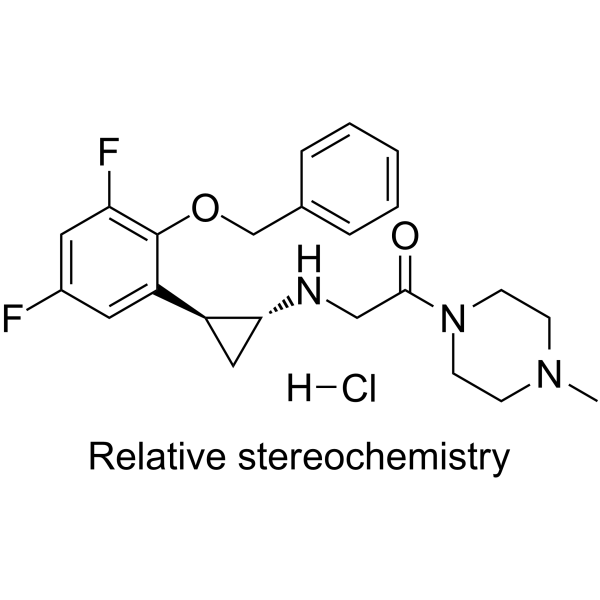
(S,S)-TAK-418 is a potent inhibitor of lysine-specific demethylase 1 (LSD1), demonstrating significant normalization of aberrant gene expression in neurodevelopmental disorders. (S,S)-TAK-418 also ameliorates ASD-like behaviors in rodent models affected by maternal exposure to valproate or poly I:C. (S,S)-TAK-418 modulates gene expression differently across various models and ages, indicating its potential as a therapeutic agent for conditions like autism spectrum disorder and schizophrenia.
loading...
    loading...
Cat. No.: HY-156202
CAS No.: 35750-48-2
Research Areas:  

Cancer

Geranylgeranoic acid (Compound 5) is inhibits lysine-specific demethylase 1 (LSD1) with an IC50 value of 46.97 µM. Geranylgeranoic acid induces apoptosis via loss of the mitochondrial membrane potential and activation of interleukin-1β-converting enzyme (ICE) and cysteine protease precursor 32 (CPP32) in Huh7 and PLC/PRF/5 human hepatoma cells and MLE-10 transformed mouse hepatocytes. Geranylgeranoic acid an isoprenoid with anticancer activity, which is found in S. chinensis .
loading...
    loading...
Cat. No.: HY-W743888
CAS No.: 65527-61-9
Synonyms: 6-Allyl-6-nor-LSD
Research Areas:  

Neurological Disease

AL-LAD is a 5-HT2A receptor ligand with rat Ki values of 8.1 nM and 3.4 nM. AL-LAD mediates behavioral responses characteristic of serotonergic psychedelics. AL-LAD induces the head-twitch response in male C57BL/6J mice in an inverted-U-shaped dose-dependent manner. AL-LAD exhibits LSD-like behavioral effects in male C57BL/6J mice .
loading...
    loading...
Cat. No.: HY-136523
CAS No.: 2262488-39-9
Purity:  98.44%
Research Areas:  

Cancer

S2157, a N-alkylated tranylcypromine (TCP) derivative, is a potent lysine-specific demethylase 1 (LSD1) inhibitor. S2157 increases H3K9 methylation and reciprocal H3K27 deacetylation at super-enhancer regions. S2157 induces apoptosis in TCP-resistant T-cell acute lymphoblastic leukemia (T-ALL) cells by repressing transcription of the NOTCH3 and TAL1 genes. S2157 efficiently pass through the blood-brain barrier and can almost completely eradicate CNS leukemia in mice transplanted with T-ALL cells .
loading...
    loading...
Cat. No.: HY-145259
CAS No.: 3023019-99-7
Purity:  ≥98.0%
Research Areas:  

Cancer

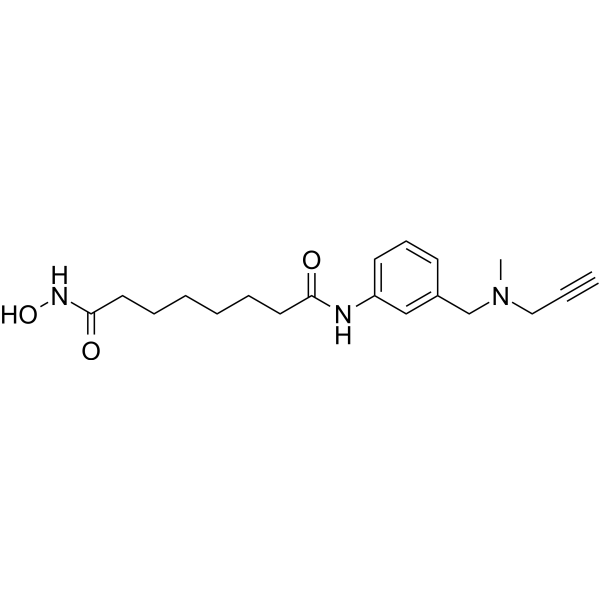
HDAC6-IN-3 (Compound 14), an antiprostate cancer agent, is a potent, orally active HDAC6 inhibitor with IC50s ranging from 0.02-1.54 μM for HDAC1/2/3/6/8/10. HDAC6-IN-3 is also an effective MAO-A (IC50=0.79 μM) and LSD1 inhibitor . HDAC6-IN-3 is a click chemistry reagent, it contains an Alkyne group and can undergo copper-catalyzed azide-alkyne cycloaddition (CuAAc) with molecules containing Azide groups.
loading...
    loading...
Cat. No.: HY-178825
Research Areas:  

Cancer

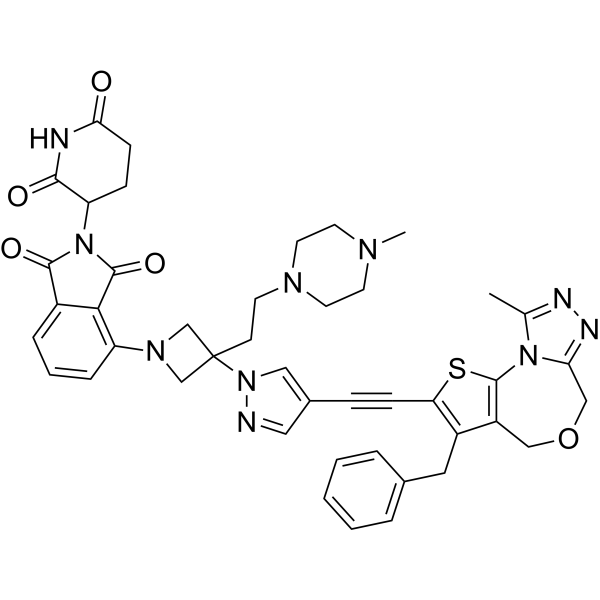
LD-110 is a PROTAC degrader targeting LSD1 with a DC50 of 0.44-1.24 μM. LD-110 acts through the CRBN E3 ubiquitin ligase and the ubiquitin-proteasome system, leading to H3K4me2 accumulation. LD-110 induces apoptosis and inhibits the growth and survival of multiple esophageal squamous cell carcinoma (ESCC) cell lines. LD-110 inhibits tumor growth in the KYSE-150 xenograft model. LD-110 can be used in research related to esophageal squamous cell carcinoma .
loading...
    loading...
Cat. No.: HY-178825B
Research Areas:  

Cancer

LD-110 trihydrochloride is a PROTAC degrader targeting LSD1 with a DC50 of 0.44-1.24 μM. LD-110 trihydrochloride acts through the CRBN E3 ubiquitin ligase and the ubiquitin-proteasome system, leading to H3K4me2 accumulation. LD-110 trihydrochloride induces apoptosis and inhibits the growth and survival of multiple esophageal squamous cell carcinoma (ESCC) cell lines. LD-110 trihydrochloride inhibits tumor growth in the KYSE-150 xenograft model. LD-110 trihydrochloride can be used in research related to esophageal squamous cell carcinoma .
loading...
    loading...
Cat. No.: HY-178825A
Research Areas:  

Cancer

LD-110 triTFA is a PROTAC degrader targeting LSD1 with a DC50 of 0.44-1.24 μM. LD-110 triTFA acts through the CRBN E3 ubiquitin ligase and the ubiquitin-proteasome system, leading to H3K4me2 accumulation. LD-110 triTFA induces apoptosis and inhibits the growth and survival of multiple esophageal squamous cell carcinoma (ESCC) cell lines. LD-110 triTFA inhibits tumor growth in the KYSE-150 xenograft model. LD-110 triTFA can be used in research related to esophageal squamous cell carcinoma .
loading...
    loading...
Cat. No.: HY-145815
CAS No.: 2669785-76-4
Target:  

PROTACs HDAC Apoptosis

Research Areas:  

Cancer

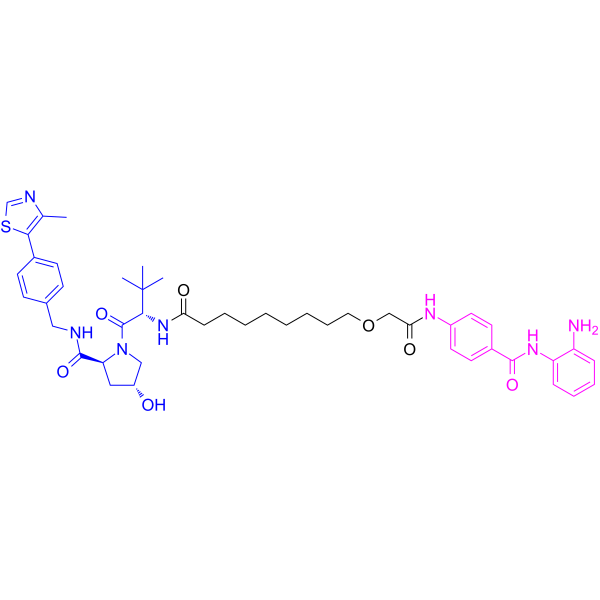
JPS014 is a PROTAC degrader targeting HDAC1, HDAC2 and HDAC3, with DC50 values of 0.91 μM, 4.19 μM and 0.64 μM, respectively. JPS014 recruits the VHL E3 ligase to mediate the ubiquitination and proteasomal degradation of HDAC1, HDAC2 and HDAC3. JPS014 acts as a submicromolar inhibitor of the HDAC1-CoREST, HDAC2-CoREST and HDAC3-SMRT complexes in vitro. JPS014 increases the level of H3K56ac, reduces the stability of LSD1 and SIN3A, and induces cell apoptosis (apoptosis). JPS014 can be used for the research of colon cancer .
loading...
    loading...
Cat. No.: HY-145815A
Purity:  98.40%
Target:  

PROTACs HDAC Apoptosis

Research Areas:  

Cancer

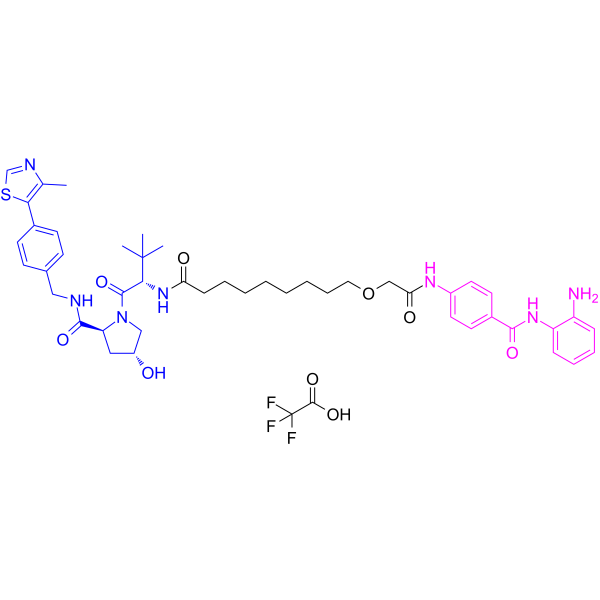
JPS014 TFA is a PROTAC degrader targeting HDAC1, HDAC2 and HDAC3, with DC50 values of 0.91 μM, 4.19 μM and 0.64 μM, respectively. JPS014 TFA recruits the VHL E3 ligase to mediate the ubiquitination and proteasomal degradation of HDAC1, HDAC2 and HDAC3. JPS014 TFA acts as a submicromolar inhibitor of the HDAC1-CoREST, HDAC2-CoREST and HDAC3-SMRT complexes in vitro. JPS014 TFA increases the level of H3K56ac, reduces the stability of LSD1 and SIN3A, and induces cell apoptosis (apoptosis). JPS014 TFA can be used for the research of colon cancer .
loading...
    loading...
Cat. No.: HY-B1018AS
CAS No.: 1219798-40-9
Phenelzine-d5 sulfate is the deuterium labeled Phenelzine sulfate (HY-B1018A). Phenelzine sulfate, an antidepressant agent, is an irreversible and orally active monoamine oxidase (MAO-A and MAO-B) inhibitor. Phenelzine sulfate inhibits GABA transaminase and primary amine oxidase (PrAO), and sequester reactive aldehydes. Phenelzine sulfate also inhibits LSD1 (Ki: 5.6 μM) and suppresses oxidative stress and lipogenesis. Phenelzine sulfate elevates neurotransmitters (serotonin, norepinephrine, dopamine). Phenelzine sulfate is studied in neurological, metabolic and cancer diseases for depression and anxiety disorders, stroke, spinal cord injury, traumatic brain injury, multiple sclerosis, Parkinson’s disease, Alzheimer’s disease, inflammatory pain, obesity and prostate cancer .
loading...
    loading...
Cat. No.: HY-N2037AR
CAS No.: 11041-94-4
Synonyms: Norcoclaurine hydrochloride (Standard)
Higenamine (hydrochloride) (Standard) is the analytical standard of Higenamine (hydrochloride). This product is intended for research and analytical applications. Higenamine hydrochloride is a selective LSD1 inhibitor (IC50=1.47 μM) that can be isolated from aconite. Higenamine hydrochloride has anti-inflammatory and antibacterial activity. Higenamine (Norcoclaurine) can attenuate IL-1β-induced Apoptosis through ROS-mediated PI3K/Akt signaling pathway. Higenamine hydrochloride protects brain cells from oxygen deprivation. Higenamine can promote bone formation in osteoporosis through the SMAD2/3 pathway. Higenamine hydrochloride can be used to study cancer, inflammation, cardiorenal syndrome and other diseases .
loading...
    loading...
Cat. No.: HY-N2037AS1
Synonyms: Norcoclaurine-d4-1 hydrochloride; Demethyl-Coclaurine-d4-1 hydrochloride
Higenamine-d4-1 (Norcoclaurine-d4-1) hydrochloride is deuterium labeled Higenamine (hydrochloride). Higenamine hydrochloride is a selective LSD1 inhibitor (IC50=1.47 μM) that can be isolated from aconite. Higenamine hydrochloride has anti-inflammatory and antibacterial activity. Higenamine (Norcoclaurine) can attenuate IL-1β-induced Apoptosis through ROS-mediated PI3K/Akt signaling pathway. Higenamine hydrochloride protects brain cells from oxygen deprivation. Higenamine can promote bone formation in osteoporosis through the SMAD2/3 pathway. Higenamine hydrochloride can be used to study cancer, inflammation, cardiorenal syndrome and other diseases .
loading...
    loading...
Cat. No.: HY-156208
CAS No.: 574738-16-2
Synonyms: AdaGalCer(d18:1/2:0); Admantanyl galactosylceramide (d18:1/2:0); Admantanyl galCer(d18:1/2:0)
C2 Adamantanyl galactosylceramide (AdaGalCer) (d18:1/2:0) is a bioactive sphingolipid. C2 Adamantanyl galactosylceramide (d18:1/2:0) stimulates glucocerebrosidase activity in vitro. C2 Adamantanyl galactosylceramide (d18:1/2:0) inhibits microsomal LacCer and Gb3 synthase, and inhibits cell sulfatide synthesis. C2 Adamantanyl galactosylceramide (d18:1/2:0) reduces glucosylceramide (GlcCer) levels in normal and lysosomal storage disease (LSD) cells. C2 Adamantanyl galactosylceramide (d18:1/2:0) acts as a substrate for A4GALT and is able to lower Gb3 levels with an IC50 concentration of 40 μM in fabry disease cells .
loading...
    loading...
Cat. No.: HY-149878
CAS No.: 3037514-38-5
Purity:  98.81%
Research Areas:  

Cancer

BD-9136 is a selective BRD4 PROTAC degrader with a DC50 of 1.2 nM, and exhibits a selectivity of ≥1000-fold over BRD2 and BRD3. BD-9136 preferentially forms a ternary complex with the BD1 domain of BRD4, and downregulates the expression of B7-H4 by disrupting the PR-P300-BRD4 axis. BD-9136 depletes BRD4 protein in tumor tissues, inhibits tumor growth, reduces B7-H4 protein expression, increases CD8+ T cell infiltration, and enhances tumor sensitivity to anti-PD-L1. Degradation of BRD4 by BD-9136 rescues the erythroid differentiation block induced by LSD1 inhibition, and transient administration restores erythroid output while retaining HbF induction. BD-9136 causes no adverse effects in mice at effective doses. BD-9136 can be used in studies related to acute myeloid leukemia, acute lymphoblastic leukemia and breast cancer .
loading...
    loading...
Cat. No.: HY-N2037R
CAS No.: 5843-65-2
Synonyms: Norcoclaurine (Standard); Demethyl-Coclaurine (Standard)
Higenamine (Norcoclaurine), a β2-AR agonist with antioxidant capability, is a key component of the Chinese herb aconite root that prescribes for treating symptoms of heart failure in the oriental Asian countries. Higenamine is also a α1-adrenergic receptor antagonist with hypotensive effect. is a selective LSD1 inhibitor (IC50=1.47 μM) that can be isolated from aconite. Higenamine hydrochloride has anti-inflammatory and antibacterial activity. Higenamine protects myocyte Apoptosis and ischemia/reperfusion (I/R) injury through selective activation of beta2-adrenergic receptor (β2-AR). Higenamine also reduces I/R-induced myocardial infarction in mice. Higenamine can attenuate IL-1β-induced Apoptosis through ROS-mediated PI3K/Akt signaling pathway. Higenamine protects brain cells from oxygen deprivation. Higenamine can promote bone formation in osteoporosis through the SMAD2/3 pathway. Higenamine can be used to study cancer, inflammation, cardiorenal syndrome and other diseases .
loading...
    loading...

