288 Results for "

ATP-binding

" in MedChemExpress (MCE) Product Catalog:
Products (288)

288 Results for "ATP-binding" in MCE Product Catalog:

Cat. No.: HY-123726
CAS No.: 231277-83-1
Target:  

EGFR

Research Areas:  

Cancer

ErbB-1/ErbB-2 tyrosine kinase-IN-1 is a dual ErbB-1/ErbB-2 tyrosine kinase inhibitor with IC50 values of 0.027 μM and 0.026 μM. ErbB-1/ErbB-2 tyrosine kinase-IN-1 targets the ATP binding region of ErbB-1 and ErbB-2 tyrosine kinases. ErbB-1/ErbB-2 tyrosine kinase-IN-1 inhibits cancer cells proliferation .
loading...
    loading...
Cat. No.: HY-15463S3
Synonyms: STI571-13C,d3; CGP-57148B-13C,d3
Imatinib- 13C,d3 (STI571- 13C,d3) is 13C labeled Imatinib. Imatinib (STI571) is an orally bioavailable tyrosine kinases inhibitor that selectively inhibits BCR/ABL, v-Abl, PDGFR and c-kit kinase activity. Imatinib (STI571) works by binding close to the ATP binding site, locking it in a closed or self-inhibited conformation, therefore inhibiting the enzyme activity of the protein semicompetitively . Imatinib also is an inhibitor of SARS-CoV and MERS-CoV .
loading...
    loading...
Cat. No.: HY-173511
Target:  

SARS-CoV

Research Areas:  

Infection

SARS-CoV-2 nsp13-IN-7 (Compound 6r) is a SARS-CoV-2 nsp13 inhibitor (IC50: 0.28 μM). SARS-CoV-2 nsp13-IN-7 interferes with the helicase function of nsp13 by binding to the 5' RNA site and ATP binding site of nsp13. SARS-CoV-2 nsp13-IN-7 can be used as a lead compound for the development of antiviral drugs targeting SARS-CoV-2 nsp13 .
loading...
    loading...
Cat. No.: HY-107779R
CAS No.: 1392429-79-6
Target:  

Reference Standards Raf

Research Areas:  

Cancer

BI-882370 (Standard) is the analytical standard of BI-882370 (HY-107779). This product is intended for research and analytical applications. BI-882370 is a potent and selective RAF Kinase inhibitor that binds to the ATP binding site of the Kinase positioned in the DFG-out (inactive) conformation of the BRAF Kinase. BI-882370 (BI 882370) inhibits the oncogenic BRAFV600E-mutant, the WT BRAF and CRAF Kinases with IC50s of 0.4, 0.8, and 0.6 nM, respectively. BI-882370 also inhibits SRC family Kinases .
loading...
    loading...
Cat. No.: HY-164399
CAS No.: 1799802-29-1
Target:  

HSP EGFR CDK Akt

Research Areas:  

Cancer

SST0116CL1 is a HSP90 inhibitor (IC50: 0.21 μM). SST0116CL1 binds to the ATP binding pocket of Hsp90, and interferes with Hsp90 chaperone function thus resulting in client protein (EGFR, CDK4 and AKT) degradation. SST0116CL1 induces degradation of Her2 in BT-474 cell (IC50: 0.2 μM). SST0116CL1 has antiproliferative activity and inhibits tumor growth. SST0116CL1 can be used for the study of leukemia, gastric and ovarian carcinoma .
loading...
    loading...
Cat. No.: HY-185227
CAS No.: 1394837-94-5
Research Areas:  

Cancer

EphB4-IN-1 is a selective EphB4 tyrosine kinase inhibitor with IC50 values of 0.16-0.30 μM. EphB4-IN-1 binds to the ATP binding site of EphB4 in a DFG-in conformation, forming four stable intermolecular hydrogen bonds. EphB4-IN-1 also inhibits Src, Abl1, Lck, and EGFR kinases. EphB4-IN-1 inhibits EphB4 autophosphorylation. EphB4-IN-1 can be used for the research of cancer, such as non small cell lung cancer .
loading...
    loading...
Cat. No.: HY-111974
CAS No.: 21414-42-6
Purity:  95.04%
Synonyms: ABA-GE; (S)-cis,trans-Abscisic acid glucosyl ester
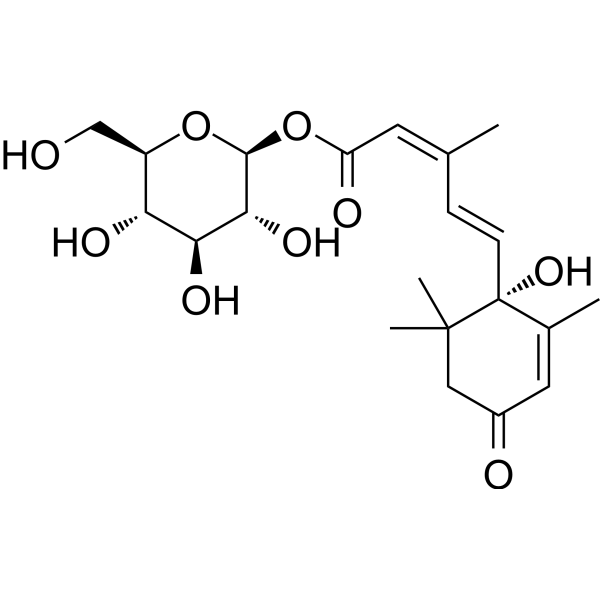
β-D-Glucopyranosyl abscisate (ABA-GE) is a hydrolyzable abscisic acid (ABA) conjugate that accumulates in the vacuole and presumably also in the endoplasmic reticulum. The deconjugation of β-D-Glucopyranosyl abscisate allows the rapid formation of free ABA in response to abiotic stress conditions such as dehydration and salt stress. β-D-Glucopyranosyl abscisate contributes to the maintenance of ABA homeostasis .
loading...
    loading...
Cat. No.: HY-169183
Target:  

Myosin

Research Areas:  

Others

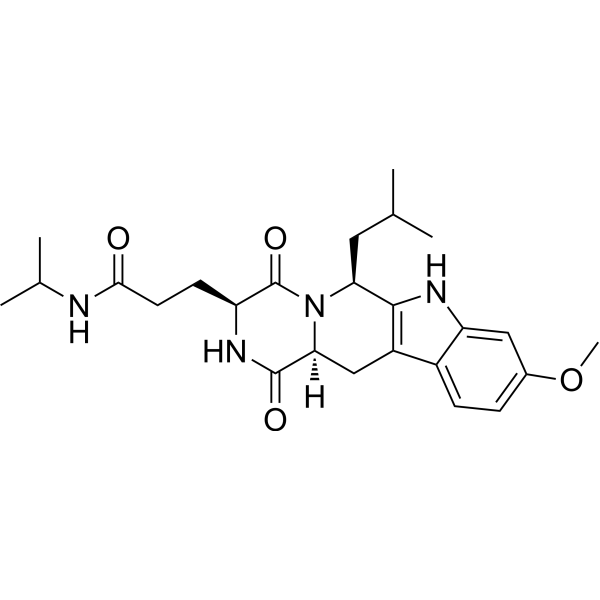
Myokinasib-II is a MLCK1 inhibitor with an IC50 of 4.4 μM. Myokinasib-II induces cell cortex softening, impairs cell migration capacity, induces multinucleation, reduces cell stiffness, alters membrane tether dynamics, decreases actomyosin tension and changes nuclear morphology. Myokinasib-II is a MLCK1 chemical biology probe with a unique structure that does not depolymerize tubulin and maintains cell viability even under high-concentration treatment in fibroblasts .
loading...
    loading...
Cat. No.: HY-11108R
CAS No.: 841290-80-0
R406 free base (Standard) is the analytical standard of R406 (free base) (HY-11108). This product is intended for research and analytical applications. R406 free base is an orally available and competitive Syk/FLT3 inhibitor for ATP binding with a Ki of 30 nM, potently inhibits Syk Kinase activity in vitro with an IC50 of 41 nM, measured at an ATP concentration corresponding to its Km value. R406 free base reduces immune complex-mediated inflammation . R406 free base also inhibits Lyn (IC50=63 nM) and Lck (IC50=37 nM) .
loading...
    loading...
Cat. No.: HY-160196
CAS No.: 2803470-63-3
Synonyms: GCN2 modulator-1
Research Areas:  

Cancer

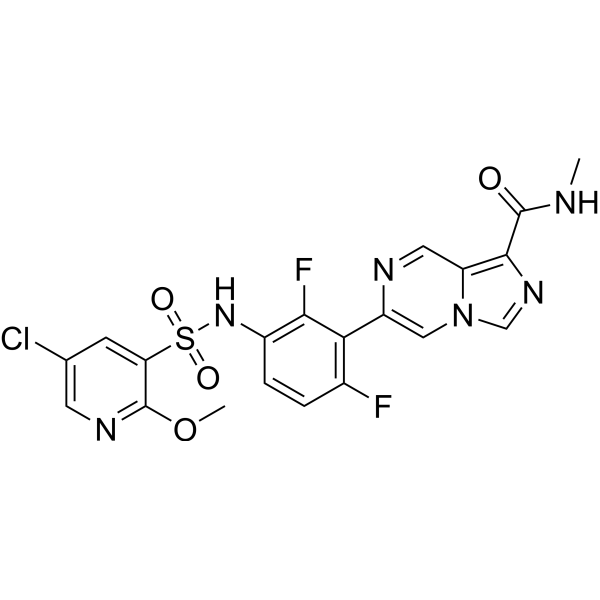
HC-7366 (GCN2 modulator-1) is an orally effective GCN2 activator. HC-7366 can effectively compete and occupy the ATP binding pocket of GCN2, with its IC50 being 72 nM. This binding triggers the conformational activation of GCN2, leading to the upregulation of downstream signals (such as ATF4, ASNS) in the integrated stress response (ISR) pathway, ultimately exerting anti-tumor effects. HC-7366 also has inhibitory activity against ZAK, with its IC50 being 47 nM. HC-7366 can be used for research on fibrosarcoma and acute myeloid leukemia .
loading...
    loading...
Cat. No.: HY-W152736
CAS No.: 33414-49-2
Target:  

DYRK

Research Areas:  

Neurological Disease

2-Methyl-5-acetylphenol is a hydroxylated methylacetophenone that exists in the aerial parts of Cannabis sativa subsp. sativa. 2-Methyl-5-acetylphenol exhibits strong binding affinity to HIPK2. 2-Methyl-5-acetylphenol cannot reverse MPP + (1-methyl-4-phenyl-pyridinium ion)-induced neuronal cytotoxicity. 2-Methyl-5-acetylphenol can be used for Parkinson's disease research .
loading...
    loading...
Cat. No.: HY-101513R
CAS No.: 2095486-67-0
eIF4A3-IN-1 (Standard) is the analytical standard of eIF4A3-IN-1 (HY-101513). This product is intended for research and analytical applications. eIF4A3-IN-1 is a selective eIF4A3 inhibitor (IC50: 0.26 μM; Kd: 0.043 μM) with cellular nonsense-mediated RNA decay (NMD) inhibitory activity. eIF4A3-IN-1 can specifically bind to the non-ATP binding site of eIF4A3. eIF4A3-IN-1 has anti-tumor and analgesic activities .
loading...
    loading...
Cat. No.: HY-P703279
Purity:  ≥ 80%, as determined by reducing SDS-PAGE.
Synonyms: ABCC5; Multi-Specific Organic Anion Transporter C; ATP binding Cassette Subfamily C Member 5; Multidrug Resistance-Associated Protein 5; MOAT-C; PABC11; MRP5; Canalicular Multispecific Organic Anion Transporter C; SMRP; ABCC5 Protein; EST277145; ABC33; AT
Species:  
Human
Source:  
HEK293
loading...
    loading...
Cat. No.: HY-103490R
CAS No.: 1111556-37-6
Synonyms: EDHS-206 (Standard)
Takinib (Standard) is the analytical standard of Takinib. This product is intended for research and analytical applications. Takinib (EDHS-206) is an orally active and selective TAK1 inhibitor (IC50=9.5 nM), more than 1.5 log more potent than the second and third ranked targets, IRAK4 (120 nM) and IRAK1 (390 nM), respectively. Takinib is an inhibitor of autophosphorylated TAK1 that non-competitively binds within the ATP binding pocket. Takinib induces apoptosis following TNFα stimulation in cell models of rheumatoid arthritis and metastatic breast cancer. Takinib is also a P. falciparum protein kinase 9 (PfPK9) inhibitor (KD(app) of 0.46 μM) .
loading...
    loading...
Cat. No.: HY-119831
CAS No.: 71294-60-5
Rohitukine is an orally active CDK9/T1 inhibitor with an IC50 of 0.3 μM. Rohitukine blocks ATP binding sites of CDK2/A and CDK9/T1, suppresses PPARγ, AKT, mTOR, C/EBPα, SREBP-2, and NF-κB signaling, and increases hepatic LXRα expression. Rohitukine induces S-phase cell cycle arrest, ROS generation, apoptosis, and exhibits anti-inflammatory activity. Rohitukine can be used for the research of leukemia, pancreatic cancer, prostate cancer, breast cancer, CNS cancer, ovarian cancer, lung cancer, dyslipidemia, inflammatory diseases, inflammatory bowel disease, and arthritis .
loading...
    loading...
Cat. No.: HY-164399A
CAS No.: 1202920-93-1
Target:  

HSP ERK CDK Akt

Research Areas:  

Cancer

SST0116CL1 free base is a HSP90 inhibitor (IC50: 0.21 μM). SST0116CL1 free base binds to the ATP binding pocket of Hsp90, and interferes with Hsp90 chaperone function thus resulting in client protein (EGFR, CDK4 and AKT) degradation. SST0116CL1 free base induces degradation of Her2 in BT-474 cell (IC50: 0.2 μM). SST0116CL1 free base has antiproliferative activity and inhibits tumor growth. SST0116CL1 free base has antiproliferative activity and inhibits tumor growth. SST0116CL1 free base can be used for the study of leukemia, gastric and ovarian carcinoma .
loading...
    loading...
Cat. No.: HY-155653
CAS No.: 2559759-59-8
Target:  

BCRP

Research Areas:  

Cancer

ABCG2-IN-2 is a potent ABCG2 inhibitor with favorable oral pharmacokinetic profiles in mice. ABCG2-IN-2 can be used for the research of tumor multidrug resistance (MDR) and erythropoietic protoporphyria (EPP) .
loading...
    loading...
Cat. No.: HY-183960
CAS No.: 890601-68-0
Target:  

ASK1

BPyO-34 is a selective inhibitor of apoptosis signal-regulating kinase 1 (ASK1), with an IC50 of 0.52 μM against human targets. BPyO-34 inhibits the activity of ASK1 in in vitro kinase assays. BPyO-34 can be used in research related to various diseases such as diabetes and cancer .
loading...
    loading...
Cat. No.: HY-184272
Target:  

SphK

Research Areas:  

Cancer

SphK2-IN-5 is a selective SphK2 inhibitor with an IC50 of 0.55 μM. SphK2-IN-5 exhibits anticancer activity against colon cancer and liver cancer .
loading...
    loading...
Cat. No.: HY-110079
CAS No.: 519178-28-0
Purity:  99.29%
Target:  

IPK Superfamily

Research Areas:  

Cancer

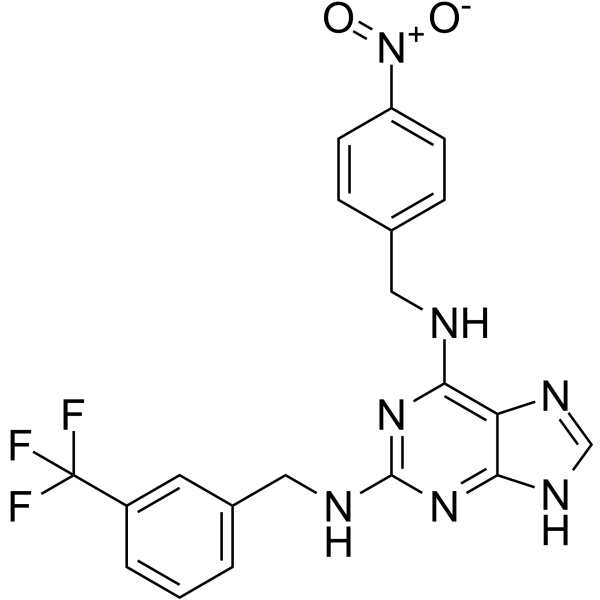
TNP is a competitive, reversible inhibitor of IP6K1 and IP3K, with IC50s of 0.55 μM and 10.2 μM for IP6K1 and IP3K, respectively. TNP competitively binds to the ATP binding site of IP6K, inhibits the generation of 5-IP7, and thus relieves the inhibition of 5-IP7 on the AKT signaling pathway. TNP can enhance insulin sensitivity and promote thermogenesis in adipose tissue. TNP cannot effectively pass through the blood-brain barrier and is mainly used in the study of obesity, type 2 diabetes, and metabolic syndrome. However, TNP also inhibits CYP3A4 and may need further optimization[1][2][3].
loading...
    loading...

