3318 Results for "

VAL

" in MedChemExpress (MCE) Product Catalog:
Products (3318)

3318 Results for "VAL" in MCE Product Catalog:

Cat. No.: HY-P11461
CAS No.: 105883-79-2
Synonyms: Biotin-corticotropin releasing factor
Target:  

Drug Derivative

Research Areas:  

Neurological Disease

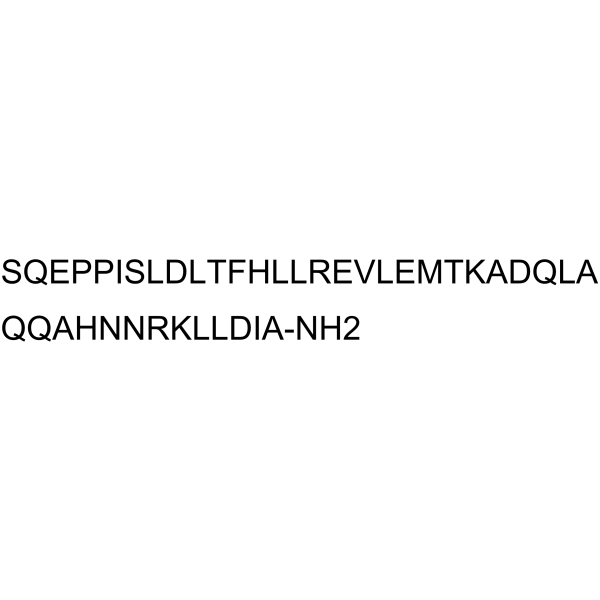
Biotin-CRF, human, rat is a biotin-conjugated CRF (human, rat). CRF (human, rat) is a corticotropin-releasing hormone, paraventricular hypothalamic nucleus marker .
loading...
    loading...
Cat. No.: HY-P11673
CAS No.: 2468152-46-5
Target:  

GLP Receptor

Research Areas:  

Metabolic Disease

Zabopegdutide is a glucagon and glucagon-like peptide 1 (GLP-1) receptor agonist. Zabopegdutide can be used for the study of obesity .
loading...
    loading...
Cat. No.: HY-P11945
Target:  

GLP Receptor

Research Areas:  

Metabolic Disease Cancer

NOTA-MAL-Cys39-Exendin-4 is an imaging agent and radiotracer precursor targeting GLP-1R. NOTA-MAL-Cys39-Exendin-4 binds specifically to GLP-1R and is rapidly cleared by the liver and spleen during the blood pool phase. NOTA-MAL-Cys39-Exendin-4 can be efficiently radiolabeled with gallium-68 to form a stable radiotracer with high radiochemical purity. NOTA-MAL-Cys39-Exendin-4 is applicable to research related to insulinomas .
loading...
    loading...
Cat. No.: HY-P1433
Target:  

Insulin Receptor

Research Areas:  

Metabolic Disease

[Pro3]-GIP (Rat) is a selective GIP receptor partial agonist with a Ki of 13 nM. [Pro3]-GIP (Rat) can be used in diabetes research .
loading...
    loading...
Cat. No.: HY-P1434
Target:  

Insulin Receptor

Research Areas:  

Metabolic Disease

[Pro3]-GIP (mouse) is a GIP receptor antagonist (IC50: 2.6 μM). [Pro3]-GIP (mouse) improves glucose tolerance and insulin sensitivity in ob/ob mice. [Pro3]-GIP (mouse) can be used for research of type 2 diabetes .
loading...
    loading...
Cat. No.: HY-P1533
CAS No.: 92307-52-3
Synonyms: Corticotropin Releasing Factor bovine
Target:  

CRFR

CRF, bovine is a potent agonist of CRF receptor, and displaces [ 125I-Tyr]ovine CRF with a Ki of 3.52 nM.
loading...
    loading...
Cat. No.: HY-P1542
CAS No.: 83930-33-0
Synonyms: Catostomus urotensin I
Target:  

CRFR

Urotensin I (Catostomus urotensin I), a CRF-like neuropeptide, acts as an agonist of CRF receptor with pEC50s of 11.46, 9.36 and 9.85 for human CRF1, human CRF2 and rat CRF receptors in CHO cells, and Kis of 0.4, 1.8, and 5.7 nM for hCRF1, rCRF and mCRF receptors, respectively .
loading...
    loading...
Cat. No.: HY-P1542B
Synonyms: Catostomus urotensin I TFA
Target:  

CRFR

Urotensin I (Catostomus urotensin I) TFA, a CRF-like neuropeptide, acts as an agonist of CRF receptor with pEC50s of 11.46, 9.36 and 9.85 for human CRF1, human CRF2 and rat CRF receptors in CHO cells, and Kis of 0.4, 1.8, and 5.7 nM for hCRF1, rCRF and mCRF receptors, respectively .
loading...
    loading...
Cat. No.: HY-P1871
CAS No.: 213779-12-5
Target:  

Amylin Receptor

Research Areas:  

Metabolic Disease

Amylin (IAPP), feline is a 37-amino acid polypeptide from feline. Amylin (IAPP), feline is one of the major secretory products of β-cells of the pancreatic islets. Amylin (IAPP), feline is a regulatory peptide, which inhibits insulin and glucagon secretion .
loading...
    loading...
Cat. No.: HY-P1871A
Target:  

Amylin Receptor

Research Areas:  

Metabolic Disease

Amylin (IAPP), feline TFA is a 37-amino acid polypeptide from feline. Amylin (IAPP), feline TFA is one of the major secretory products of β-cells of the pancreatic islets. Amylin (IAPP), feline TFA is a regulatory peptide, which inhibits insulin and glucagon secretion .
loading...
    loading...
Cat. No.: HY-P2315
CAS No.: 452274-53-2
Synonyms: HβD-1
Target:  

Antibiotic Bacterial

Research Areas:  

Infection

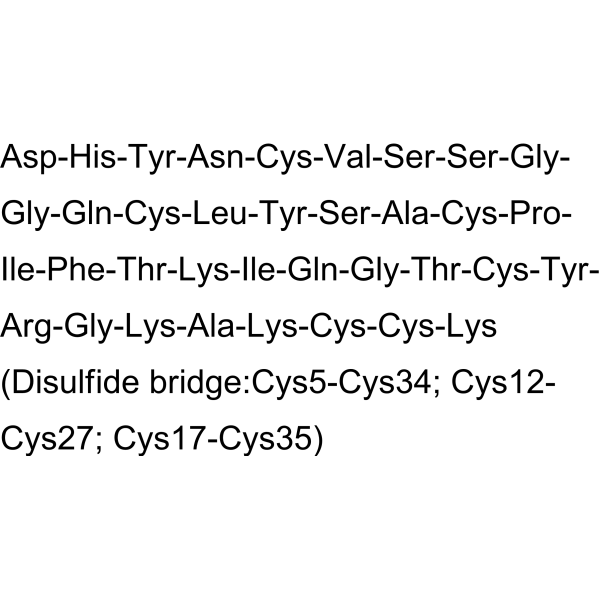
Human β-defensin-1 (HβD-1) is a cysteine-rich cationic skin-antimicrobial peptide (SAP) produced by all epithelial surfaces, but also by circulatory cells and cells of the reproductive tract. Human β-defensin-1 has antimicrobial activities against a broad-sperm bacteria .
loading...
    loading...
Cat. No.: HY-P3142
NMNNAGDKWSAFLKEQSTLAQMYPLQEIQNLTVKLQLQALQQ is an angiotensin-converting enzyme 2 (ACE2) related peptide that can be used as a tool for understanding ACE2 functions.
loading...
    loading...
Cat. No.: HY-P3247
CAS No.: 444073-04-5
Target:  

Insulin Receptor

[D-Ala2]-GIP (human) is a GIP receptor agonist (EC50 = 630 pM). [D-Ala2]-GIP (human) improves glucose tolerance. [D-Ala2]-GIP (human) shows neuroprotective activity in MPTP (HY-W114750)-induced Parkinson's disease model. [D-Ala2]-GIP (human) also improves cognitive function and hippocampal synaptic plasticity in obese diabetic rats. [D-Ala2]-GIP (human) can be used for research of type 2 diabetes, Parkinson's disease, etc
loading...
    loading...
Cat. No.: HY-P3491
CAS No.: 2420483-82-3
Synonyms: Polyethylene glycol loxenatide; PEX 168
Pegloxenatide (Polyethylene glycol loxenatide) is a long-acting glucagon-like peptide-1 receptor (GLP-1RA) agonist. Pegloxenatide has various activities such as lowering blood glucose, lowering blood lipids, improving body weight, anti-inflammation, promoting wound healing, protecting the liver, and protecting the heart. Pegloxenatide can be used in the research of type 2 diabetes and its multiple complications .
loading...
    loading...
Cat. No.: HY-P3538
CAS No.: 9015-71-8
Synonyms: CRH (Sheep)
Target:  

Inhibitory Antibodies

Research Areas:  

Neurological Disease

Corticotropin-releasing factor (CRH) (Sheep) is a brain-penetrant hypothalamic releasing factor and a peptide hormone with analgesic and arousal-inducing activity. Corticotropin-releasing factor (Sheep) mediates stress effects, including stress-induced analgesia. Corticotropin-releasing factor (Sheep) increases wakefulness, reduces slow wave sleep, alters EEG frequency content, stimulates ACTH and β-endorphin release, activates locomotor activity. Corticotropin-releasing factor (Sheep) can be used for the research of neurological disease .
loading...
    loading...
Cat. No.: HY-P3580
CAS No.: 299898-33-2
Synonyms: Human N-acetyl GIP
Target:  

Insulin Receptor

Research Areas:  

Metabolic Disease Endocrinology

Acetyl Gastric Inhibitory Peptide (human) is a fatty acid derivatized analog of glucose-dependent insulinotropic polypeptide with improved antihyperglycaemic and insulinotropic properties. Acetyl Gastric Inhibitory Peptide (human) can be used for research of diabetes, insulin resistance and obesity .
loading...
    loading...
Cat. No.: HY-P3580A
Synonyms: Human N-acetyl GIP TFA
Target:  

Insulin Receptor

Research Areas:  

Metabolic Disease Endocrinology

Acetyl Gastric Inhibitory Peptide (human) TFA is a fatty acid derivatized analog of glucose-dependent insulinotropic polypeptide with improved antihyperglycaemic and insulinotropic properties. Acetyl Gastric Inhibitory Peptide (human) TFA can be used for research of diabetes, insulin resistance and obesity .
loading...
    loading...
Cat. No.: HY-P3584
CAS No.: 299898-52-5
Synonyms: (Pro3) Gastric Inhibitory Peptide, human
Target:  

Insulin Receptor

Research Areas:  

Metabolic Disease

(Pro3) GIP, human ((Pro3) Gastric Inhibitory Peptide, human) is an efficacious, stable and specific human GIP receptor (hGIPR) full agonist. (Pro3) GIP, human has high binding affinity for human GIPR with Ki/ Kd values of 0.90 nM. (Pro3) GIP, human can be used for the research of obesity-related diabetes .
loading...
    loading...
Cat. No.: HY-P3584A
Synonyms: (Pro3) Gastric Inhibitory Peptide, human TFA
Target:  

Insulin Receptor

Research Areas:  

Metabolic Disease

(Pro3) GIP, human TFA is an efficacious, stable and specific human GIP receptor (hGIPR) full agonist. (Pro3) GIP, human TFA has high binding affinity for human GIPR with Ki/ Kd value of 0.90 nM. (Pro3) GIP, human TFA human can be used for the research of obesity-related diabetes .
loading...
    loading...
Cat. No.: HY-P3684A
Target:  

CRFR

Research Areas:  

Neurological Disease

[DPro5] Corticotropin Releasing Factor, human, rat TFA is a selective corticotropin releasing factor/hormone R2 (CRH-R2)agonist. [DPro5] Corticotropin Releasing Factor, human, rat TFA fails to cause the typical anxiogenic effect, but modulates learning and memory processes in rat .
loading...
    loading...