32 Results for "

cigarette

" in MedChemExpress (MCE) Product Catalog:
Products (32)

32 Results for "cigarette" in MCE Product Catalog:

Cat. No.: HY-W700491
CAS No.: 1189920-50-0
Synonyms: 2-Amino-α-carboline-15N3; AαC-15N3
AalphaC- 15N3 (2-Amino-α-carboline- 15N3) is 15N labeled AalphaC. AalphaC (AαC) is a potential carcinogen with carcinogenic activity. AalphaC is an important biomarker in tobacco smoke and is associated with tobacco smoke exposure. Urinary concentrations of AalphaC are significantly higher in dedicated smokers than in non-smokers, indicating its importance in monitoring tobacco exposure. AalphaC levels increase significantly with increasing serum nicotine levels, indicating its close relationship with tobacco use. In addition, consuming high-temperature cooked beef significantly increases the amount of AalphaC in urine, while consuming vegetables is associated with a decrease in AalphaC concentrations. Smoking half a pack of cigarettes is associated with a significant increase in the amount of AalphaC, which further confirms the biological activity of AalphaC and its association with dietary habits .
loading...
    loading...
Cat. No.: HY-15651S
Synonyms: AZD9668-13C,d3
Alvelestat- 13C,d3 (AZD9668- 13C,d3) is the deuterated, 13C-labeled Alvelestat (HY-15651). Alvelestat (AZD9668) is an orally active, selective inhibitor of neutrophil elastase. Alvelestat reduces elastase activity, myeloperoxidase release, neutrophil recruitment and activation, and calcium phosphate precipitation; promotes smooth muscle cell colonization and collagen deposition; and inhibits the formation of neutrophil extracellular traps (NETs) as well as NET-derived neutrophil elastase activity. Alvelestat restores endothelial dysfunction, regulates antioxidant factors, improves the expression of endothelial tight junctions, reduces vascular leakage, and accelerates wound healing. Alvelestat prevents pulmonary hemorrhage, matrix protein degradation, airspace enlargement, and small airway wall remodeling; and alleviates cigarette-induced inflammatory responses. Alvelestat inhibits the growth of abdominal aortic aneurysms exacerbated by Porphyromonas gingivalis. Alvelestat can be used in research related to chronic obstructive pulmonary disease, abdominal aortic aneurysm, radiation-induced skin injury, and bronchiectasis .
loading...
    loading...
Cat. No.: HY-W653722
CAS No.: 71267-22-6
Synonyms: (S)-N-NAT; (S)-N'-Nitrosoanatabine
Target:  

Drug Isomer

Research Areas:  

Cancer

(S) -N-Nitrosoanatabine ( (S) -N-NAT) is a potent carcinogen and biomarker of exposure to cigarette smoke. It′s found in a variety of tobacco products and oral snuff.
loading...
    loading...
Cat. No.: HY-145476S
CAS No.: 1020719-69-0
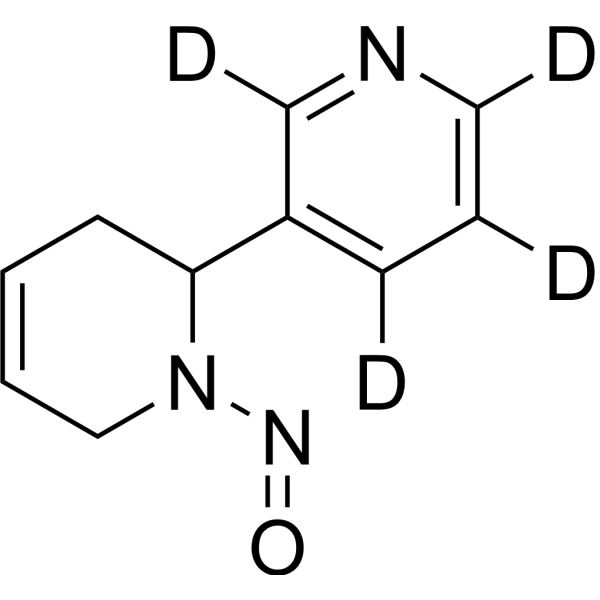
N-Nitrosoanatabine-d4 is the deuterium labeled N-Nitrosoanatabine (HY-145476). N-Nitrosoanatabine (N-NAT; N'-Nitrosoanatabine) is a tobacco-specific nitrosamine that exists in tobacco, tobacco products and e-cigarettes .
loading...
    loading...
Cat. No.: HY-118614R
CAS No.: 487-19-4
Research Areas:  

Neurological Disease

β-Nicotyrine (Standard) is the analytical standard of β-Nicotyrine. This product is intended for research and analytical applications. β-Nicotyrine is a metabolite of Nicotine.β-Nicotyrine, isolated from the leaves of Nicotiana tabacum plants and from cigarette smoke condensate, is a minor tobacco alkaloid .
loading...
    loading...
Cat. No.: HY-145476S2
Synonyms: N-NAT-d3; N'-Nitrosoanatabine-d3
N-Nitrosoanatabine-d3 (N-NAT-d3; N'-Nitrosoanatabine-d3) is the deuterium labeled N-Nitrosoanatabine (HY-145476). N-Nitrosoanatabine (N-NAT; N'-Nitrosoanatabine) is a tobacco-specific nitrosamine that exists in tobacco, tobacco products and e-cigarettes .
loading...
    loading...
Cat. No.: HY-W697750
CAS No.: 497-03-0
Synonyms: Tiglaldehyde
trans-2-Methyl-2-butenal (Tiglaldehyde) is an adduct former that can be found in cigarette smoke, and very weakly inhibits growth of cancer cells and normal mouse cells. trans-2-Methyl-2-butenal forms adducts with glutathione (GSH) via Michael addition.trans-2-Methyl-2-butenal is an α,β-unsaturated carbonyl compound .
loading...
    loading...
Cat. No.: HY-121621
CAS No.: 1123155-95-2
Target:  

Endogenous Metabolite

Research Areas:  

Inflammation/Immunology

RO5101576 is a potent LTB4 receptor antagonist with activity to inhibit LTB4-induced calcium mobilization and chemotaxis of human neutrophils. RO5101576 significantly attenuated LTB4-induced pulmonary eosinophilia in guinea pigs. RO5101576 inhibited allergen- and ozone-induced pulmonary neutrophilia in nonhuman primates with efficacy comparable to that of budesonide. RO5101576 had no effect on LPS-induced neutrophilia in guinea pigs and cigarette smoke-induced neutrophilia in mice and rats. RO5101576 performed well in toxicology studies and was well tolerated .
loading...
    loading...
Cat. No.: HY-135446
CAS No.: 141595-53-1
Target:  

Endothelin Receptor

BQ-610 is a selective antagonist of the endothelin A receptor (ETA receptor). BQ-610 specifically blocks the ETA receptor, competitively inhibiting the binding of endothelin-1 (ET-1) (a vasoconstrictive peptide) to the receptor, thereby blocking the effects of ET-1 such as vascular smooth muscle contraction, cell mitosis, and inhibition of hormone secretion. BQ-610 significantly alleviates cerebral vasospasm in rabbits. BQ-610 blocks the bronchial epithelial and pulmonary vascular cell proliferation caused by cigarette smoke in rat models. BQ-610 can delay the natural luteal regression in the cow's uterus. BQ-610 can be used for research on vasospasm, abnormal cell proliferation, and reproductive endocrine disorders .
loading...
    loading...
Cat. No.: HY-160844
CAS No.: 2417155-47-4
CT-133 is a selective and potent CRTH2 Receptor antagonist, with a Ki value of 2.2 nM. The Ki value for the DP1 receptor is greater than 3800 nM. CT-133 inhibits neutrophil migration induced by PGD2 (HY-101988). CT-133 significantly alleviates lung inflammation and improves lung function impairment in a mouse model of acute lung injury (ALI) induced by cigarette smoke. CT-133 effectively inhibits the excessive expression of pro-inflammatory cytokines (TNF-α, IL-1β, and IL-6) and chemokines (KC), and reverses the inhibition of the anti-inflammatory factor IL-10. CT-133 can be used for the study of ALI .
loading...
    loading...
Cat. No.: HY-181646
CAS No.: 3052591-16-6
PDE4-IN-34 is a phosphodiesterase 4 (PDE4) inhibitor, with IC50 values of 19 pM and 14 pM against PDE4B1 and PDE4D2, respectively. PDE4-IN-34 shows weak inhibitory activity against PDE8A1, with an IC50 value of 4.092 μM, and exhibits significant selectivity over other subtypes (IC50 > 10 μM). PDE4-IN-34 improves pulmonary function, reduces inflammatory responses and alleviates lung tissue damage in a rat model induced by cigarette smoke combined with LPS (HY-D1056). PDE4-IN-34 can be used for research related to chronic obstructive pulmonary disease .
loading...
    loading...
Cat. No.: HY-15651B
CAS No.: 1240425-11-9
Synonyms: AZD9668 hydrochloride
Alvelestat hydrochloride (AZD9668 hydrochloride) is an orally active, selective inhibitor of neutrophil elastase. Alvelestat hydrochloride reduces elastase activity, myeloperoxidase release, neutrophil recruitment and activation, and calcium phosphate precipitation; promotes smooth muscle cell colonization and collagen deposition; and inhibits the formation of neutrophil extracellular traps (NETs) as well as NET-derived neutrophil elastase activity. Alvelestat hydrochloride restores endothelial dysfunction, regulates antioxidant factors, improves the expression of endothelial tight junctions, reduces vascular leakage, and accelerates wound healing. Alvelestat hydrochloride prevents pulmonary hemorrhage, matrix protein degradation, airspace enlargement, and small airway wall remodeling; and alleviates cigarette-induced inflammatory responses. Alvelestat hydrochloride inhibits the growth of abdominal aortic aneurysms exacerbated by Porphyromonas gingivalis. Alvelestat hydrochloride can be used in research related to chronic obstructive pulmonary disease, abdominal aortic aneurysm, radiation-induced skin injury, and bronchiectasis .
loading...
    loading...

