45 Results for "

rigid

" in MedChemExpress (MCE) Product Catalog:
Products (45)

45 Results for "rigid" in MCE Product Catalog:

Cat. No.: HY-W763591C
CAS No.: 24991-55-7
Polyethylene Glycol dimethyl ether (MW=1000) is a polyethylene glycol derivative that can be used to prepare rigid gel electrolytes .
loading...
    loading...
Cat. No.: HY-W763591A
CAS No.: 24991-55-7
Polyethylene glycol dimethyl ether (MW=250) is a polyethylene glycol derivative that can be used to prepare rigid gel electrolytes and serve as a plasticizer .
loading...
    loading...
Cat. No.: HY-D2971
CAS No.: 2781892-92-8
NCIC-VIS is a lysosome-targeted, viscosity-sensitive two-photon near-infrared fluorescent probe. NCIC-VIS has a rigid structure that can restrict molecular torsion, thereby increasing the fluorescence quantum yield and two-photon absorption cross-section. NCIC-VIS enables real-time imaging of the autophagy process in cells .
loading...
    loading...
Cat. No.: HY-176731
Target:  

P2X Receptor

Research Areas:  

Neurological Disease

MSK-9 is a positive allosteric modulator of the P2X4 receptor with dual activities of enhancing ion conductance and delaying receptor inactivation. MSK-9 stabilizes the open state of the P2X4 receptor through rigid 3-piperidinyl and hydrophobic menthyl substituents. MSK-9 can be used in the study of multiple sclerosis (MS) .
loading...
    loading...
Cat. No.: HY-W763591D
CAS No.: 24991-55-7
Polyethylene Glycol dimethyl ether (MW=2000) is a polyethylene glycol derivative that can be used to prepare rigid gel electrolytes .
loading...
    loading...
Cat. No.: HY-N7106S1
CAS No.: 85448-30-2
Synonyms: DMP-d6
Research Areas:  

Others

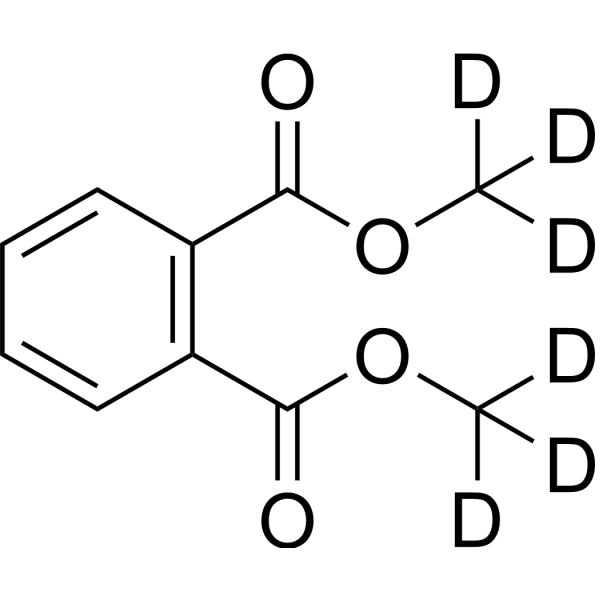
Dimethyl phthalate-d6 is the deuterium labeled Dimethyl phthalate. Dimethyl phthalate, a known endocrine disruptor and one of the phthalate esters (PAEs), is a ubiquitous pollutant. Dimethyl phthalate is commonly used as a plasticizer to impart flexibility to rigid polyvinylchloride (PVC) resins .
loading...
    loading...
Cat. No.: HY-N7106S
CAS No.: 93951-89-4
Synonyms: DMP (Ring-d4)
Research Areas:  

Others

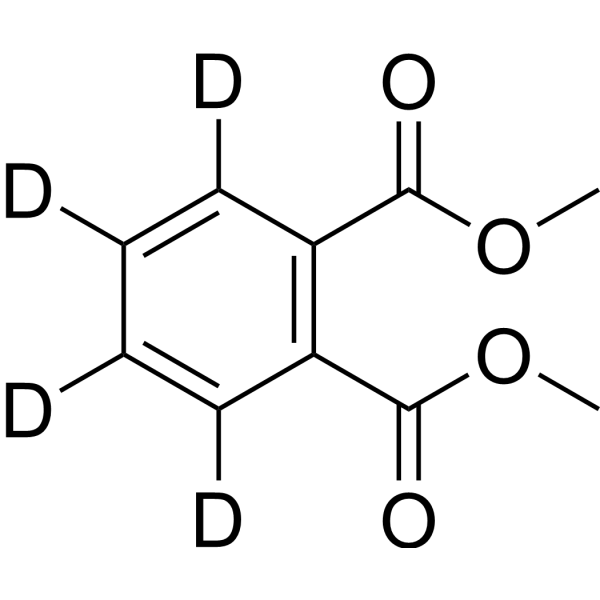
Dimethyl phthalate (Ring-d4) is the deuterium labeled Dimethyl phthalate. Dimethyl phthalate, a known endocrine disruptor and one of the phthalate esters (PAEs), is a ubiquitous pollutant. Dimethyl phthalate is commonly used as a plasticizer to impart flexibility to rigid polyvinylchloride (PVC) resins .
loading...
    loading...
Cat. No.: HY-116222
CAS No.: 115103-48-5
Target:  

Fluorescent Dye

Research Areas:  

Endocrinology

A 53693 is a rigid catecholamine with selective adrenergic agonist activity. A 53693 has affinity for certain rat alpha-2 receptor subtypes. A 53693 shows high selectivity for alpha-2 receptors and, in contrast, has low affinity for alpha-1 receptors. A 53693 is used as a probe in biological studies to explore the molecular interactions of alpha agonist compounds .
loading...
    loading...
Cat. No.: HY-N7106S3
Synonyms: DMP-13C6
Dimethyl phthalate- 13C6 (DMP- 13C6) is the 13C-labeled Dimethyl phthalate (HY-N7106). Dimethyl phthalate (DMP) can be used as a plasticizer to impart flexibility to rigid polyvinyl chloride (PVC) resin. Additionally, Dimethyl phthalate is an oral active endocrine disruptor that can cause ovarian dysfunction in mice. Dimethyl phthalate can also induce oxidative stress and apoptosis in cells, thereby affecting blood and red blood cell function in rats .
loading...
    loading...
Cat. No.: HY-W778335
CAS No.: 1346598-73-9
Synonyms: DMP-13C2
Dimethyl Phthalate- 13C2 (DMP- 13C2) is the 13C-labeled Dimethyl phthalate (HY-N7106). Dimethyl phthalate (DMP) can be used as a plasticizer to impart flexibility to rigid polyvinyl chloride (PVC) resin. Additionally, Dimethyl phthalate is an oral active endocrine disruptor that can cause ovarian dysfunction in mice. Dimethyl phthalate can also induce oxidative stress and apoptosis in cells, thereby affecting blood and red blood cell function in rats .
loading...
    loading...
Cat. No.: HY-133675S
CAS No.: 866864-06-4
Synonyms: MECPP-d4
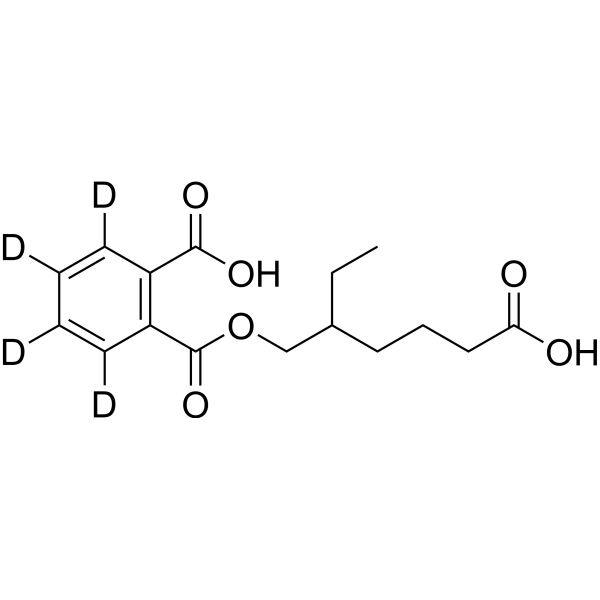
Mono(5-carboxy-2-ethylpentyl) phthalate-d4 (MECPP-d4) is a deuterium labeled Mono(5-carboxy-2-ethylpentyl) phthalate (HY-133675). Mono(5-carboxy-2-ethylpentyl) phthalate (MECPP) is a metabolite of Di-(2-ethylhexyl) phthalate (DEHP). Di(2-ethylhexyl) phthalate is the predominant plasticizer added to rigid polyvinyl chloride (PVC) to impart flexibility, temperature tolerance, optical clarity, strength and resistance to kinking .
loading...
    loading...
Cat. No.: HY-N7106S2
Synonyms: DMP-13C6,d4
Dimethyl phthalate- 13C6,d4 (DMP- 13C6,d4) is the deuterium labeled and 13C-labeled Dimethyl phthalate (HY-N7106). Dimethyl phthalate (DMP) can be used as a plasticizer to impart flexibility to rigid polyvinyl chloride (PVC) resin. Additionally, Dimethyl phthalate is an oral active endocrine disruptor that can cause ovarian dysfunction in mice. Dimethyl phthalate can also induce oxidative stress and apoptosis in cells, thereby affecting blood and red blood cell function in rats .
loading...
    loading...
Cat. No.: HY-P10669
CAS No.: 2999646-19-2
Target:  

Caspase Apoptosis

Research Areas:  

Cancer

NDI-Lyso is a lysosome-targeted anticancer agent that induces the formation of rigid long fibers in cancer cell lysosomes through an enzyme-instructed self-assembly (EISA) mechanism catalyzed by cathepsin B. This process triggers lysosomal swelling, membrane permeabilization (LMP), and membrane disruption, ultimately leading to cancer cell apoptosis via a non-classical caspase-independent pathway. NDI-Lyso exhibits significant selective anticancer activity in various cancer cell lines and drug-resistant cancer cells (IC50 ~10 μM) while showing low toxicity to normal cells (IC50 > 60 μM) .
loading...
    loading...
Cat. No.: HY-W709755
Synonyms: MECPP-d9
Mono(5-carboxy-2-ethylpentyl) phthalate-d9 (MECPP-d9) is the deuterium labeled Mono(5-carboxy-2-ethylpentyl) phthalate (HY-133675). Mono(5-carboxy-2-ethylpentyl) phthalate (MECPP) is a metabolite of Di-(2-ethylhexyl) phthalate (DEHP). Di(2-ethylhexyl) phthalate is the predominant plasticizer added to rigid polyvinyl chloride (PVC) to impart flexibility, temperature tolerance, optical clarity, strength and resistance to kinking .
loading...
    loading...
Cat. No.: HY-78985S
CAS No.: 62790-27-6
Synonyms: Trimesic acid-d3
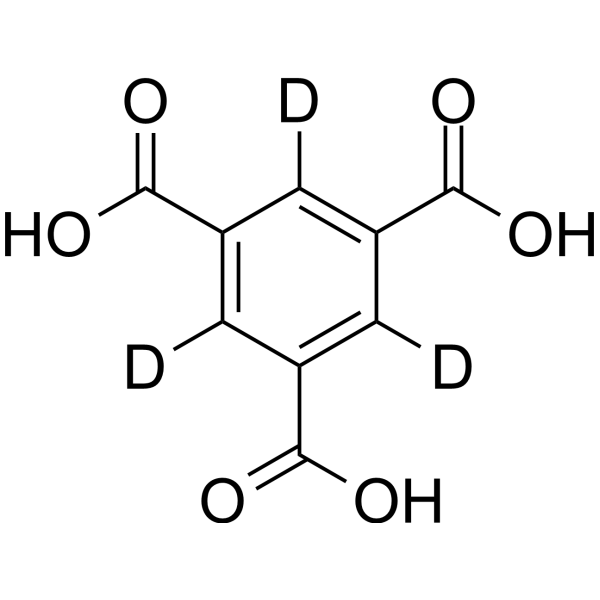
Benzene-1,3,5-tricarboxylic acid-d3 (Trimesic acid-d3) is the deuterium labeled Benzene-1,3,5-tricarboxylic acid (HY-78985). Benzene-1,3,5-tricarboxylic acid (Trimesic acid) is a rigid planar small-molecule scaffold and crosslinker. Benzene-1,3,5-tricarboxylic acid induces bicyclic peptides to adopt a planar conformation, so as to maximize surface area and bind to the flat protein surfaces involved in protein-protein interactions. Benzene-1,3,5-tricarboxylic acid forms ionic crosslinks, hydrogen bonds and π-π bonds with chitosan, thereby constructing a hydrogel network. Benzene-1,3,5-tricarboxylic acid endows chitosan hydrogel systems with specific mechanical properties, enabling sustained release of cancer therapeutic drugs including 5-Fluorouracil (HY-90006) .
loading...
    loading...
Cat. No.: HY-P6299A
MAX8 is a peptide made up of 20 residues that can fold and self-assemble under the influence of DMEM, forming a mechanically rigid hydrogel, this allows cells to be evenly immersed in the gel when the gelation is triggered in the presence of cells .
loading...
    loading...
Cat. No.: HY-W703578
CAS No.: 87818-31-3
Target:  

Herbicide

Research Areas:  

Others

Cinmethylin is a herbicide. Cinmethylin inhibits plant fatty acid biosynthesis. Cinmethylin reduces the emergence rate and above-ground biomass of rigid ryegrass. Cinmethylin kills weeds by inhibiting cell division at root meristems. Cinmethylin exhibits activity against paddy field weeds including Echinochloa crus-galli (L.) var. formosensis and Scirpus juncoides var. ohwianus. Cinmethylin is applicable to agricultural herbicide research .
loading...
    loading...
Cat. No.: HY-L951
505 compounds

Macrocyclic scaffolds are increasingly valued in modern drug discovery for their exceptional activity against undruggable targets (proteases, kinases, PPIs). 2026 marks a key commercial breakthrough for oral macrocyclic peptides: enlicitide, the world’s first oral PCSK9 macrocyclic peptide, has received FDA approval. Macrocyclic candidates targeting KRAS and other classic undruggable targets have also entered clinical development, validating macrocyclization as an effective strategy to overcome druggability barriers.

Two core R&D directions lead current macrocyclic drug design: AI-driven de novo generation and structural optimization of small-molecule macrocycles, and macrocyclic peptides based on sequence design and conformational engineering. Macrocycle druggability hinges on embedded linkers, which determine cyclization efficiency, final conformation and drug-like properties. Bifunctional reaction orthogonality is the core linker selection criterion. Our linker library enables stepwise intramolecular cyclization with suppressed side reactions, accommodates varied ring sizes, and covers three key reaction systems: amide condensation, nucleophilic substitution and CuAAC click chemistry.

Built on classical macrocyclization systems, the library is processed through reaction classification, bifunctional orthogonality evaluation, novelty clustering and redundancy removal, with PROTAC long-chain and ADC cleavable linkers explicitly excluded. Featuring rigid, semi-rigid and flexible scaffolds, it is widely applicable to small-molecule macrocycle synthesis and linear peptide cyclization.

Cat. No.: HY-L0093V
10,119 compounds
Diversity-based screening continues to be a vital tool for drug discovery. Efficiency and productivity can be improved by using screening libraries that offer maximum diversity whilst retaining drug-like properties. Chemspace Scaffold derived set composes 10,119 compounds, which including 3,373 scaffolds, 3 compounds per each. This library has exceptional coverage of drug-like chemical space.
Cat. No.: HY-L942
1,626 compounds

Unlike highly conserved orthosteric sites, allosteric sites exhibit low conservation, high hydrophobicity, weak polarity, confined geometry, and dynamic cryptic properties. Rather than rigid keyhole-like cavities, they typically appear as flexible grooves, subunit interface clefts, or shallow depressions formed by protein conformational changes.

Based on the dynamic, hydrophobic, and elongated nature of allosteric pockets, MCE has carried out targeted fragment modification and screening under strict physicochemical criteria: MW 120–280 Da, HBD ≤ 2, HBA ≤ 3, PSA 30–80 Ų, rotatable bonds ≤ 2, cLogP 1–3.5. High 3D diversity was further ensured by PMI analysis, yielding fragments with excellent shape complementarity to allosteric pockets.

This library contains 1,800 structurally diverse, drug-like fragments, this library supports allosteric drug development and pocket optimization. It significantly improves screening hit rates and enables efficient, precise early-stage R&D of allosteric drugs.

