62 Results for "

NAD substrate

" in MedChemExpress (MCE) Product Catalog:
Products (62)

62 Results for "NAD substrate" in MCE Product Catalog:

Cat. No.: HY-E70990
Research Areas:  

Metabolic Disease

Diaphorase (NADH), Bacillus megaterium (EC 1.6.99.3) is an enzyme that catalyzes the chemical reaction NAD (P)H + H+ + a quinone? NAD (P)+ + a hydroquinone. The 4 substrates of this enzyme are NADH, NADPH, H+, and quinone, whereas its 3 products are NAD+, NADP+, and hydroquinone.
loading...
    loading...
Cat. No.: HY-136263
CAS No.: 146385-37-7
Target:  

PARP

Research Areas:  

Cancer

Biotin-NAD + is a PARylation donor and also a substrate of poly (ADP-ribose) polymerase-1 (PARP1). Under the mediation of PARP1, Biotin-NAD + undergoes poly (ADP-ribosyl) ation to generate biotinylated poly (ADP-ribose) polymers. Biotin-NAD + can be used for pull-down assays of PARylated proteins in renal epithelial cells. Biotin-NAD + is applicable to cancer-related research .
loading...
    loading...
Cat. No.: HY-E71009
Research Areas:  

Metabolic Disease

N-Acylmannosamine 1-Dehydrogenase, Pseudomonas sp. (EC 1.1.1.233) acts on the CH-OH group of donor with NAD+ or NADP+ as acceptor. The two substrates of this enzyme are N-acyl-D-mannosamine and NAD+, whereas its 3 products are N-acyl-D-mannosaminolactone, NADH, and H+.
loading...
    loading...
Cat. No.: HY-P3186B
Target:  

Endogenous Metabolite

Research Areas:  

Metabolic Disease

Glucose dehydrogenase, Pseudomonas sp. (EC 1.1.1.47) is an oxidoreductase that acts on the CH-OH group of a donor molecule and uses NAD + or NADP + as an acceptor. The three substrates of glucose dehydrogenase are β-D-glucose, NAD +, and NADP +, while its four products are D-gluconic acid-1,5-lactone, NADH, NADPH, and H +.
loading...
    loading...
Cat. No.: HY-E70891
Target:  

Endogenous Metabolite

Research Areas:  

Metabolic Disease

β-Galactose Dehydrogenase S, Pseudomonas fluorescens (EC 1.1.1.48) belongs to the oxidoreductase family and is an oxidoreductase that acts on the CH-OH group as a donor and uses NAD+ or NADP+ as an acceptor. β-Galactose Dehydrogenase S, Pseudomonas fluorescens, is involved in galactose metabolism. The enzyme's two substrates are D-galactose and NAD+, while its three products are D-galactonide-1,4-lactone, NADH, and H+.
loading...
    loading...
Cat. No.: HY-P2901A
Target:  

3α-HSD

Research Areas:  

Endocrinology

3α-Hydroxysteroid Dehydrogenase, Pseudomonas testosteroni (EC 1.1.1.50) belongs to the oxidoreductase family. Its three substrates are androstenedione, NAD+, and NADP+, while its four products are 5α-androstane-3,17-dione, NADH, NADPH, and H+. 3α-Hydroxysteroid Dehydrogenase, Pseudomonas testosteroni, acts on the CH-OH group of the donor molecule, with NAD+ or NADP+ as the acceptor.
loading...
    loading...
Cat. No.: HY-179598
Research Areas:  

Neurological Disease

SARM1-IN-8 (compound 6) is a competitive SARM1 base-exchange inhibitor. SARM1-IN-8 shows competitive inhibition of SARM1 Δ1-27 activity with respect to the NAD + substrate .
loading...
    loading...
Cat. No.: HY-DY1108
CAS No.: 38806-38-1
Synonyms: ε-NAD (solution)
Nicotinamide 1,N6-ethenoadenine dinucleotide (solution) (ε-NAD (solution)) is a fluorescent analog of NAD. Nicotinamide 1,N6-ethenoadenine dinucleotide can be cleaved by phosphodiesterase I (from C. adamanteus venom) and binds to bovine liver glutamate dehydrogenase. Nicotinamide 1,N6-ethenoadenine dinucleotide can serve as a substrate for G-ADP ribosylation of G proteins catalyzed by bacterial toxins. Nicotinamide 1,N6-ethenoadenine dinucleotide can be used as a fluorescent substrate for the study of ADP ribosylation reactions .
Solvent and concentration: ddH2O: 20 mM
loading...
    loading...
Cat. No.: HY-W714186
CAS No.: 60207-93-4
Synonyms: Etaconazole
Target:  

Bacterial Fungal

Research Areas:  

Infection

Etaconazol (Etaconazole) is an azole fungicide. Etaconazol possesses endocrine-disrupting potential and inhibits placental steroidogenesis by suppressing 3β-hydroxysteroid dehydrogenase (3β-HSD1). Etaconazol binds to the NAD +/steroid-binding site of the target enzyme and acts on both the free enzyme and enzyme-substrate complex to inhibit their activity .
loading...
    loading...
Cat. No.: HY-W006081
CAS No.: 4920-77-8
Target:  

UGT

Research Areas:  

Others

3-Methyl-2-nitrophenol is a UDP-glucuronyltransferase (EC 2.4.1.17) acceptor substrate that can be confirmed to undergo glucuronidation catalyzed by the enzyme to form a glucuronide conjugate. 3-Methyl-2-nitrophenol functions as a substrate for conjugation, with glucuronidation forming a glucuronide conjugate that eliminates the parent compound’s characteristic yellow color. 3-Methyl-2-nitrophenol has higher lipid solubility that contributes to high glucuronidation conversion rate, and exhibits lower absorbance at 340 nm to act as a less interfering substrate for the NADH-NAD +-linked UDP-glucuronyltransferase assay .
loading...
    loading...
Cat. No.: HY-184021
Target:  

CD38

Research Areas:  

Neurological Disease

A-8531 is an orally active CD38 inhibitor with IC50 values of 1.10 nM against human CD38, IC50 values of 2.93 nM against mouse CD38, and a human Ka of 0.32 nM. A-8531 exerts its inhibitory activity via its 4-pyridine reactive warhead interacting with the CD38 substrate NAD +, and binds stably to CD38 only in the presence of NAD +, with a binding KD of 0.32 nM as detected by SPR. A-8531 dose-dependently increases NAD + levels in mouse skin, lung and liver tissues, while simultaneously reducing the contents of NAM and ADPR in these tissues. A-8531 derivative A-3190 (HY-184206) has blood-brain barrier penetration. A-8531 can be used in studies related to neurodegenerative diseases .
loading...
    loading...
Cat. No.: HY-184860
CAS No.: 3913-64-2
Synonyms: (2S)-Hydroxypropanal
Target:  

Endogenous Metabolite

Research Areas:  

Metabolic Disease

L-Lactaldehyde ((2S)-Hydroxypropanal) is a chiral aldehyde, metabolic intermediate, and enzyme substrate. L-Lactaldehyde is oxidized to L-lactate by NAD-dependent lactaldehyde dehydrogenase. L-Lactaldehyde is reduced to L-1,2-propanediol by NADH/NADPH-dependent oxidoreductases. L-Lactaldehyde is used in studies of microbial sugar metabolism and carbonyl metabolism .
loading...
    loading...
Cat. No.: HY-E70922
Target:  

Endogenous Metabolite

Research Areas:  

Metabolic Disease

Yeast 6-Phosphogluconic Dehydrogenase (EC 1.1.1.44) belongs to the oxidoreductase family. It is an oxidoreductase that acts on the CH-OH group of the donor molecule and uses NAD+ or NADP+ as the acceptor. Yeast 6-Phosphogluconic Dehydrogenase has two substrates: 6-phosphate-D-gluconic acid and NADP+, and three products: D-ribulose-5-phosphate, CO2, and NADPH.
loading...
    loading...
Cat. No.: HY-E70945
Target:  

Endogenous Metabolite

Research Areas:  

Metabolic Disease

6-Phosphogluconic Dehydrogenase, Sheep (EC 1.1.1.44) belongs to the oxidoreductase family. Its two substrates are 6-phosphate-D-gluconic acid and NADP+, and its three products are D-ribulose-5-phosphate, CO2, and NADPH. 6-Phosphogluconic Dehydrogenase, Sheep (EC 1.1.1.44) refers to an oxidoreductase that acts on the CH-OH group of the donor molecule and uses NAD+ or NADP+ as the acceptor.
loading...
    loading...
Cat. No.: HY-108631R
CAS No.: 1190332-25-2
Research Areas:  

Inflammation/Immunology

EB-47 dihydrochloride (Standard) is the analytical standard of EB-47 (dihydrochloride) (HY-108631). This product is intended for research and analytical applications. EB-47 dihydrochloride, a potent and selective PARP-1/ARTD-1 inhibitor with an IC50 value of 45 nM, shows modest potency against ARTD5 with an IC50 value of 410 nM. EB-47 mimics the substrate NAD+ and extends from the nicotinamide to the adenosine subsite .
loading...
    loading...
Cat. No.: HY-E70977
Research Areas:  

Metabolic Disease

6-phospho-D-gluconate dehydrogenase, E. coli (EC 1.1.1.44) is an oxidoreductase that acts on the CH-OH group of a donor molecule and uses NAD+ or NADP+ as an acceptor. The two substrates of 6-phospho-D-gluconate dehydrogenase, E. coli (EC 1.1.1.44) are 6-phospho-D-gluconate and NADP+, while its three products are D-ribulose-5-phosphate, CO2, and NADPH.
loading...
    loading...
Cat. No.: HY-182567
CAS No.: 2109805-79-8
Target:  

NAMPT

Research Areas:  

Cancer

Nampt-IN-19 is an orally active and non-substrate nicotinamide phosphoribosyltransferase (NAMPT) inhibitor with a human Ki of 5.6 nM. Nampt-IN-19 blocks NAD + biosynthesis from Nicotinamide (HY-B0150). Nampt-IN-19 acts as an antiproliferative agent in cancer cells. Nampt-IN-19 has preclinical pharmacokinetic properties supporting oral antitumor activity in mouse xenograft models. Nampt-IN-19 can be used for the research of colorectal cancer .
loading...
    loading...
Cat. No.: HY-W490804
CAS No.: 2971-36-0
Research Areas:  

Metabolic Disease

HPTE is the active in vivo metabolite of Methoxychlor (HY-B1873), and acts as an inhibitor of 3β‑HSD and 17β‑HSD3. HPTE binds to the substrate-binding pocket of 3β‑HSD in a non-competitive manner, but competitively occupies the coenzyme NAD +-binding site, thereby inhibiting the conversion of pregnenolone to progesterone. HPTE binds to the androstenedione-binding pocket (the substrate pocket) of 17β‑HSD3 in a non-competitive manner, and competitively occupies the coenzyme NADPH-binding site, thus blocking the conversion of androstenedione to testosterone. HPTE interferes with androgen biosynthesis in Leydig cells by inhibiting the activities of these two key steroidogenic enzymes. HPTE can be used in studies related to androgen biosynthesis .
loading...
    loading...
Cat. No.: HY-141764S
CAS No.: 1794780-53-2
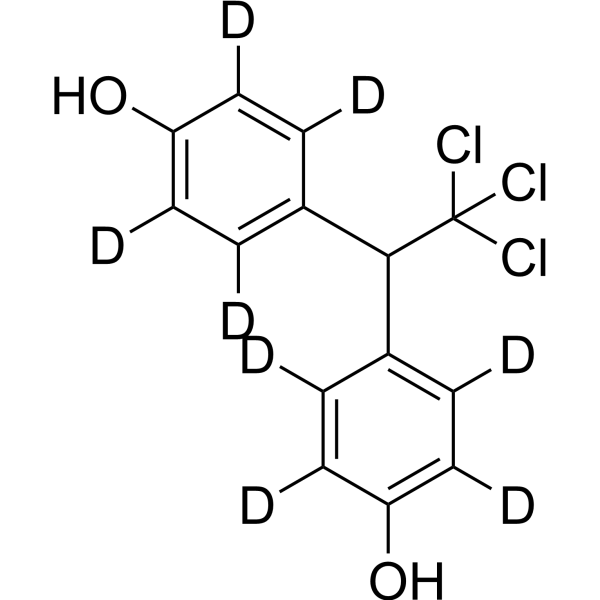
2,2-Bis(p-hydroxyphenyl)-1,1,1-trichloroethane-d8 is the deuterated-labeled HPTE (HY-W490804). HPTE is the active in vivo metabolite of Methoxychlor (HY-B1873), and acts as an inhibitor of 3β‑HSD and 17β‑HSD3. HPTE binds to the substrate-binding pocket of 3β‑HSD in a non-competitive manner, but competitively occupies the coenzyme NAD +-binding site, thereby inhibiting the conversion of pregnenolone to progesterone. HPTE binds to the androstenedione-binding pocket (the substrate pocket) of 17β‑HSD3 in a non-competitive manner, and competitively occupies the coenzyme NADPH-binding site, thus blocking the conversion of androstenedione to testosterone. HPTE interferes with androgen biosynthesis in Leydig cells by inhibiting the activities of these two key steroidogenic enzymes. HPTE can be used in studies related to androgen biosynthesis .
loading...
    loading...
Cat. No.: HY-Y0075S1
CAS No.: 116815-49-7
2-Naphthaldehyde-13C is the 13C-labeled 2-Naphthaldehyde (HY-Y0075). 2-Naphthaldehyde belongs to naphthalene-based bis-aromatic aldehyde compounds. 2-Naphthaldehyde scavenges DPPH and ABTS + free radicals, and exerts reductive effects by donating hydrogen atoms to interrupt free radical chain reactions. 2-Naphthaldehyde inhibits the growth and proliferation of colon cancer cells. 2-Naphthaldehyde serves as a substrate for NAD +-dependent salicylaldehyde dehydrogenase from Pseudomonas strain C6 and is catalytically oxidized. 2-Naphthaldehyde acts as a precursor material for the chemical synthesis of antioxidant Schiff bases .
loading...
    loading...

