63 Results for "

cachexia

" in MedChemExpress (MCE) Product Catalog:
Products (63)

63 Results for "cachexia" in MCE Product Catalog:

Cat. No.: HY-14734B
CAS No.: 339539-92-3
Synonyms: RC-1291 Fumarate; ONO-7643 Fumarate
Target:  

GHSR

Research Areas:  

Endocrinology Cancer

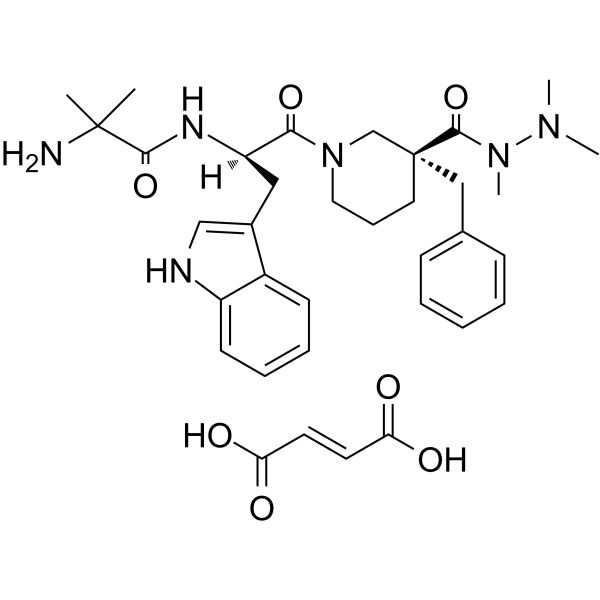
Anamorelin (RC-1291) Fumarate is an orally active Ghrelin receptor agonist with an EC50 of 0.74 nM. Anamorelin Fumarate can promote appetite, increase body weight, and stimulate the secretion of growth hormone and insulin-like growth factor-1. Anamorelin Fumarate can be used in the research of anorexia and cancer cachexia .
loading...
    loading...
Cat. No.: HY-B1834S1
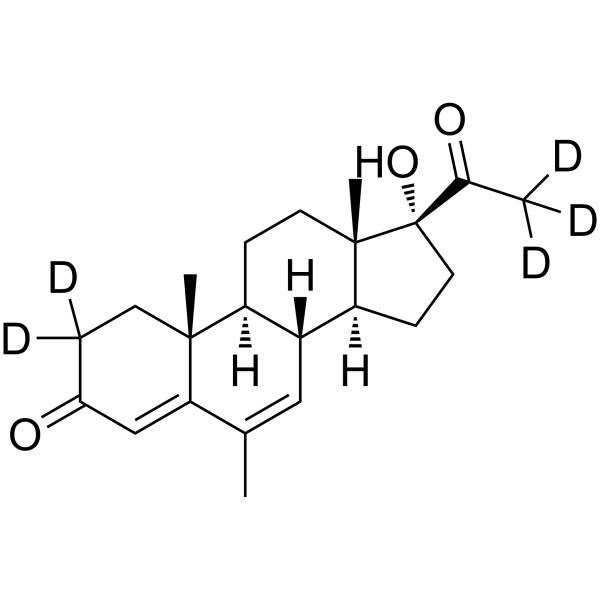
Megestrol-d5 is the deuterium labeled Megestrol. Megestrol is an orally active glucocorticoid and progesterone receptor agonist. Megestrol can alleviate anorexia, cachexia or unexplained significant weight loss associated with acquired immunodeficiency syndrome (AIDS). Megestrol may cause glucocorticoid-like effects and an increased risk of mental disorders.
loading...
    loading...
Cat. No.: HY-B1834R
CAS No.: 3562-63-8
Megestrol (Standard) is the analytical standard of Megestrol. This product is intended for research and analytical applications. Megestrol is an orally active glucocorticoid and progesterone receptor agonist. Megestrol can alleviate anorexia, cachexia or unexplained significant weight loss associated with acquired immunodeficiency syndrome (AIDS). Megestrol may cause manifestations similar to those of glucocorticoids and increase the risk of mental disorders.
loading...
    loading...
Cat. No.: HY-13676S1
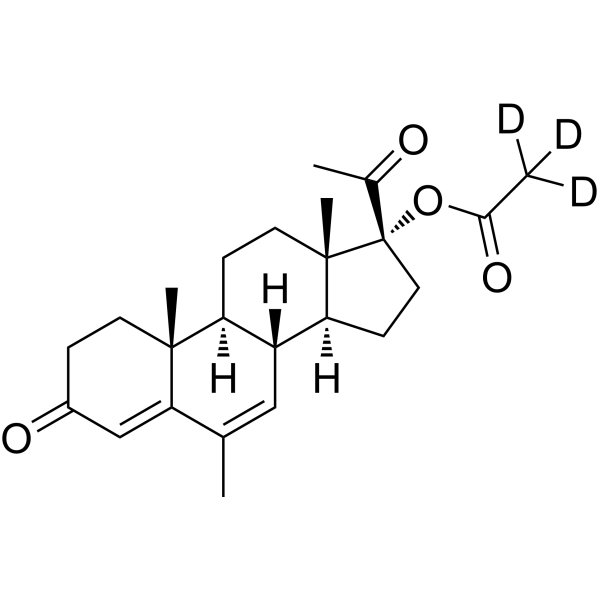
Megestrol acetate-d3-1 is deuterium labeled Megestrol acetate. Megestrol acetate is a synthetic and orally active progesteronal agent. Megestrol acetate is effective as an appetite stimulant for wasting syndromes such as cachexia. Megestrol acetate decreases nuclear and cytosol androgen receptors human BPH tissue. Megestrol acetate has the potential for HIV study and downregulates autophagic catabolic pathway .
loading...
    loading...
Cat. No.: HY-14734R
CAS No.: 249921-19-5
Synonyms: RC-1291 (Standard); ONO-7643 (Standard)
Research Areas:  

Endocrinology Cancer

Anamorelin (Standard) (RC-1291 (Standard)) is the analytical standard of Anamorelin (HY-14734). This product is intended for research and analytical applications. Anamorelin (RC-1291) is an orally active Ghrelin receptor agonist with an EC50 of 0.74 nM. Anamorelin can promote appetite, increase body weight, and stimulate the secretion of growth hormone and insulin-like growth factor-1. Anamorelin can be used in the research of anorexia and cancer cachexia .
loading...
    loading...
Cat. No.: HY-129692R
CAS No.: 27570-38-3
Withanone (Standard) is the analytical standard of Withanone (HY-129692). This product is intended for research and analytical applications. Withanone is an active ingredient from the roots of Withania somnifera and a GRP75 inhibitor. Withanone has multifunctional neuroprotective effects in alleviating cognitive dysfunction. In neuron-like cells, Withanone can inhibit NMDA-induced excitotoxicity. Withanone can inhibit white adipose tissue browning by blocking the formation of the GRP75-ANT2-UCP1 complex, thereby alleviating cancer-related cachexia. Withanone can be used in the research of tumors and nervous system diseases .
loading...
    loading...
Cat. No.: HY-P992393

Target:  

TGF-β Receptor

Research Areas:  

Cancer

JMT203 is a monoclonal antibody against GFRAL and a body weight gain inducer. JMT203 induces early-onset, sustained and progressive body weight gain in cancer cachexia. JMT203 can be used for research related to cancer cachexia .
loading...
    loading...
Cat. No.: HY-W1142093
CAS No.: 3039974-41-6
Target:  

TGF-β Receptor

Research Areas:  

Neurological Disease Cancer

ActRIIB-IN-4 (Compound 10) is an ActRIIB inhibitor with an IC50 of 4.0 nM. ActRIIB-IN-4 enhances muscle grip strength in tumor cachexia mice .
loading...
    loading...
Cat. No.: HY-W1142089
CAS No.: 3039974-32-5
Target:  

TGF-β Receptor

Research Areas:  

Cancer

ActRIIB-IN-2 is an ActRIIB inhibitor with an IC50 of 1.1 nM. ActRIIB-IN-2 can be used for the research of cancer cachexia .
loading...
    loading...
Cat. No.: HY-178999
Target:  

Drug Derivative

Research Areas:  

Cancer

Carnosol analog 1 (Compound 10) is a derivative of carnosol. Carnosol analog 1 attenuates myotube atrophy (67.08% reversal) and adipocyte lipolysis in C26 tumor-conditioned models. Carnosol analog 1 alleviates cachexia-related weight loss without altering tumor progression in C26 tumor-bearing mice. Carnosol analog 1 can be used for the study of cancer cachexia .
loading...
    loading...
Cat. No.: HY-183504
CAS No.: 3039974-35-8
Target:  

TGF-β Receptor

Research Areas:  

Cancer

ActRIIB-IN-3 is a ActRIIB inhibitor. ActRIIB-IN-3 inhibits the ActRIIB protein in the MSTN pathway and induces the reversal of skeletal muscle atrophy associated with cancer cachexia. ActRIIB-IN-3 is applicable for the research of cancer cachexia .
loading...
    loading...
Cat. No.: HY-183005
CAS No.: 3039974-31-4
Target:  

TGF-β Receptor

Research Areas:  

Inflammation/Immunology Cancer

ActRIIB-IN-1, 7-azaindole compound is an orally active activin type II receptor B (ActRIIB) inhibitor with an IC50 of 1.8 nM. ActRIIB-IN-1 can alleviate weight loss, muscle atrophy and decreased muscle strength caused by tumor cachexia, as well as improve appetite. ActRIIB-IN-1 can be used for the research of cancer cachexia .
loading...
    loading...
Cat. No.: HY-183106
CAS No.: 3038478-21-3
MC4R antagonist-2 is a potent melanocortin 4 receptor (MC4R) antagonist with an IC50 of 0.54 nM. MC4R antagonist-2 can be used for the research of MC4R-mediated conditions, such as cachexia, osteoporosis, neuropathic pain, depression, hypertension, malnutrition-related obesity, and associated inflammatory diseases .
loading...
    loading...
Cat. No.: HY-182773
Target:  

Melanocortin Receptor

Research Areas:  

Metabolic Disease

MC4R Antagonist-1 (compound 1) is an MC4R-selective antagonist (IC50<10 nM). MC4R Antagonist-1 can be used for the research of cachexia, anorexia, anorexia nervosa, involuntary weight loss, failure to thrive, sarcopenia, muscle wasting, muscle weakness, frailty, osteoporosis .
loading...
    loading...
Cat. No.: HY-181619
CAS No.: 3114565-22-6
Target:  

MAP3K

TAO Kinase-IN-3 is a potent pan-TAOK (Thousand-And-One Kinase) inhibitor that specifically binds to and inhibits the kinase activities of TAOK1, TAOK2 and TAOK3 with Kd values of <0.17 nM, 0.34 nM, and 0.17 nM, respectively. TAO Kinase-IN-3 can be used to study Alzheimer's disease, primary tauopathies and related syndromes. In addition, TAO Kinase-IN-3 is also widely used in research on the mechanisms of cancer cachexia and the muscle atrophy it induces .
loading...
    loading...
Cat. No.: HY-12176S2
Synonyms: CGP 60536-d6 hemifumarate; CGP60536B-d6 hemifumarate; SPP 100-d6 hemifumarate
Aliskiren-d6-1 hemifumarate (CGP 60536-d6-1 hemifumarate) is the deuterium labeled Aliskiren hemifumarate (HY-12177). Aliskiren is an orally active, highly potent and selective renin inhibitor, with IC50 of 1.5 nM. Aliskiren can be used for the research of hypertension, cardiovascular diseases and cancer cachexia .
loading...
    loading...
Cat. No.: HY-182270
Target:  

Orphan GPCR

Research Areas:  

Metabolic Disease

GPR61 Inverse agonist 2 is a selective GPR61 inverse agonist with human IC50 of 6.2 nM and mouse IC50 of 20 nM, human Ki of 0.21 nM, and mouse Ki of 0.72 nM. GPR61 Inverse agonist 2 binds to an induced intracellular allosteric pocket of GPR61, disrupts receptor-Gαs interactions, and abolishes GPR61 constitutive activity. GPR61 Inverse agonist 2 does not alter food intake or body weight in healthy mice. GPR61 Inverse agonist 2 can be used for the research of cachexia/sarcopenia .
loading...
    loading...
Cat. No.: HY-10459A
CAS No.: 939791-39-6
Synonyms: VS-6062 mesylate
Target:  

FAK Pyk2

Research Areas:  

Neurological Disease Cancer

PF-562271 mesylate (VS-6062 mesylate) is an orally active, ATP-competitive, reversible FAK/Pyk2 inhibitor, with an IC50 of 1.5 nM for FAK and 13 nM for Pyk2. PF-562271 mesylate induces tumor regression, and inhibits tumor growth, invasion and metastasis. PF-562271 mesylate exerts no effect on tumor necrosis, angiogenesis or apoptosis in an orthotopic mouse model of pancreatic ductal adenocarcinoma. When combined with Sunitinib (HY-10255A), PF-562271 mesylate reduces tumor vascularization, decreases serum alpha-fetoprotein levels and improves cachexia. PF-562271 mesylate can be used in research related to prostate cancer, breast cancer, pancreatic cancer, colon cancer, glioblastoma, lung cancer, pancreatic ductal adenocarcinoma and hepatocellular carcinoma .
loading...
    loading...
Cat. No.: HY-182271
GPR61 Inverse agonist 3 is a selective and brain-penetrant GPR61 inverse agonist with human IC50 of 4.0 nM, mouse IC50 of 8.8 nM, human Ki of 0.34 nM, mouse Ki of 1.1 nM. GPR61 Inverse agonist 3 disrupts GPR61-Gαs protein interactions to abolish GPR61 constitutive activity. GPR61 Inverse agonist 3 moderately inhibits GABAA chloride channel and PDE3A1 with IC50 values of 4.6 and 8.9 μM. GPR61 Inverse agonist 3 shows no functional effect on food intake in adult mice co-administered with a pan-CYP inhibitor. GPR61 Inverse agonist 3 can be used for the research of cachexia/sarcopenia .
loading...
    loading...
Cat. No.: HY-10459R
CAS No.: 717907-75-0
Synonyms: VS-6062 (Standard)
PF-562271 (Standard) (VS-6062 (Standard)) is the analytical standard of PF-562271 (HY-10459). This product is intended for research and analytical applications. PF-562271 (VS-6062) is an orally active, ATP-competitive, reversible FAK/Pyk2 inhibitor, with an IC50 of 1.5 nM for FAK and 13 nM for Pyk2. PF-562271 induces tumor regression, and inhibits tumor growth, invasion and metastasis. PF-562271 exerts no effect on tumor necrosis, angiogenesis or apoptosis in an orthotopic mouse model of pancreatic ductal adenocarcinoma. When combined with Sunitinib (HY-10255A), PF-562271 reduces tumor vascularization, decreases serum alpha-fetoprotein levels and improves cachexia. PF-562271 can be used in research related to prostate cancer, breast cancer, pancreatic cancer, colon cancer, glioblastoma, lung cancer, pancreatic ductal adenocarcinoma and hepatocellular carcinoma .
loading...
    loading...

