80 Results for "

Angina pectoris

" in MedChemExpress (MCE) Product Catalog:
Products (80)

80 Results for "Angina pectoris" in MCE Product Catalog:

  • Disease Areas Recommended:
Cat. No.: HY-P2061
CAS No.: 128140-12-5
Target:  

Calcium Channel

Research Areas:  

Cardiovascular Disease

Leualacin, a calcium channel blocker, can be isolated from the fungus Hapsidospora irregularis .
loading...
    loading...
Cat. No.: HY-183473
CAS No.: 34535-83-6
Target:  

Drug Derivative

Research Areas:  

Cardiovascular Disease

Fenalcomine hydrochloride is an orally active phenethylamine derivative with antianginal activity. Fenalcomine hydrochloride reduces myocardial oxygen consumption, and increases cardiac output and coronary blood flow. Fenalcomine hydrochloride is suitable for angina models complicated by hypertension, diabetes, and old myocardial infarction. Fenalcomine hydrochloride can be used in studies related to angina pectoris .
loading...
    loading...
Cat. No.: HY-183473A
CAS No.: 34616-39-2
Target:  

Drug Derivative

Research Areas:  

Cardiovascular Disease

Fenalcomine is an orally active phenethylamine derivative with antianginal activity. Fenalcomine reduces myocardial oxygen consumption, and increases cardiac output and coronary blood flow. Fenalcomine is suitable for angina models complicated by hypertension, diabetes, and old myocardial infarction. Fenalcomine can be used in studies related to angina pectoris .
loading...
    loading...
Cat. No.: HY-160637
CAS No.: 1818842-74-8
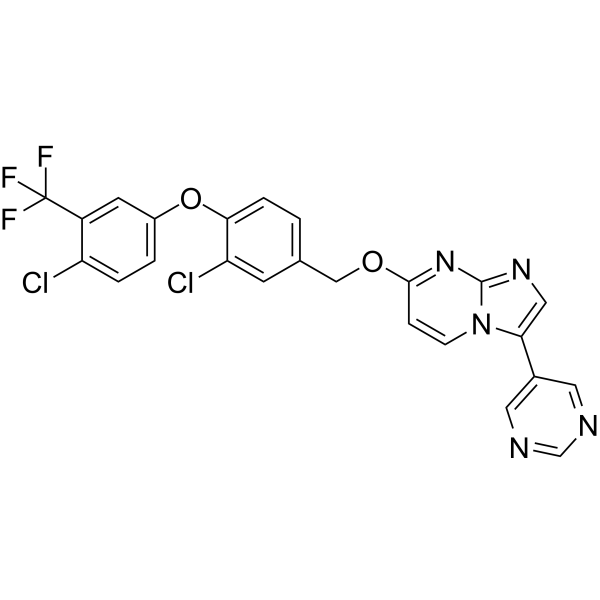
Lp-PLA2-IN-17 (Compound 39) is an inhibitor of Lp-PLA2. Lp-PLA2-IN-17 can be used to study disorders involving the hydrolysis of oxidized lipids into two inflammatory substances with the participation of Lp-PLA2 .
loading...
    loading...
Cat. No.: HY-129680
CAS No.: 90-54-0
Target:  

Adrenergic Receptor

Research Areas:  

Cardiovascular Disease

Etafenone is an antiarrhythmic agent and vasodilator. Etafenone exerts β-adrenergic agonistic effects. Etafenone inhibits the automaticity of sinoatrial nodes, atrioventricular junctions and Purkinje fibers, prolongs action potential duration and refractory period, slows the rising rate of action potentials, and prolongs conduction time. Etafenone enhances collateral circulation after coronary occlusion and suppresses ventricular premature beats. Etafenone delays ischemic myocardial energy imbalance, improves the recovery of high-energy phosphates after ischemia, and reduces myocardial oxygen consumption. Etafenone can be used in research related to ischemic heart disease, arrhythmia and angina pectoris .
loading...
    loading...
Cat. No.: HY-N20270
Category:  

Extract

Target:  

Others

Trichosanthis fructus extract is an extract of Trichosanthis fructus that can be used in research on angina pectoris, heart failure, myocardial infarction, pulmonary heart disease, and cerebral ischemia.
loading...
    loading...
Cat. No.: HY-119652
CAS No.: 2933-94-0
Target:  

Adrenergic Receptor

Research Areas:  

Cardiovascular Disease

Toliprolol is a β12-selective β-adrenergic Receptor antagonist. Toliprolol is used in the research of angina pectoris and hypertension .
loading...
    loading...
Cat. No.: HY-121186S
Synonyms: SOM3355-d7
Bevantolol-d7 hydrochloride (SOM3355-d7) is the d7-labeled Bevantolol hydrochloride (HY-121186). Bevantolol hydrochloride (SOM3355) is a selective β1-adrenergic receptor antagonist, with an IC50 of 35 nM for β1-adrenergic receptor and an IC50 of 60 nM for VMAT2. Bevantolol hydrochloride blocks β1-adrenergic receptors, exerts partial agonistic effects on α-adrenoceptor, inhibits calcium currents in the sinoatrial and atrioventricular nodes as well as sodium currents in cardiomyocytes, delays repolarization, and shortens the action potential duration of Purkinje cells. Bevantolol hydrochloride reduces peripheral vascular resistance, increases subendocardial blood flow, inhibits VMAT2, elevates the serum HDL/LDL ratio, and does not affect glomerular filtration rate or cause cold extremities. Bevantolol hydrochloride is applicable to research related to angina pectoris, hypertension, arrhythmia, and Huntington's disease .
loading...
    loading...
Cat. No.: HY-118587
CAS No.: 55393-37-8
Synonyms: HE 165
Target:  

Drug Derivative

Research Areas:  

Cardiovascular Disease

CH-102 (HE 165) is an isoquinoline derivative. CH-102 exhibits significant anti-platelet aggregation and antithrombotic activities. CH-102 can be used in the study of angina pectoris .
loading...
    loading...
Cat. No.: HY-14656S4
CAS No.: 2699608-24-5
Synonyms: CRD-401-d4-1
Diltiazem-d4-1 hydrochloride (CRD-401-d4-1) is the deuterium labeled Diltiazem hydrochloride (HY-14656). Diltiazem is an orally active L-type Ca 2+ channel blocker. Diltiazem shows antihypertensive and antiarrhythmic effects. Diltiazem can be used for the research of cardiac arrhythmia, hypertension, and angina pectoris.
loading...
    loading...
Cat. No.: HY-165437
CAS No.: 135124-72-0
AY 31390 is a potent PDE III inhibitor. AY 31390 increases intracellular cAMP levels by selectively inhibiting the low-Km cAMP-specific PDE III, thereby stabilizing platelets and exerting antithrombotic effects independently of plasma adenosine concentrations. AY 31390 can be used in the study of thrombosis, angina pectoris, cerebral ischemia, and peripheral vascular diseases .
loading...
    loading...
Cat. No.: HY-106458
CAS No.: 22609-73-0
Synonyms: Bay a 7168
Target:  

Calcium Channel

Research Areas:  

Cardiovascular Disease

Niludipine (Bay a 7168) is an orally active calcium channel blocker and vasodilator with antihypertensive effects. Niludipine can improve early fatal ventricular arrhythmias induced by acute myocardial ischemia in rats. Niludipine can reduce left ventricular systolic and diastolic loads during pacing-induced angina pectoris. Niludipine can be used in the research of cardiovascular diseases such as coronary heart disease and myocardial ischemia .
loading...
    loading...
Cat. No.: HY-116957
CAS No.: 29876-08-2
Target:  

Adrenergic Receptor

Research Areas:  

Cardiovascular Disease

Bunitrolol hydrochloride is an orally active β-adrenergic blocker that has a high affinity for β-adrenergic receptors. Bunitrolol hydrochloride exerts significant β-receptor antagonist activity and has weak α1-blocking activity. Bunitrolol hydrochloride is mainly used in the study of cardiovascular diseases such as hypertension and angina pectoris, and is also used in placental transport research .
loading...
    loading...
Cat. No.: HY-183921
CAS No.: 135100-65-1
SQ 32547 is a dihydropyridine calcium channel inhibitor with antihypertensive and anti-ischemic activities. SQ 32547 modulates sarcolemmal voltage-dependent calcium channels to inhibit calcium influx, and exerts direct anti-ischemic activity by suppressing myocardial contracture formation and reducing lactate dehydrogenase (LDH) release. SQ 32547 can be used in research related to hypertension, angina pectoris and neurogenic inflammation .
loading...
    loading...
Cat. No.: HY-E71367
Bromelain USP is an orally active proteolytic agent. Bromelain USP converts plasminogen to plasmin to support fibrinolysis, cleaves CD44 adhesion molecules from cell surfaces, and diminishes uPAR expression and uPA activity. Bromelain USP can inhibit the activity of a variety of fungi and bacteria. Bromelain USP can be used for the research of angina pectoris, atherosclerotic disease, fungal infections, bacterial infections, chronic inflammatory bowel disease, and cancer .
loading...
    loading...
Cat. No.: HY-E72116
Target:  

UGT

Human UGT2B4 is a UDP-glucuronosyltransferase. UGT2B4 catalyzes the glucuronidation of bile acids, Carvedilol (HY-B0006) and 6-hydroxylated bile acids to form glucuronide derivatives. UGT2B4 participates in the inactivation of endogenous and exogenous substances, including catechol estrogens, C19 steroids, phenols and monoterpenoids. Human UGT2B4 can be used in the research of hypertension, angina pectoris, chronic heart failure and intrahepatic cholestasis .
loading...
    loading...
Cat. No.: HY-W192276
CAS No.: 20862-11-7
Synonyms: N-Desisopropylpropranolol
(±)-Desisopropylpropranolol (N-Desisopropylpropranolol) is a metabolite of Propranolol (HY-B0573B). Propranolol is a nonselective β-adrenergic receptor (βAR) antagonist, has high affinity for the β1AR and β2AR with Kis of 1.8 nM and 0.8 nM, respectively. Propranolol inhibits [ 3H]-DHA binding to rat brain membrane preparation with an IC50 of 12 nM. Propranolol is used for the study of hypertension, pheochromocytoma, myocardial infarction, cardiac arrhythmias, angina pectoris, and hypertrophic cardiomyopathy .
loading...
    loading...
Cat. No.: HY-W751362
CAS No.: 14176-10-4
Cetiedil is a vasodilator and potassium channel blocker with anti-sickle cell and analgesic activities. Cetiedil increases cyclic adenosine monophosphate levels, relaxes vascular smooth muscle, and blocks the action of Bradykinin (HY-P0206). Cetiedil inhibits platelet aggregation, reduces plasma fibrinogen concentration and blood viscosity, suppresses sickling of sickle red blood cells and improves their filterability, and decreases irreversible sickle cells. Cetiedil binds to calmodulin, inhibits Ca 2+-dependent potassium permeability of erythrocyte membranes, increases sodium permeability of erythrocytes, and regulates polymorphonuclear leukocyte function. Cetiedil can be used in research related to intermittent claudication, arteriosclerosis obliterans, diabetic arteriosclerosis, Raynaud's disease, angina pectoris, and sickle cell anemia .
loading...
    loading...
Cat. No.: HY-136907
CAS No.: 36622-29-4
Synonyms: (S)-(-)-Verapamil
Research Areas:  

Cardiovascular Disease Cancer

(S)-Verapamil ((S)-(-)-Verapamil) is an orally active MRP1 (ABCC1) modulator with a Kd value of 113 nM for hamster MRP1. (S)-Verapamil regulates MRP1, promotes MRP1-mediated glutathione efflux and the transport of calcein and leukotriene C4, reverses glutathione-activated MRP1 ATPase activity, and ultimately depletes intracellular glutathione and induces cell death. (S)-Verapamil specifically induces apoptosis in MRP1-overexpressing tumor cells. (S)-Verapamil can be used in research related to cancer, cardiac diseases such as supraventricular arrhythmia, and hypertension .
loading...
    loading...
Cat. No.: HY-L238
2,383 compounds

Mongolian medicine refers to drugs used for disease prevention and treatment under the guidance of Mongolian medical theory. Originating from the vast grasslands and desert regions of northern China, Mongolian medicine developed under specific natural conditions and a nomadic lifestyle, forming a unique theoretical system and treatment methods. It emphasizes the balance between the human body and the natural environment and has demonstrated distinct efficacy in treating digestive system diseases, rheumatism, skin diseases, and various chronic conditions. For example, Mongolian medicine often uses Chinese red date for palpitations and angina pectoris, sea buckthorn to relieve coughs, reduce phlegm, promote blood circulation, and remove blood stasis, and scabious to clear lung heat and treat liver heat diseases. The application of these characteristic Mongolian medicines embodies the profound wisdom of Mongolian medical practice.

With the advancement of modern technology, research on Mongolian medicine continues to deepen. Systematic studies on the chemical composition and pharmacological effects of Mongolian medicines can provide new ideas and methods for modern drug development.

MCE has collected 2,383 characteristic natural products derived from Mongolian medicines, with 400+ plant sources of Mongolian medicine.

