68 Results for "

amidation

" in MedChemExpress (MCE) Product Catalog:
Products (68)

68 Results for "amidation" in MCE Product Catalog:

Cat. No.: HY-E70918
Target:  

Endogenous Metabolite

Research Areas:  

Metabolic Disease

N-Methylhydantoinase (ATP-hydrolyzing), Arthrobacter sp., belongs to the hydrolase family and acts on carbon-nitrogen bonds other than peptide bonds, especially the carbon-nitrogen bonds in cyclic amides. N-Methylhydantoinase (ATP-hydrolyzing) is involved in the metabolism of arginine, creatinine, and proline. Its three substrates are ATP, N-methylimidazolidine-2,4-dione, and water, while its three products are ADP, phosphate, and N-carbamoylsarcosine.
loading...
    loading...
Cat. No.: HY-E71011
Research Areas:  

Metabolic Disease

N-Carbamoylsarcosine Amidase, E. coli, belongs to the hydrolase family. This family of enzymes acts on carbon-nitrogen bonds other than peptide bonds, particularly the carbon-nitrogen bonds in linear amides, and participates in the metabolism of arginine and proline. The two substrates of N-Carbamoylsarcosine Amidase, E. coli, are N-carbamoylsarcosine and H2O, while its three products are sarcosine, CO2, and NH3.ions to the healing immune response.
loading...
    loading...
Cat. No.: HY-E70997
Research Areas:  

Metabolic Disease

Glycopeptidase A, Almonds (EC 3.5.1.52) is an enzyme that catalyzes a chemical reaction that cleaves a N4-(acetyl-beta-D-glucosaminyl)asparagine residue in which the glucosamine residue may be further glycosylated, to yield a (substituted) N-acetyl-beta-D-glucosaminylamine and a peptide containing an aspartate residue. Glycopeptidase A, Almonds (EC 3.5.1.52) belongs to the family of hydrolases, specifically those acting on carbon-nitrogen bonds other than peptide bonds in linear amides.
loading...
    loading...
Cat. No.: HY-164575C
(S)-NH2-NODAGA hydrochloride is the S isomer of NH2-NODAGA hydrochloride (HY-164575B). NH2-NODAGA hydrochloride is an amino-modified NODAGA-type bifunctional chelator, specifically designed for amidation coupling with targeting ligands via squaric acid (SA), followed by coordination with radionuclides (e.g., 68Ga, 177Lu). NH2-NODAGA hydrochloride can be coupled with diethyl squarate to form a PSMA inhibitor conjugate, which is used in prostate cancer research.
loading...
    loading...
Cat. No.: HY-A0084AS
Synonyms: Procaine amide-d4; SP 100-d4
Procainamide-d4 (Procaine amide-d4) is the deuterium labeled Procainamide (HY-A0084A). Procainamide (Procaine amide) is a specific and potent inhibitor of DNA methyltransferase 1 (DNMT1), which reactivates the expression of tumor suppressor factors by demethylating tumor suppressor genes. Procainamide induces vacuolization in various cell types and reduces cell proliferation and migration. Procainamide relaxes airway smooth muscle by activating potassium channels. Procainamide can be used in cancer and arrhythmia research .
loading...
    loading...
Cat. No.: HY-W015464S
CAS No.: 1330037-21-2
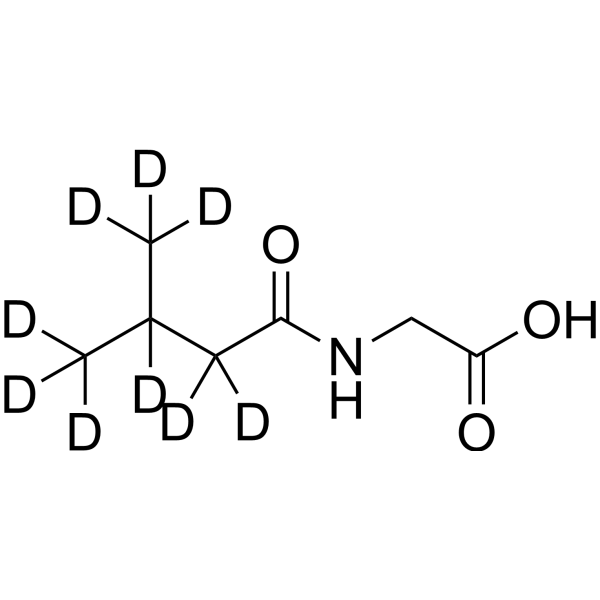
N-Isovalerylglycine-d9 is the deuterium labeled N-Isovaleroylglycine (HY-W015464). N-Isovaleroylglycine is a peptidylglycine α-amidating monooxygenase (PAM) inhibitor with a Ki value of 2.0 mM against human hsPAM. N-Isovaleroylglycine undergoes oxidative cleavage by purified rat PAM to produce fatty acid amide and glyoxylic acid. N-Isovaleroylglycine exerts competitive inhibition by binding to hsPAM, blocking the amidation of dansyl-Tyr-Val-Gly. N-Isovaleroylglycine exhibits lowered urinary abundance in MRSA-infected mice, which qualifies it as a non-invasive biomarker. N-Isovaleroylglycine can be used in studies related to Staphylococcus aureus pneumonia and diabetic foot .
loading...
    loading...
Cat. No.: HY-P11909
Research Areas:  

Infection

3-WP is a linear 20-peptide with a C-terminal amidation modification. 3-WP acts on lipoteichoic acid (LTA) and disrupts cell wall permeability, induces intracellular reactive oxygen species (ROS) accumulation in a dose-dependent manner, and simultaneously inhibits respiratory chain dehydrogenase activity and intracellular ATP synthesis, thereby interfering with bacterial energy metabolism and exerting Bacterial antibacterial effects. The combination of 3-WP and Melittin (HY-P0233) exerts synergistic antibacterial effects against Gram-positive bacteria, reduces the required dosage of Melittin, and thus improves the cell selectivity of Melittin. 3-WP can serve as a peptide adjuvant for Melittin in food storage scenarios. 3-WP can be used in the research of foodborne diseases caused by methicillin-resistant Staphylococcus aureus .
loading...
    loading...
Cat. No.: HY-182024
Target:  

SARS-CoV Virus Protease

Research Areas:  

Infection

SARS-CoV-2 3CLpro-IN-36 is a SARS-CoV-2 3CLpro inhibitor and antiviral agent with a human sub-micromolar IC50 against SARS-CoV-2 3CLpro.SARS-CoV-2 3CLpro-IN-36 forms a covalent bond with catalytic Cys145 of SARS-CoV-2 3CLpro; its tetrazole core occupies the S1 pocket and interacts with His163, while its chloroacetamide carbonyl forms hydrogen bonds with the backbone amides of Gly143 and Ser144 in the oxyanion hole.SARS-CoV-2 3CLpro-IN-36 reduces SARS-CoV-2 replication in infected cells.SARS-CoV-2 3CLpro-IN-36 can be used for the research of SARS-CoV-2 infection .
loading...
    loading...

