84 Results for "

carbon source

" in MedChemExpress (MCE) Product Catalog:
Products (84)

84 Results for "carbon source" in MCE Product Catalog:

Cat. No.: HY-N2024AS2
Maltose monohydrate- 13C is the 13C labeled isotope of Maltose monohydrate. Maltose monohydrate is a disaccharide composed of two glucose molecules linked together. Maltose monohydrate is an endogenous metabolic product in plants, yeast, or bacteria, and it participates in carbon source storage and metabolism. Maltose monohydrate is a key core metabolite and main transport form in the temporary starch degradation, carbon output, and subsequent sucrose synthesis metabolism of the night chloroplast. In X. dendrorhous, maltose can act as a sugar donor and is converted into isomaltulose by α-glucosidase. Maltose monohydrate can act as a osmotic agent, supporting continuous capillary ultrafiltration and preventing severe metabolic disorders.
loading...
    loading...
Cat. No.: HY-130778R
CAS No.: 35061-50-8
N,N'-Diacetylchitobiose (Standard) is the analytical standard of N,N'-Diacetylchitobiose. This product is intended for research and analytical applications. N,N'-Diacetylchitobiose is a dimer of β(1,4) linked N-acetyl-D glucosamine. N,N'-Diacetylchitobiose is the hydrolysate of chitin and can be used as alternative carbon source by E. coli. N,N'-Diacetylchitobiose also reverses myocardial depression .
loading...
    loading...
Cat. No.: HY-N3686S
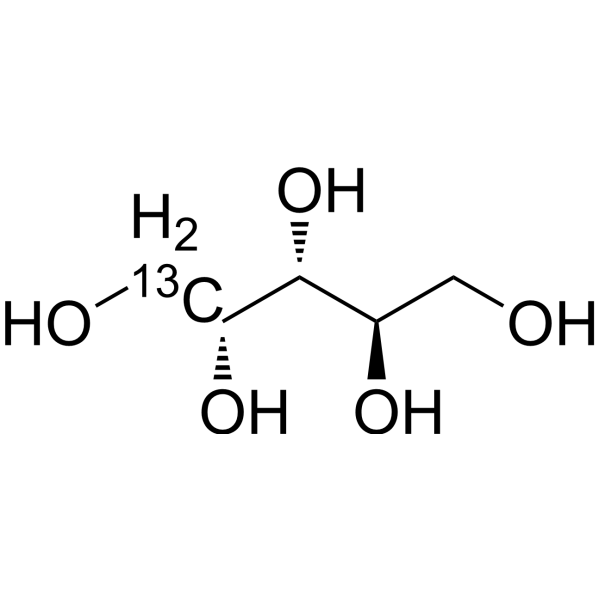
D-Arabitol- 13C is the 13C labeled D-Arabitol. D-Arabitol is an orally active D-enantiomer of arabitol. D-Arabitol modulates the composition of gut microbiota, increases short-chain fatty acids, and promotes AMPK-PGC-1α-related browning of white adipose tissue. D-Arabitol improves weight gain, fat accumulation, insulin resistance, lipid deposition and inflammatory responses. D-Arabitol serves as the sole carbon/energy source for Bacillus methanolicus MGA3, a strain that can co-utilize it with mannitol. D-Arabitol is applicable to obesity-related research.
loading...
    loading...
Cat. No.: HY-N3686S1
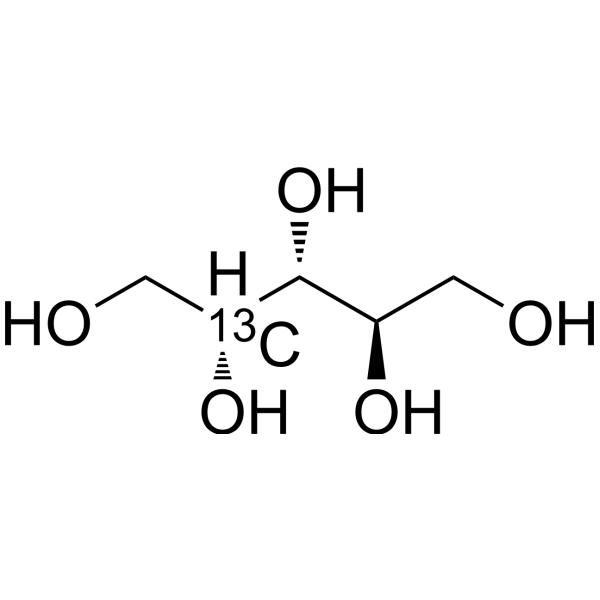
D-Arabitol- 13C-1 is the 13C labeled D-Arabitol. D-Arabitol is an orally active D-enantiomer of arabitol. D-Arabitol modulates the composition of gut microbiota, increases short-chain fatty acids, and promotes AMPK-PGC-1α-related browning of white adipose tissue. D-Arabitol improves weight gain, fat accumulation, insulin resistance, lipid deposition and inflammatory responses. D-Arabitol serves as the sole carbon/energy source for Bacillus methanolicus MGA3, a strain that can co-utilize it with mannitol. D-Arabitol is applicable to obesity-related research.
loading...
    loading...
Cat. No.: HY-N3686S2
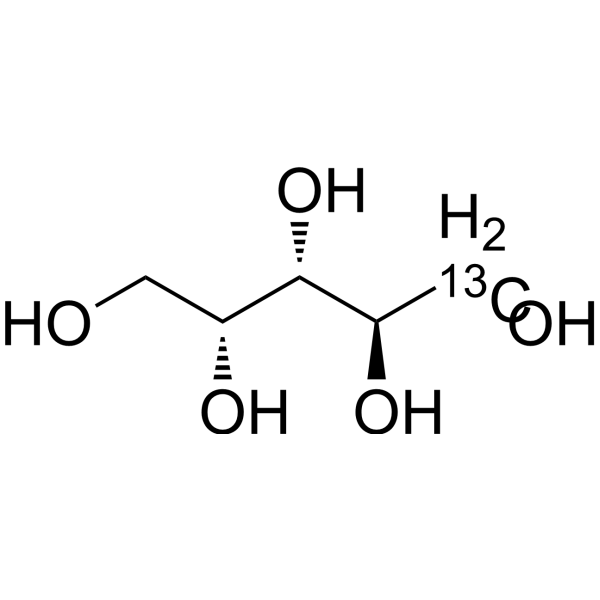
D-Arabitol- 13C-2 is the 13C labeled D-Arabitol. D-Arabitol is an orally active D-enantiomer of arabitol. D-Arabitol modulates the composition of gut microbiota, increases short-chain fatty acids, and promotes AMPK-PGC-1α-related browning of white adipose tissue. D-Arabitol improves weight gain, fat accumulation, insulin resistance, lipid deposition and inflammatory responses. D-Arabitol serves as the sole carbon/energy source for Bacillus methanolicus MGA3, a strain that can co-utilize it with mannitol. D-Arabitol is applicable to obesity-related research.
loading...
    loading...
Cat. No.: HY-W010062R
CAS No.: 1878-66-6
4-Chlorophenylacetic acid (Standard) is the analytical standard of 4-Chlorophenylacetic acid (HY-W010062). This product is intended for research and analytical applications. 4-Chlorophenylacetic acid is an aromatase antagonist. 4-Chlorophenylacetic acid inhibits estrogen-induced breast tumorigenesis by blocking estrogen conversion. 4-Chlorophenylacetic acid also serves as the sole carbon and energy source for Pseudomonas sp. CBS3; it is degraded via dechlorination and aromatic ring cleavage pathways, and induces the synthesis of protocatechuate 2,3-dioxygenase. 4-Chlorophenylacetic acid can be applied to studies related to estrogen-induced breast tumors and bacterial degradation pathways .
loading...
    loading...
Cat. No.: HY-78086R
CAS No.: 620-23-5
Synonyms: 3-Methylbenzaldehyde (Standard)
m-Tolualdehyde (Standard) is the analytical standard of m-Tolualdehyde (HY-78086). This product is intended for research and analytical applications. m-Tolualdehyde (3-Methylbenzaldehyde) is an aldehyde metabolite produced by m-xylene metabolism, and it bidirectionally regulates the CYP 2B1, CYP 2E1, and CYP 4B1 isoenzymes in the respiratory tract of rats. m-Tolualdehyde serves as an oxidation substrate and carbon source for Pseudomonas Pxy, and it can be oxidized to m-toluic acid in an NAD + -dependent manner. m-Tolualdehyde exerts a dose-dependent inhibitory effect on CYP 2B1 and CYP 2E1 in the nasal mucosa and lungs of rats, and a dose-dependent activating effect on pulmonary CYP 4B1. m-Tolualdehyde can form aldehyde-heme adducts with the heme group of cytochrome P450. m-Tolualdehyde can be used in studies related to metabolic enzymes in the respiratory tract of rats .
loading...
    loading...
Cat. No.: HY-W127434A
CAS No.: 1466461-81-3
Synonyms: (12R)-Octadecane-1,12-diol
Research Areas:  

Others

(12R)-1,12-Octadecanediol ((12R)-Octadecane-1,12-diol) is a compound characterized by a linear chain of 18 carbon atoms with two hydroxyl groups (C18H38O2). This colorless substance has unique properties owing to the presence of two hydroxyl groups in its molecular structure. Whether derived from natural sources or synthesized chemically, 12-Octadecanediol finds applications in various industries. It is often utilized in the formulation of cosmetics, personal care products, and pharmaceuticals due to its emollient properties, enhancing moisturization and conditioning effects in different formulations. The compound's distinctive structure may make it suitable for specific uses in research or industrial processes. In industrial contexts, 12-Octadecanediol serves as a valuable chemical intermediate for synthesizing other compounds. Its specialized structure and adaptability in formulations make it a significant component across diverse industries, contributing to the development of products for various purposes.
loading...
    loading...
Cat. No.: HY-N16496
CAS No.: 136514-33-5
17-Oxoheptadecanoic acid is a ω-oxocarboxylic acid with a carbon chain length of 17 carbon atoms. 17-Oxoheptadecanoic acid can be as a tracer for atmospheric source organic matter .
loading...
    loading...
Cat. No.: HY-189512
Research Areas:  

Others

Simmon's Citrate Agar is a synthetic differential medium that uses sodium citrate as the sole carbon source. Simmon's Citrate Agar can determine the ability of bacteria to utilize citrate as a carbon source. Bacterial metabolism of citrate produces bicarbonate, which causes bromothymol blue to change from blue to deep blue. Simmon's Citrate Agar can be used for bacterial identification and isolation-related research .
loading...
    loading...
Cat. No.: HY-E71567
Research Areas:  

Others

2-Hydroxymethylglutarate dehydrogenase (EC 1.1.1.291) is an NADPH-dependent D-ribulose reductase—a type of oxidoreductase—that catalyzes the reduction of D-ribulose to D-arabitol. It plays a key role in pentose metabolism, sugar alcohol metabolism, and carbon source utilization in microorganisms and fungi.
loading...
    loading...
Cat. No.: HY-178398S
Nonadecanoic acid-d3 is the deuterium labeled Nonadecanoic acid (HY-W004261). Nonadecanoic acid is a 19-carbon long saturated fatty acid. Nonadecanoic acid is the major constituent of the substance secreted by Rhinotermes marginalis. Nonadecanoic acid can be isolated from several sources, including fungus, plant, and marine sponge. Nonadecanoic acid exhibits inhibitory effects on fibrinolysis and plasmin activity. Nonadecanoic acid produced from Streptomyces is an anti-tumor agent and inhibits IL-12 production .
loading...
    loading...
Cat. No.: HY-W004303S
CAS No.: 1809273-36-6
Synonyms: Tetradecyl Aldehyde-d27
Tetradecanal-d27 (Tetradecyl Aldehyde-d27) is the deuterium labeled Tetradecanal. Tetradecanal is a compound belonging to the class of fatty aldehydes. It is an aldehyde with a 14-carbon chain that occurs naturally in certain plant and animal sources, such as coconut oil and butter. Due to its unique properties, Tetradecanal has several uses in industry, such as a flavoring agent in certain foods and as a precursor for the production of perfumes and other cosmetics. It is also used as an insecticide and insecticide due to its ability to repel certain types of insects.
loading...
    loading...
Cat. No.: HY-E71124
Research Areas:  

Others

(S)-Mandelate dehydrogenase (EC 1.1.99.31) belongs to the FMN-dependent α-hydroxy acid oxidase/dehydrogenase family. (S)-Mandelate dehydrogenase (EC 1.1.99.31) is part of a Pseudomonas metabolic pathway that enables these organisms to utilize mandelic acid (derived from the common soil metabolite amygdalin) as their sole carbon and energy source.
loading...
    loading...
Cat. No.: HY-W708332
3-Methylvaleric acid-d11 is the deuterium labeled 3-Methylvaleric Acid (HY-W010513). 3-Methylvaleric Acid is a branched alkanoic acid. 3-Methylvaleric Acid can be utilized by Pseudomonas citronettotis as a sole carbon source for its growth. 3-Methylvaleric Acid derivatives exhibit anti-hyperalgesic and anticonvulsant activities .
loading...
    loading...
Cat. No.: HY-N21558
CAS No.: 135463-09-1
α-D-Fructofuranose-β-D-fructofuranose-1,2':2,6'-dianhydride is a difructose dianhydride that is found in cultures of Aspergillus fumigatus grown with inulin as the carbon source. α-D-Fructofuranose-β-D-fructofuranose-1,2':2,6'-dianhydride exhibits non-reducing properties toward Nelson and Somogyi reagents and cannot be fermented by baker's yeast .
loading...
    loading...
Cat. No.: HY-W415856
CAS No.: 7296-64-2
Synonyms: Beta-D-galactose
Target:  

Drug Derivative

Research Areas:  

Others

β-D-galactose (Beta-D-galactose) is one of the two anomers of D-Galactose (HY-N0210). β-D-galactose efficiently binds to and inhibits the galactose repressor (GalR), thereby inducing the expression of the gal regulon. β-D-galactose acts as a persistent induction signal to trigger the synthesis of UDP-galactose for the biosynthetic glycosylation pathway, rather than serving as a carbon source in Yersinia pestis with inactivated GalM .
loading...
    loading...
Cat. No.: HY-179649
CAS No.: 484026-63-3
Target:  

Bacterial

Research Areas:  

Infection

sALT629 is an orally active antitubercular agent with potent intramacrophage activity (EC50 = 1.5 μM). sALT629 shows broad-spectrum anti-Mycobacterium tuberculosis (Mtb) activities across four carbon sources, equipotent efficacy against drug-resistant Mtb, and activity against both slow-replicating and nonreplicating Mtb. sALT629 exhibits synergistic activity when combined with oxazolidinone drugs, such as Linezolid (HY-10394) and Sutezolid (HY-10392). sALT629 can be used for the research of tuberculosis .
loading...
    loading...
Cat. No.: HY-W587486A
CAS No.: 75350-40-2
N-Acetyltaurine hemimagnesium is an orally active endogenous sulfonate that is synthesized from taurine and acetate in the renal cortex. N-Acetyltaurine hemimagnesium supports bacterial growth as a sole fixed nitrogen or carbon source. N-Acetyltaurine hemimagnesium buffers acetyl moieties of mitochondrial acetyl‑CoA in skeletal muscle. N-Acetyltaurine hemimagnesium reduces food intake and body weight in obese and lean wild‑type mice in a GFRAL‑dependent manner. N-Acetyltaurine hemimagnesium can be used for the research of diet‑induced obesity, hyperacetatemia and diabetes .
loading...
    loading...
Cat. No.: HY-W779018
CAS No.: 201741-00-6
Synonyms: D-(+)-Xylose-13C2; (+)-Xylose-13C2; Wood sugar-13C2
Xylose- 13C2 (D-(+)-Xylose- 13C2) is the 13C-labeled Xylose. Xylose (D-(+)-Xylose) is a natural pentose sugar that is catalyzed by xylose isomerase to form xylulose, which is a key step in the anaerobic ethanol fermentation of Xylose. Xylose can be used by microorganisms to produce fuels, chemicals, and bulk industrial enzymes. Xylose provides the substances and energy for cells, as a carbon source for the biosynthesis of high-value chemicals and biofuel. Xylose can be used to fully explore lignocellulose resources and provide a new direction for microbia fermentation .
loading...
    loading...

