114 Results for "

cross-presentation

" in MedChemExpress (MCE) Product Catalog:
Products (114)

114 Results for "cross-presentation" in MCE Product Catalog:

Cat. No.: HY-158278A
Aflatoxin B1/OVA is an antigen-adjuvant conjugate conjugate of Aflatoxin B1 (HY-N6615) and ovalbumin (OVA). By conjugating the antigen with a protein adjuvant, the production of antigen-specific antibodies in vaccine models can be enhanced. The conjugate does not affect protein folding or disrupt major epitopes, and can enhance cross-presentation and the production of antigen-specific T cells.
loading...
    loading...
Cat. No.: HY-161563
4,4'-Sulfonyldiphenol/BSA is the antigen-adjuvant conjugate of 4,4'-Sulfonyldiphenol (HY-W011927) and Bovine Serum Albumin (BSA). By conjugating the antigen with a protein adjuvant, the production of antigen-specific antibodies in vaccine models can be enhanced. The conjugate does not affect protein folding or disrupt major epitopes, and it can enhance cross-presentation and the production of antigen-specific T cells.
loading...
    loading...
Cat. No.: HY-161565
Research Areas:  

Inflammation/Immunology

Gastrin(1-17)/BSA is an antigen-adjuvant conjugate formed by the coupling of Gastrin(1-17) and Bovine Serum Albumin (BSA). By conjugating the antigen with a protein adjuvant, the production of antigen-specific antibodies in vaccine models can be enhanced. The conjugate does not affect protein folding or destroy major epitopes, and it can enhance cross-presentation and the production of antigen-specific T cells.
loading...
    loading...
Cat. No.: HY-163552
Prostaglandin F2a/BSA is an antigen-adjuvant conjugate formed by the conjugation of Prostaglandin F2a with Bovine Serum Albumin (BSA). By conjugating the antigen with a protein adjuvant, the production of antigen-specific antibodies in vaccine models can be enhanced. The conjugate does not affect protein folding or disrupt major epitopes and can enhance cross-presentation as well as the generation of antigen-specific T cells.
loading...
    loading...
Cat. No.: HY-183211
Ginsenoside Rg1/OVA is an antigen-adjuvant conjugate conjugate of Ginsenoside Rg1 (HY-N0045) and ovalbumin (OVA). By conjugating the antigen with a protein adjuvant, the production of antigen-specific antibodies in vaccine models can be enhanced. The conjugate does not affect protein folding or disrupt major epitopes, and can enhance cross-presentation and the production of antigen-specific T cells.
loading...
    loading...
Cat. No.: HY-N0045B
Ginsenoside Rg1/OVA is an antigen-adjuvant conjugate conjugate of Ginsenoside Rg1 (HY-N0045) and ovalbumin (OVA). By conjugating the antigen with a protein adjuvant, the production of antigen-specific antibodies in vaccine models can be enhanced. The conjugate does not affect protein folding or disrupt major epitopes, and can enhance cross-presentation and the production of antigen-specific T cells.
loading...
    loading...
Cat. No.: HY-161551
25-OH Vitamin D3/KLH is an antigen-adjuvant conjugate of 25-OH Vitamin D3 (HY-158285) and Keyhole Limpet Hemocyanin (KLH). By conjugating the antigen with the protein adjuvant, the production of antigen-specific antibodies in vaccine models can be enhanced. The conjugate does not affect protein folding or disrupt major epitopes, and it can enhance cross-presentation and the generation of antigen-specific T cells.
loading...
    loading...
Cat. No.: HY-161525
1-(2-Aminoethyl)-1H-pyrazol-4-ylphosphonic acid linker/BSA is the conjugate of 1-(2-Aminoethyl)-1H-pyrazol-4-ylphosphonic acid linker and bovine serum albumin (BSA). By conjugating the antigen with a protein adjuvant, it enhances the production of antigen-specific antibodies in vaccine models. The conjugate does not affect protein folding or disrupt key epitopes, and it can enhance cross-presentation and the generation of antigen-specific T cells.
loading...
    loading...
Cat. No.: HY-161527
1-(2-Aminoethyl)-1H-pyrazol-4-ylphosphonic acid-OVA is a conjugate of 1-(2-Aminoethyl)-1H-pyrazol-4-ylphosphonic acid and ovalbumin (OVA). By conjugating the antigen with a protein adjuvant, the production of antigen-specific antibodies in vaccine models can be enhanced. The conjugate does not affect protein folding or disrupt major epitopes, and it can enhance cross-presentation and the production of antigen-specific T cells.
loading...
    loading...
Cat. No.: HY-P990716
CAS No.: 2648346-74-9
Synonyms: AZD7789

Target:  

PD-1/PD-L1 Tim3

Research Areas:  

Inflammation/Immunology

Sabestomig (AZD7789) is a monovalent bispecific antibody targeting PD-1 and TIM-3. Sabestomig binds to PD-1 and an epitope in the TIM-3 IgV domain outside the phosphatidylserine-binding cleft, thereby precisely regulating immune responses. Sabestomig promotes IL-2 production, efferocytosis and cross-presentation of tumor antigens, and enhances the release of anti-tumor T cell cytokines, cytotoxicity, and secretion of IFN-γ. Sabestomig inhibits the growth of solid tumors, prolongs the duration of tumor suppression, and significantly enhances anti-tumor responses following anti-PD-1 therapy. Sabestomig has been used in studies related to non-small cell lung cancer and classical Hodgkin lymphoma .
loading...
    loading...
Cat. No.: HY-P991525
CAS No.: 2923542-55-4

Target:  

Fc Receptor (FcR)

Research Areas:  

Cancer

2141-V11 is an Fc-engineered agonistic antibody against human CD40 with selectively enhanced binding affinity for human FcγRIIB. 2141-V11 drives CD40 multimerization and agonistic signal transduction, activates dendritic cells, promotes antigen cross-presentation and CD8 + T cell priming, induces tertiary lymphoid structure formation, increases leukocyte infiltration, and mediates local and abscopal anti-tumor effects, systemic immune activation and immune memory. 2141-V11 exhibits extremely low systemic toxicity upon intratumoral or intravesical administration, with no dose-limiting toxicity observed at the tested intratumoral doses, whereas high-dose systemic administration induces thrombocytopenia and elevated transaminases. 2141-V11 can be used in research related to breast cancer, melanoma, BCG-unresponsive non-muscle invasive bladder cancer, and recurrent malignant glioma .
loading...
    loading...
Cat. No.: HY-117573
CAS No.: 1438280-73-9
1Z105 is an orally active TLR4/MD2 agonist, immunostimulant and vaccine adjuvant. 1Z105 activates NF-κB via the MyD88/TRIF pathway in a CD14-independent manner, with EC50 values of 0.63 µM and 0.77 µM for inducing IL-6 and IL-12 in mBMDCs, respectively. 1Z105 promotes dendritic cell maturation, antigen uptake and cross-presentation; when used alone, it induces Th2-IgG1, while combined with the TLR7 agonist 1V270, it synergistically induces balanced Th1/Th2 responses and provides low-reactogenic protection against homologous, heterologous and heterosubtypic influenza. 1Z105 prevents LPS (HY-D1056A1)- and galactosamine-induced liver injury as well as autoantibody-driven arthritis in mice. 1Z105 can be used in studies related to influenza virus infection, inflammation, and LPS/galactosamine-induced liver injury .
loading...
    loading...
Cat. No.: HY-P3350
CAS No.: 2892148-58-0
Target:  

Bacterial

Research Areas:  

Infection

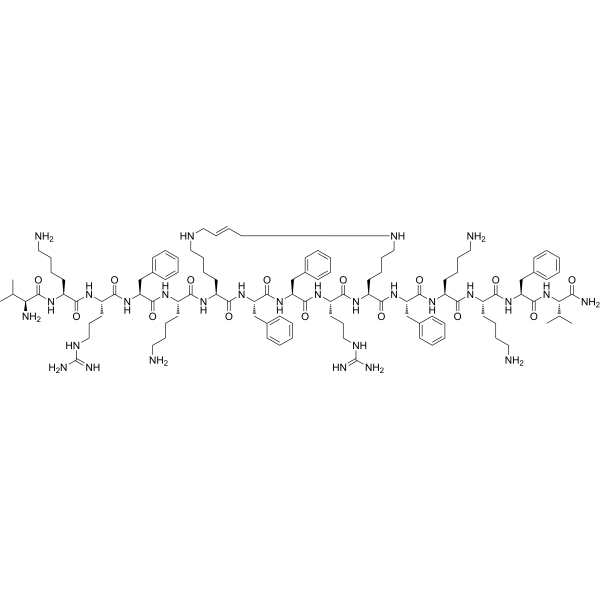
LS-BF1 is a stable and low toxic cationic antimicrobial peptide. LS-BF1 displays broad spectrum of antibacterial activity, including the challenging ESKAPE pathogens, by cell membrane disruptive mechanism. LS-BF1 shows good in vivo efficacy for elimination of bacteria in a mouse infection model[1].
loading...
    loading...
Cat. No.: HY-P12137
CAS No.: 2869056-74-4
Synonyms: RAY1225
Research Areas:  

Metabolic Disease

Bilpatide (RAY1225) is a dual agonist of glucagon-like peptide-1 receptor (GLP-1R) and glucose-dependent insulinotropic polypeptide receptor (GIPR). Bilpatide is applicable to research related to obesity and diabetes .
loading...
    loading...

