173 Results for "

CYP2A6

" in MedChemExpress (MCE) Product Catalog:
Products (173)

173 Results for "CYP2A6" in MCE Product Catalog:

  • Categories Recommended:
    More
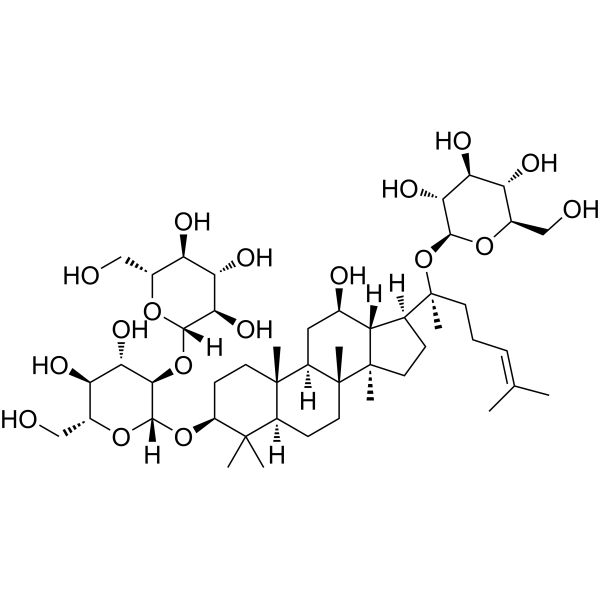
Cat. No.: HY-N0043R
CAS No.: 52705-93-8
Synonyms: Gypenoside VIII (Standard)
Ginsenoside Rd (Standard) is the analytical standard of Ginsenoside Rd. This product is intended for research and analytical applications. Ginsenoside Rd inhibits TNFα-induced NF-κB transcriptional activity with an IC50 of 12.05±0.82 μM in HepG2 cells. Ginsenoside Rd inhibits expression of COX-2 and iNOS mRNA. Ginsenoside Rd also inhibits Ca2+ influx. Ginsenoside Rd inhibits CYP2D6, CYP1A2, CYP3A4, and CYP2C9, with IC50s of 58.0±4.5 μM, 78.4±5.3 μM, 81.7±2.6 μM, and 85.1±9.1 μM, respectively.
loading...
    loading...
Cat. No.: HY-W663179
CAS No.: 681492-17-1
Research Areas:  

Infection

DNDI-VL-2098 is an orally active antileishmanial agent. DNDI-VL-2098 exhibits high permeability, in vitro metabolic stability, and selective inhibition of CYP2C19 (IC50=0.47 μM). DNDI-VL-2098 does not affect the activities of other major CYP enzymes (CYP1A2, CYP2C9, CYP2D6 and CYP3A4) at concentrations up to 12.5 μM. It shows favorable pharmacokinetic properties in multiple animal models including mice, hamsters, rats and dogs. DNDI-VL-2098 is characterized by moderate to high plasma protein binding and can be used for the research of visceral leishmaniasis .
loading...
    loading...
Cat. No.: HY-B2169R
CAS No.: 3575-80-2
Melperone (Standard) is the analytical standard of Melperone (HY-B2169). This product is intended for research and analytical applications. Melperone is a butyrophenone with atypical antipsychotic properties. Melperone is a multireceptor antagonist with Kds of 102 nM, 180 nM, 180 nM, and 150 nM for 5-HT2A, dopamine D2, α1-adrenergic, and α2-adrenergic receptors, respectively. Melperone has weak binding to histamine H1, 5-HT2C, 5-HT1A, 5-HT1D, and muscarinic receptors, with Kd values ​​of 580 nM, 2100 nM, 2200 nM, 3400 nM, >10000 nM, respectively. Melperone is also a CYP2D6 inhibitor. Melperone can be used for the study of schizophrenia, and agitation in the elderly.
loading...
    loading...
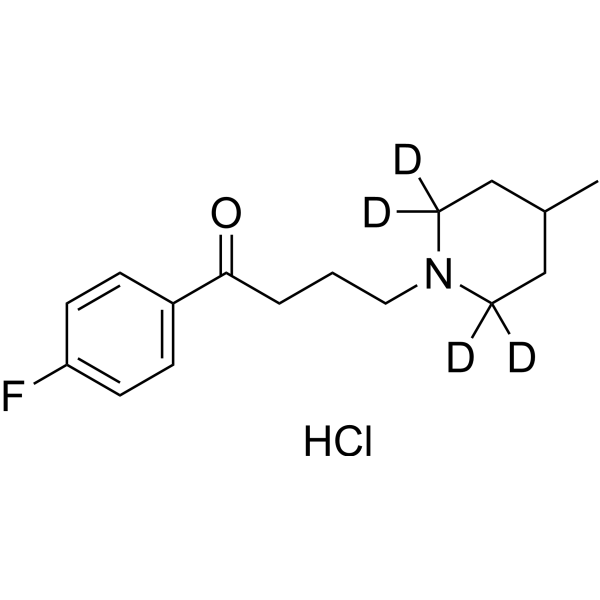
Cat. No.: HY-B2169S2
CAS No.: 1219798-80-7
Melperone-d4 hydrochloride is the deuterium labeled Melperone hydrochloride (HY-103109) . Melperone hydrochloride is a butyrophenone with atypical antipsychotic properties. Melperone hydrochloride is a multireceptor antagonist with Kds of 102 nM, 180 nM, 180 nM, and 150 nM for 5-HT2A, dopamine D2, α1-adrenergic, and α2-adrenergic receptors, respectively. Melperone hydrochloride has weak binding to histamine H1, 5-HT2C, 5-HT1A, 5-HT1D, and muscarinic receptors, with Kd values ​​of 580 nM, 2100 nM, 2200 nM, 3400 nM, >10000 nM, respectively. Melperone hydrochloride is also a CYP2D6 inhibitor. Melperone hydrochloride can be used for the study of schizophrenia, and agitation in the elderly .
loading...
    loading...
Cat. No.: HY-111124
CAS No.: 923932-43-8
Synonyms: BRL29060-d2
Paroxetine-d2 (BRL29060-d2) is the deuterated-labeled Paroxetine (HY-122272). Paroxetine (BRL29060) is an orally active and selective serotonin reuptake inhibitor (SSRI) and apoptosis inducer with blood-brain barrier permeability. Paroxetine inhibits nitric oxide synthase and CYP2D6, induces desensitization of 5-HT1A/1B/1D autoreceptors, downregulates 5-HT2 receptors, and promotes the production of inflammatory cytokines. Paroxetine is a weak norepinephrine (NE) uptake inhibitor and possesses antitumor activity. Paroxetine is widely used in research concerning depression, obsessive-compulsive disorder, panic disorder, social phobia, generalized anxiety disorder, post-traumatic stress disorder, premenstrual dysphoric disorder, hot flashes, and related conditions .
loading...
    loading...
Cat. No.: HY-122272R
CAS No.: 61869-08-7
Synonyms: BRL29060 (Standard)
Paroxetine (BRL29060) (Standard) is the analytical standard of Paroxetine (HY-122272). This product is intended for research and analytical applications. Paroxetine (BRL29060) is an orally active and selective serotonin reuptake inhibitor (SSRI) and apoptosis inducer with blood-brain barrier permeability. Paroxetine inhibits nitric oxide synthase and CYP2D6, induces desensitization of 5-HT1A/1B/1D autoreceptors, downregulates 5-HT2 receptors, and promotes the production of inflammatory cytokines. Paroxetine is a weak norepinephrine (NE) uptake inhibitor and possesses antitumor activity. Paroxetine is widely used in research concerning depression, obsessive-compulsive disorder, panic disorder, social phobia, generalized anxiety disorder, post-traumatic stress disorder, premenstrual dysphoric disorder, hot flashes, and related conditions .
loading...
    loading...
Cat. No.: HY-122272S
CAS No.: 923932-45-0
Synonyms: BRL29060-d4
Paroxetine-d4 (BRL29060-d4) is the deuterated-labeled Paroxetine (HY-122272). Paroxetine (BRL29060) is an orally active and selective serotonin reuptake inhibitor (SSRI) and apoptosis inducer with blood-brain barrier permeability. Paroxetine inhibits nitric oxide synthase and CYP2D6, induces desensitization of 5-HT1A/1B/1D autoreceptors, downregulates 5-HT2 receptors, and promotes the production of inflammatory cytokines. Paroxetine is a weak norepinephrine (NE) uptake inhibitor and possesses antitumor activity. Paroxetine is widely used in research concerning depression, obsessive-compulsive disorder, panic disorder, social phobia, generalized anxiety disorder, post-traumatic stress disorder, premenstrual dysphoric disorder, hot flashes, and related conditions .
loading...
    loading...
Cat. No.: HY-170928
CAS No.: 2756978-82-0
DA-0157 is the orally active inhibitor for EGFR and ALK that overcomes drug-resistant mutations of EGFR C797S and ALK in NSCLC) cells. DA-0157 inhibits the proliferation of Ba/F3-EGFR Del19/T790M/C797S (IC50 = 6.9 nM), Ba/F3-EGFR WT (IC50 = 0.83 μM), Ba/F3-EML4-ALK-L1196M (IC50 = 5.5 nM), and Ba/F3-EML4-ALK (IC50 = 7.4 nM). DA-0157 inhibits CYP2D6 with IC50 of 5.26 μM. DA-0157 exhibits antitumor efficacy in mouse models .
loading...
    loading...
Cat. No.: HY-178786
CAS No.: 2491726-04-4
Research Areas:  

Cancer

RET-IN-31 (Compound 13) is an orally active, selective RET inhibitor (IC50s: 1.4 nM, 1.9 nM, 3.8 nM for RET WT, RET V804L, RET V804M, respectively). RET-IN-31 inhibits hERG and Cytochrome P450 (IC50s: 13.6 μM, 7.9 μM, 12.8 μM, 16.9 μM, 8.9 μM, 13.0 μM for CYP1A2, CYP2C9, CYP2C19, CYP2D6, CYP3A4-M, CYP3A4-T, respectively). RET-IN-31 has anti-cancer effects against activated RET mutations and gene fusion-driven cancers .
loading...
    loading...
Cat. No.: HY-187364
CAS No.: 3050594-88-9
Research Areas:  

Inflammation/Immunology

TRPV4 antagonist-7 is a potent and selective TRPV4 antagonist with an IC50 of 0.2 nM against human targets. TRPV4 antagonist-7 binds to the voltage-sensor-like domain cavity of TRPV4 and inhibits channel activity through the formation of salt bridges, hydrogen bonds, and edge-to-face π-stacking interactions. TRPV4 antagonist-7 induces phospholipid accumulation in HepG2 C3A cells in vitro with an IC50 of 3.8 μM, and exhibits moderate inhibitory effects on CYP2D6 with an IC50 of 5.1 μM. TRPV4 antagonist-7 dose-dependently inhibits GSK1016790A (HY-19608)-induced bronchoconstriction in rats and cough in guinea pigs. TRPV4 antagonist-7 can be used in studies related to respiratory system diseases .
loading...
    loading...
Cat. No.: HY-122272S2
CAS No.: 1435728-63-4
Synonyms: BRL29060-d6-1
Paroxetine-d6-1 (BRL29060-d6-1) is the deuterated-labeled Paroxetine (HY-122272). Paroxetine (BRL29060) is an orally active and selective serotonin reuptake inhibitor (SSRI) and apoptosis inducer with blood-brain barrier permeability. Paroxetine inhibits nitric oxide synthase and CYP2D6, induces desensitization of 5-HT1A/1B/1D autoreceptors, downregulates 5-HT2 receptors, and promotes the production of inflammatory cytokines. Paroxetine is a weak norepinephrine (NE) uptake inhibitor and possesses antitumor activity. Paroxetine is widely used in research concerning depression, obsessive-compulsive disorder, panic disorder, social phobia, generalized anxiety disorder, post-traumatic stress disorder, premenstrual dysphoric disorder, hot flashes, and related conditions .
loading...
    loading...
Cat. No.: HY-18719H
CAS No.: 1032008-71-1
Endoxifen Z-isomer methanesulfonate is an orally active selective PKCβ1 inhibitor with an IC50 of 360 nM against human PKCβ1. It also acts as an estrogen receptor modulator and antiestrogen. Endoxifen Z-isomer methanesulfonate binds to and blocks ERα, ERβ and PKCβ1, inhibits estrogen and PI3K/AKT/mTORC1 signaling pathways, suppresses the expression of genes associated with cell cycle, cell proliferation and extracellular matrix remodeling, and induces apoptosis, reactive oxygen species (ROS) production and hypoxic features. Endoxifen Z-isomer methanesulfonate inhibits tumor growth in breast tumor and glioblastoma models, reduces bone turnover and blood lipid levels, and does not require metabolism via CYP2D6. It can be used in research related to ER + breast cancer, invasive breast cancer, glioblastoma multiforme, type I bipolar disorder, desmoid tumor, gynecological malignancies, melanoma and hormone receptor-positive solid tumors .
loading...
    loading...
Cat. No.: HY-18719S
CAS No.: 1584173-54-5
Endoxifen-d5 (Z-isomer) is the deuterated-labeled Endoxifen (Z-isomer methanesulfonate) (HY-18719H). Endoxifen-d5 Z-isomer is an orally active selective PKCβ1 inhibitor with an IC50 of 360 nM against human PKCβ1. It also acts as an estrogen receptor modulator and antiestrogen. Endoxifen-d5 Z-isomer binds to and blocks ERα, ERβ and PKCβ1, inhibits estrogen and PI3K/AKT/mTORC1 signaling pathways, suppresses the expression of genes associated with cell cycle, cell proliferation and extracellular matrix remodeling, and induces apoptosis, reactive oxygen species (ROS) production and hypoxic features. Endoxifen-d5 Z-isomer inhibits tumor growth in breast tumor and glioblastoma models, reduces bone turnover and blood lipid levels, and does not require metabolism via CYP2D6. It can be used in research related to ER + breast cancer, invasive breast cancer, glioblastoma multiforme, type I bipolar disorder, desmoid tumor, gynecological malignancies, melanoma and hormone receptor-positive solid tumors
loading...
    loading...

