186 Results for "

quinone

" in MedChemExpress (MCE) Product Catalog:
Products (186)

186 Results for "quinone" in MCE Product Catalog:

Cat. No.: HY-N14774
CAS No.: 101342-94-3
Lactoquinomycin B is a quinone antibiotic. Lactoquinomycin B has the activity of anti-Gram-positive bacteria and some Gram-negative bacteria, but the effect of anti-Gram-negative bacteria is weak and has no effect on fungi. Lactoquinomycin B inhibits a variety of cell lines including lymphoma L5178Y progenitor, Adriamycin resistant, Bleomycin-resistant, human leukemia K562, mouse leukemia L-1210 and mouse leukemia P 388 with ID50 (μg/mL) of 0.43, 0.21, 0.19, 0.16, 0.2 and 0.12, respectively .
loading...
    loading...
Cat. No.: HY-W011956R
CAS No.: 2208-41-5
6-Hydroxymelatonin (Standard) is the analytical standard of 6-Hydroxymelatonin. This product is intended for research and analytical applications. 6-Hydroxymelatonin is the main metabolite of melatonin (HY-B0075) after being metabolized by CYP1A2 and can cross the blood-brain barrier. 6-Hydroxymelatonin has strong free radical scavenging ability and antioxidant activity, and can alleviate oxidative damage caused by various neurotoxins. 6-Hydroxymelatonin can cause oxidative DNA damage in the presence of copper ions through a "non-quinone" type redox cycling mechanism.
loading...
    loading...
Cat. No.: HY-W110927
CAS No.: 130-22-3
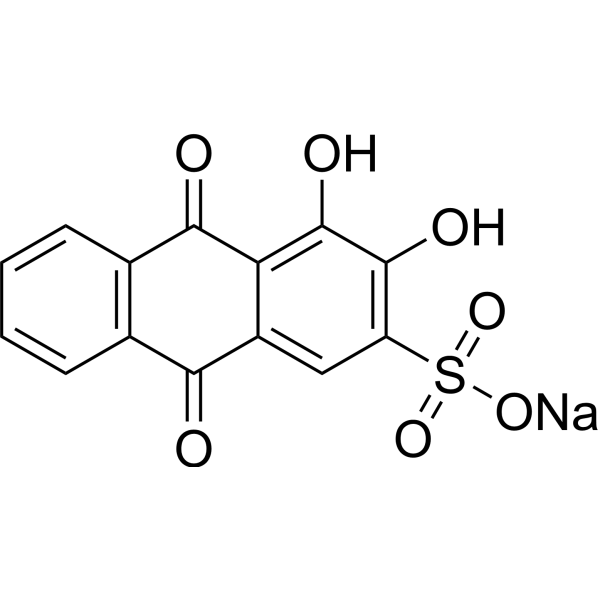
Alizarin red S indicator (C.I. 58005) is a reductively active (quinone-based) anthraquinone dye that forms complexes with metal ions (such as zirconium, calcium) or boric acid to label calcium deposition and perform electrochemical sensing functions. Alizarin Red S undergoes reversible redox reactions (for electrochemical detection) and irreversible chelation (for bone staining). Alizarin Red S is mainly used in bone metabolism research (labeling mineralized tissue), sugar detection (boric acid-sugar competition system) and metal ion sensing (such as zirconium ion detection), and can be used in osteoporosis and metabolic disease research .
loading...
    loading...
Cat. No.: HY-189057
Anethole trithione derivative-1 is a derivative of Anethole trithione (HY-B1223), and also a regulator of sulfide:quinone oxidoreductase (SQR) and uncoupling protein 2 (UCP2), with mitochondrial uncoupling-inducing activity and neuroprotective activity. Anethole trithione derivative-1 mediates mitochondrial uncoupling via SQR-dependent reverse electron transport of complex I, ROS-dependent UCP2 activation, and reduction of mitochondrial membrane potential. Anethole trithione derivative-1 reduces brain damage and improves function in mouse models of ischemic and hemorrhagic stroke. Anethole trithione derivative-1 can be used in stroke research .
loading...
    loading...
Cat. No.: HY-N6715R
CAS No.: 610-88-8
Tenuazonic acid (Standard) is the analytical standard of Tenuazonic acid. This product is intended for research and analytical applications. Tenuazonic acid is a nonhost-selective mycotoxin belonging to the tetramic acids family. Tenuazonic acid inhibits protein biosynthesis on ribosomes by suppressing the release of new protein. Tenuazonic acid is acutely toxic, and oral LD50 is set between 81-186 mg/kg in rats and mice. Tenuazonic acid blocks electron transport beyond the primary quinone receptor (QA) by interacting with the D1 protein and is a photosystem II (PSII) inhibitor. In addition, Tenuazonic acid has antiviral effects on measles virus, enterovirus, respiratory virus and so on. Tenuazonic acid has an inhibitory effect on skin cancer .
loading...
    loading...
Cat. No.: HY-W007671R
CAS No.: 1080-06-4
H-Tyr-OMe (Standard) is the analytical standard of H-Tyr-OMe (HY-W007671). This product is intended for research and analytical applications. H-Tyr-OMe is an amino acid derivative and also a coordinating ligand for Cu II ions. H-Tyr-OMe can serve as a surface functionalization reagent for carbon dots, and is used to prepare fluorescent probes for biothiol sensing. H-Tyr-OMe is oxidized to quinone under the catalysis of Tyrosinase via its phenolic hydroxyl group, which quenches the fluorescence of carbon dots. H-Tyr-OMe contains potential coordination sites, including carboxyl, amino and phenolic hydroxyl groups .
loading...
    loading...
Cat. No.: HY-W010323
CAS No.: 615-94-1
Synonyms: DHBQ
Research Areas:  

Others

2,5-Dihydroxy-1,4-benzoquinone (DHBQ) is a redox-active quinone-based organic ligand with antibacterial activity that can be obtained from fungal metabolites. After 2,5-Dihydroxy-1,4-benzoquinone is incorporated into the Fe (dhbq) metal-organic framework, a two-electron redox process occurs, which helps improve the discharge capacity of Li +-ion battery cathodes. 2,5-Dihydroxy-1,4-benzoquinone can be used to construct conductive metal-organic frameworks suitable for Li +-ion battery cathodes .
loading...
    loading...
Cat. No.: HY-P810413
Synonyms: DHQV, DIA6, EC 1.10.99.2, MGC94180, NAD(P)H dehydrogenase quinone 2, NAD(P)H menadione oxidoreductase 1 dioxin inducible 2, NAD(P)H menadione oxidoreductase 2 dioxin inducible, NMOR2, NQO 2, NQO2

Host:  

Rabbit

Application:  

WB, IHC-P

Reactivity:  

Human, Rat, Mouse

loading...
    loading...
Cat. No.: HY-N6715S
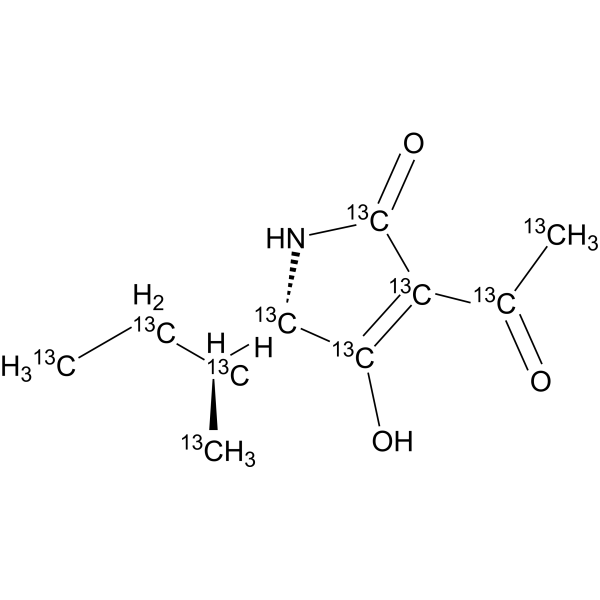
Tenuazonic acid- 13C10 is 13C labeled Tenuazonic acid (HY-N6715). Tenuazonic acid is a nonhost-selective mycotoxin belonging to the tetramic acids family. Tenuazonic acid inhibits protein biosynthesis on ribosomes by suppressing the release of new protein. Tenuazonic acid is acutely toxic, and oral LD50 is set between 81-186 mg/kg in rats and mice. Tenuazonic acid blocks electron transport beyond the primary quinone receptor (QA) by interacting with the D1 protein and is a photosystem II (PSII) inhibitor. In addition, Tenuazonic acid has antiviral effects on measles virus, enterovirus, respiratory virus and so on. Tenuazonic acid has an inhibitory effect on skin cancer .
loading...
    loading...
Cat. No.: HY-W653921
CAS No.: 2714417-30-6
Tenuazonic acid-d13 is deuterium labeled Tenuazonic acid. Tenuazonic acid is a nonhost-selective mycotoxin belonging to the tetramic acids family. Tenuazonic acid inhibits protein biosynthesis on ribosomes by suppressing the release of new protein. Tenuazonic acid is acutely toxic, and oral LD50 is set between 81-186 mg/kg in rats and mice. Tenuazonic acid blocks electron transport beyond the primary quinone receptor (QA) by interacting with the D1 protein and is a photosystem II (PSII) inhibitor. In addition, Tenuazonic acid has antiviral effects on measles virus, enterovirus, respiratory virus and so on. Tenuazonic acid has an inhibitory effect on skin cancer .
loading...
    loading...
Cat. No.: HY-W269285
CAS No.: 72002-54-1
Synonyms: D-1,2,3,4-Tetrahydronorharman-3-carboxylic acid
Research Areas:  

Cancer

H-D-Tpi-OH (D-1,2,3,4-Tetrahydronorharman-3-carboxylic acid) is a tetrahydro-β-carboline derivative. H-D-Tpi-OH only slightly upregulates QR1, mildly inhibits the aromatase and NO synthesis pathways, and shows no significant in vitro anti-breast tumor proliferation activity. H-D-Tpi-OH can be used in cancer-related research .
loading...
    loading...
Cat. No.: HY-P704102
Purity:  ≥ 85%, as determined by reducing SDS-PAGE.
Synonyms: VAT1L; Vesicle Amine Transport 1 Like; KIAA1576; Vesicle Amine Transport Protein 1 Homolog (T. California)-Like; Putative NADPH-Dependent quinone Oxidoreductase VAT1L; Synaptic Vesicle Membrane Protein VAT-1 Homolog-Like; Vesicle Amine Transport Protein 1
Species:  
Human
Source:  
E. coli
loading...
    loading...
Cat. No.: HY-W001213
CAS No.: 20734-76-3
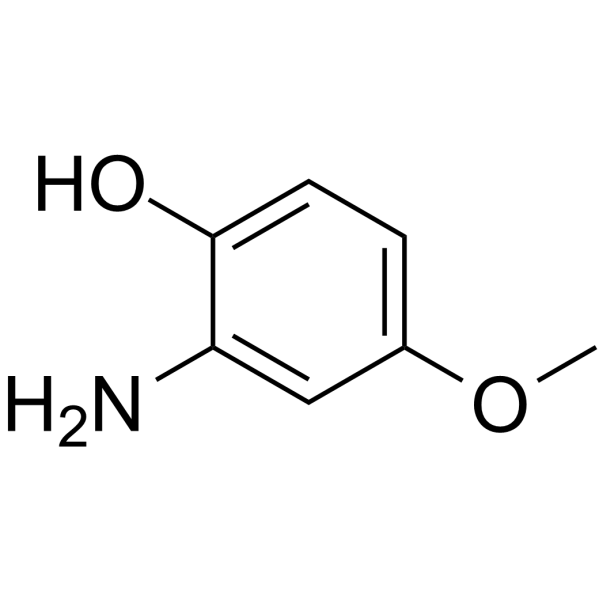
2-Amino-4-methoxyphenol is a volatile constituent in the aroma concentrate of Tieguanyin teas . 2-Amino-4-methoxyphenol is used for the synthesis of pyridine analogues .
loading...
    loading...
Cat. No.: HY-W001213R
CAS No.: 20734-76-3
2-Amino-4-methoxyphenol (Standard) is the analytical standard of 2-Amino-4-methoxyphenol (HY-W001213). This product is intended for research and analytical applications. 2-Amino-4-methoxyphenol is a volatile constituent in the aroma concentrate of Tieguanyin teas . 2-Amino-4-methoxyphenol is used for the synthesis of pyridine analogues .
loading...
    loading...
Cat. No.: HY-165424
CAS No.: 3036456-18-2
NIR-BG2 is a fluorescent indicator targeting senescence-associated β-galactosidase (SA-β-Gal). NIR-BG2 contains a hemicyanine fluorophore caged by SA-β-Gal; cleavage of its β-galactosyl group by SA-β-Gal generates an electrophilic quinone methide, which can form covalent bonds with adjacent proteins to achieve long-term signal retention. NIR-BG2 activates a near-infrared fluorescent signal upon recognition of SA-β-Gal. NIR-BG2 can be used for non-invasive in vivo imaging of cellular senescence in mouse xenograft models. The excitation/emission wavelengths are 675/708 nm .
loading...
    loading...
Cat. No.: HY-177543
CAS No.: 65490-84-8
Target:  

Quinone Reductase

Research Areas:  

Others

5-(4-Methoxyphenol)-4-methyl-3H-1,2-dithiole-3-thione is a Phase 2 enzyme inducer. 5-(4-Methoxyphenol)-4-methyl-3H-1,2-dithiole-3-thione induces the activity of NAD (P) H:quinone oxidoreductase (QR; NQO1) in hepatoma cells. 5-(4-Methoxyphenol)-4-methyl-3H-1,2-dithiole-3-thione enhances growth hormone production in plasmid-transfected hepatoma cells .
loading...
    loading...
Cat. No.: HY-D3377
CAS No.: 1616953-95-7
Synonyms: LysoRhoNox
Target:  

Fluorescent Dye

Research Areas:  

Others

HMRhoNox-M (LysoRhoNox) is a selective fluorescent probe for detecting Fe 2+ (ferrous iron ions), with excitation/emission wavelengths of Ex/Em = 550/575 nm. HMRhoNox-M exists in a non-fluorescent spirocyclic closed conformation under physiological pH conditions. Fe 2+ triggers the deoxidation of its N-oxide group, shifting the equilibrium toward the fluorescent quinone-type (TMHMR) open conformation. HMRhoNox-M shows selectivity for Fe 2+ over other metal ions, as well as biologically relevant reactive oxygen species, reactive sulfur species, reactive nitrogen species and reducing agents. HMRhoNox-M can penetrate cell membranes and localize to lysosomes, enabling the imaging of intracellular Fe 2+ fluctuations, transferrin-mediated labile iron accumulation, and lysosomal Fe 2+ changes associated with ferroptosis .
loading...
    loading...
Cat. No.: HY-D3209
CAS No.: 2646628-35-3
NIR-ASM is a near-infrared fluorescent probe that can cross cell membranes and be activated by NQO1. NIR-ASM can distinguish NQO1-expressing cancer cells from normal cells via fluorescence microscopy and flow cytometry. NIR-ASM generates near-infrared fluorescence with a high signal-to-noise ratio in tumor models with NQO1 activity, enabling the detection of endogenous NQO1 activity in vivo. NIR-ASM is applicable to the research of lung cancer and breast cancer .
loading...
    loading...
Cat. No.: HY-153169R
CAS No.: 2754428-18-5
6PPD-Q (Standard) is the analytical standard of 6PPD-Q (HY-153169). This product is intended for research and analytical applications. 6PPD-Q (6PPD-Quinone) is an environmental pollutant that can be detected in human urine and is widely present in the environment. 6PPD-Q targets and binds to CNR2, CNR1, AA2AR, LCAT, and TRPA1, with CNR2 exhibiting the highest binding affinity, potentially acting as a CNR2 receptor agonist to activate cannabinoid receptors. 6PPD-Q induces intestinal inflammation and barrier damage by disrupting mitochondrial function, reducing neuronal glycolysis metabolites and TCA cycle intermediates, and exacerbating α-synuclein (α-syn) aggregation. 6PPD-Q is applicable in research on environmental toxicology, neurodegenerative diseases, and inflammation-related disorders .
loading...
    loading...
Cat. No.: HY-138439
CAS No.: 173662-97-0
Research Areas:  

Infection

Mandestrobin is a fungicide that exerts fungal killing activity by inhibiting mitochondrial respiratory chain complex III. Mandestrobin exhibits differential fungicidal activity between its enantiomers, and the R-enantiomer possesses stronger activity than the S-enantiomer. Mandestrobin is used in studies related to fungal infections and the agricultural field .
loading...
    loading...

