30 Results for "

Compound E (Standard)

" in MedChemExpress (MCE) Product Catalog:
Products (30)

30 Results for "Compound E (Standard)" in MCE Product Catalog:

Cat. No.: HY-14176R
CAS No.: 209986-17-4
Synonyms: γ-Secretase-IN-1 (Standard)
Research Areas:  

Neurological Disease

Compound E (Standard) is the analytical standard of Compound E (HY-14176). This product is intended for research and analytical applications. Compound E is a γ-secretase inhibitor. Compound E blocks β-amyloid(40), β-amyloid(42), and Notch γ-secretase cleavage with IC50s of 0.24, 0.37, 0.32 nM, respectively.
loading...
    loading...
Cat. No.: HY-101445B
CAS No.: 53174-06-4
Purity:  99.36%
Target:  

Drug Isomer

Research Areas:  

Neurological Disease

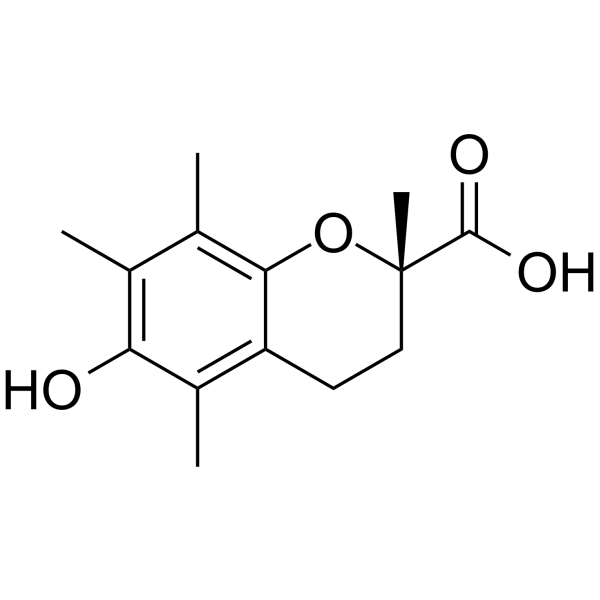
(S)-Trolox is an analogue of vitamin E, in which the phytyl chain is replaced with a carboxyl group. (S)-Trolox is frequently used as a model compound for studies of structural features, as well as a standard for evaluation of antioxidant activity. (S)-Trolox has potent and specific neuroprotective and antioxidant effects .
loading...
    loading...
Cat. No.: HY-17461R
CAS No.: 53-06-5
Synonyms: 17-Hydroxy-11-dehydrocorticosterone(Standard); Kendall's Compound E (Standard)
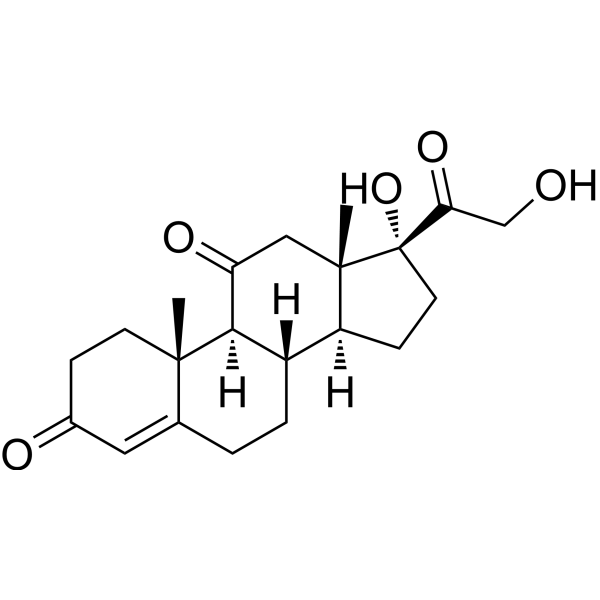
Cortisone (Standard) is the analytical standard of Cortisone. This product is intended for research and analytical applications. Cortisone (17-Hydroxy-11-dehydrocorticosterone), an oxidized metabolite of Cortisol (a Glucocorticoid). Cortisone acts as an immunosuppressant and anti-inflammatory agent. Cortisone can partially intervene in binding of Glucocorticoid to Glucocorticoid-receptor at high concentrations .
loading...
    loading...
Cat. No.: HY-N0417R
CAS No.: 18444-66-1
Synonyms: α-Elaterin (Standard); α-Elaterine (Standard)
Cucurbitacin E (Standard) is the analytical standard of Cucurbitacin E. This product is intended for research and analytical applications. Cucurbitacin E is a natural compound which from Cucurbitaceae plants. Cucurbitacin E significantly suppresses the activity of the cyclin B1/CDC2 complex.
loading...
    loading...
Cat. No.: HY-N2543R
CAS No.: 23696-85-7
Synonyms: (E/Z)-Damascenone (Standard)
Damascenone (Standard) is the analytical standard of Damascenone. This product is intended for research and analytical applications. Damascenone ((E/Z)-Damascenone) is an active compound of Epipremnum pinnatum with anti-inflammatory activity . Damascenone is a mixture complex of E-isomer-Damascenone and Z-isomer Damascenone.
loading...
    loading...
Cat. No.: HY-16686R
CAS No.: 38976-17-9
Synonyms: alpha-Tocopherol phosphate (Standard); TocP (Standard); vitamin E phosphate (Standard)
α-Tocopherol (phosphate) (Standard) is the analytical standard of α-Tocopherol (phosphate). This product is intended for research and analytical applications. α-Tocopherol phosphate is a compound with the high activity of vitamin E.
loading...
    loading...
Cat. No.: HY-19384R
CAS No.: 251442-94-1
Synonyms: E 6087 (Standard)
Target:  

COX Reference Standards

Research Areas:  

Inflammation/Immunology

Enflicoxib (Standard) is the analytical standard of Enflicoxib. This product is intended for research and analytical applications. Enflicoxib (E 6087) is a nonsteroidal anti-inflammatory compound that selectively inhibits cyclooxygenase-2 (COX-2). Enflicoxib does not inhibit cyclooxygenase-1 (COX-1). E-6087 shows anti-inflammatory, analgesic and antipyretic activities in animal models .
loading...
    loading...
Cat. No.: HY-N0060BR
CAS No.: 537-98-4
Synonyms: (E)-Coniferic acid (Standard)
(E)-Ferulic acid (Standard) is the analytical standard of (E)-Ferulic acid. This product is intended for research and analytical applications. (E)-Ferulic acid is an isomer of ferulic acid, an aromatic compound abundant in plant cell walls. (E)-Ferulic acid causes phosphorylation of β-catenin (β-catenin), leading to proteasome degradation, increasing the expression of pro-apoptotic factor Bax and reducing pro-apoptotic factor Expression of the survival factor survivin. (E)-Ferulic acid can effectively remove reactive oxygen species (ROS) and inhibit lipid peroxidation. (E)-Ferulic acid exerts antiproliferative and antimigratory effects in the human lung cancer cell line H1299.
loading...
    loading...
Cat. No.: HY-16950AR
CAS No.: 68392-35-8
Synonyms: Afimoxifene (Standard); 4-OHT (Standard)
(E/Z)-4-Hydroxytamoxifen (Standard) is the analytical standard of (E/Z)-4-Hydroxytamoxifen. This product is intended for research and analytical applications. (E/Z)-4-Hydroxytamoxifen (Afimoxifene) is a racemic compound of (Z)-4-Hydroxytamoxifen and (E)-4-Hydroxytamoxifen isomers. (E/Z)-4-Hydroxytamoxifen is a selective estrogen receptor modulator with mixed estrogenic and antiestrogenic activity, which is also an active metabolite of Tamoxifen (HY-13757A). (E/Z)-4-Hydroxytamoxifen is an agonist of the G protein-coupled estrogen receptor (GPER) with relatively low affinity (100-1000 nM). (E/Z)-4-Hydroxytamoxifen is promising for research of cyclical mastalgia, such as breast pain, tenderness, and nodularity .
loading...
    loading...
Cat. No.: HY-W016194R
CAS No.: 67950-95-2
Synonyms: 1-Carboxycyclohexaneacetic acid (Standard); Gabapentin Impurity E (Standard); Gabapentin Related Compound E (Standard)
Research Areas:  

Others

1-(Carboxymethyl)cyclohexanecarboxylic acid (Standard) (1-Carboxycyclohexaneacetic acid (Standard); Gabapentin Impurity E (Standard); Gabapentin Related Compound E (Standard)) is the analytical standard of 1-(Carboxymethyl)cyclohexanecarboxylic acid (HY-W016194). This product is intended for research and analytical applications. 1-(Carboxymethyl) cyclohexanecarboxylic acid (1-Carboxycyclohexaneacetic acid; Gabapentin Impurity E; Gabapentin Related Compound E) is a succinic acid and a potential impurity in the synthesis of Gabapentin (HY-A0057), and it can be used in studies related to organic synthesis .
loading...
    loading...
Cat. No.: HY-Y0367R
CAS No.: 110-16-7
Maleic Acid (Standard) is the analytical standard of Maleic Acid. This product is intended for research and analytical applications. Maleic Acid is a Glutamate Decarboxylase (GAD) inhibitor of E. coli and L. monocytogenes. IC50 & Target: GAD . In Vitro: The MICs of WT 10403S for the acids (e.g., Maleic Acid) are 34 mM, 25 mM, 31 mM and 30 mM which correspond to pH values prior to growth of 4.84, 5.14, 5.32 and 5.02 respectively. Of all compounds tested, Maleic Acid is the least inhibitory despite acting at a lower pH (4.84). The most acid resistant (10403S) and the weakest (EGD-e) strain are challenged with 8.6 mM and 4.3 mM of each organic acid at pH 3 and 3.3 respectively. On both strains, Maleic Acid is the most bactericidal .
loading...
    loading...
Cat. No.: HY-N6928R
CAS No.: 88901-37-5
Mogroside III-E (Standard) is the analytical standard of Mogroside III-E. This product is intended for research and analytical applications. Mogroside III-E is a cucurbitane-type compound isolated from Siraitia grosvenorii, inhibits NO release, with anti-fibrotic activity .
loading...
    loading...
Cat. No.: HY-14270R
CAS No.: 53882-12-5
Synonyms: U-42585E free acid (Standard)
Lodoxamide (Standard) is the analytical standard of Lodoxamide. This product is intended for research and analytical applications. Lodoxamide (U-42585E free acid) is an antiallergic compound acting as a mast-cell stabilizer for the treatment of asthma and allergic conjunctivitis.
loading...
    loading...
Cat. No.: HY-109081R
CAS No.: 1141397-80-9
Synonyms: E7727 (Standard)
Research Areas:  

Cancer

Cedazuridine (Standard) is the analytical standard of Cedazuridine. This product is intended for research and analytical applications. Cedazuridine (E7727) (Compound 7a) is an orally active cytidine deaminase (CDA) inhibitor with an IC50 value of 0.4 μM. Cedazuridine can be used for cancer research .
loading...
    loading...
Cat. No.: HY-W012952R
CAS No.: 4313-03-5
Synonyms: trans,trans-2,4-Heptadienall (Standard)
(2E,4E)-Hepta-2,4-dienal (Standard) is the analytical standard of (2E,4E)-Hepta-2,4-dienal. This product is intended for research and analytical applications. (2E,4E)-Hepta-2,4-dienal is a naturally occurring organic compound that belongs to the group of aldehydes. It is an unsaturated aldehyde with two conjugated double bonds, giving it unique chemical and physical properties. (2E,4E)-Hepta-2,4-dienal is commonly found in various plant sources, especially in spices such as parsley and coriander. It is used as a flavoring agent and food additive in the formulation of various foods such as baked goods, snacks and beverages. It is also used in the fragrance industry, especially in the production of perfume and cologne.
loading...
    loading...
Cat. No.: HY-W017378R
CAS No.: 700-13-0
Research Areas:  

Others

Trimethylhydroquinone (Standard) is the analytical standard of Trimethylhydroquinone (HY-W017378). This product is intended for research and analytical applications. Trimethylhydroquinone is an active compound intermediate. Trimethylhydroquinone can condense with isophytol or phytol to produce synthetic Vitamin E (HY-B1278A). Trimethylhydroquinone serves as the parent compound for the synthesis of trimethylhydroquinone derivatives with antioxidant, anti-allergic, and 5-lipoxygenase inhibitory activities .
loading...
    loading...
Cat. No.: HY-N2492R
CAS No.: 19367-38-5
Synonyms: Methyl trans-p-coumarate (Standard)
(E)-Methyl 4-coumarate (Standard) is the analytical standard of (E)-Methyl 4-coumarate (HY-N2492). This product is intended for research and analytical applications. (E)-Methyl 4-coumarate (Methyl 4-hydroxycinnamate) is a phenolic compound and derivative of Cinnamic acid (HY-N0610A). (E)-Methyl 4-coumarate can be found in several plants, such as the leaves of Allium cepa and Morinda citrifolia L. (E)-Methyl 4-coumarate, when combined with Carnosic acid (HY-N0644), induces Apoptosis. (E)-Methyl 4-coumarate inhibits GSK3β activity and modulates inflammatory cytokine levels (increasing IL-10 and decreasing IL-4). (E)-Methyl 4-coumarate combined with Carnosic acid exhibits anticancer effects against acute myeloid leukemia. (E)-Methyl 4-coumarate ameliorates Plasmodium berghei NK65 infection .
loading...
    loading...
Cat. No.: HY-N6954R
CAS No.: 76996-27-5
Garcinone C (Standard) is the analytical standard of Garcinone C. This product is intended for research and analytical applications. Garcinone C, a xanthone derivative, is a natural compound extracted from Garcinia oblongifolia that is used as an anti-inflammatory, astringency and granulation-promoting medicine, and has potential cytotoxic effects on certain cancers. Garcinone C stimulates the expression levels of ATR and 4E-BP1, arrests the cell cycle, inhibits cell viability of the human Nasopharyngeal carcinoma (NPC) cell lines CNE1, CNE2, HK1 and HONE1 in a time‑ and dose‑dependent manner through inhibition of Hedgehog signaling pathway. Garcinone C is orally active .
loading...
    loading...
Cat. No.: HY-B2121R
CAS No.: 2471-70-7
Synonyms: 6-MNA (Standard); Naproxen impurity O (Standard)
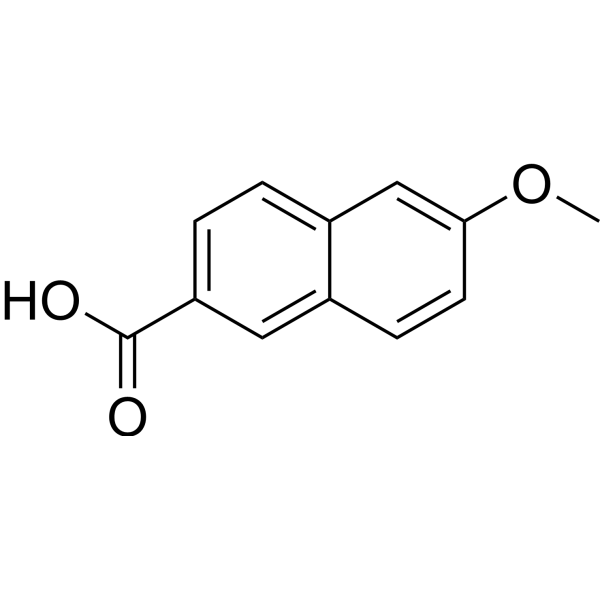
6-Methoxy-2-naphthoic acid (Standard) (6-MNA (Standard)) is the analytical standard of 6-Methoxy-2-naphthoic acid (HY-B2121). This product is intended for research and analytical applications. 6-Methoxy-2-naphthoic acid (6-MNA) is the active metabolite of Nabumetone (HY-B0559). 6-Methoxy-2-naphthoic acid is also an inhibitor of COX-1 and COX-2. 6-Methoxy-2-naphthoic acid can inhibit the synthesis of gastric mucosal prostaglandin E2. 6-Methoxy-2-naphthoic acid can be used in the research of inflammation and pain-related diseases. In addition, 6-Methoxy-2-naphthoic acid is an impurity in Naproxen (HY-15030) and can also be used in the synthesis of other active compounds.
loading...
    loading...
Cat. No.: HY-13270R
CAS No.: 141430-65-1
Synonyms: E7010 (Standard)
ABT-751 (Standard) is the analytical standard of ABT-751. This product is intended for research and analytical applications. ABT-751 (E7010) is a novel, highly orally bioavailable sulfonamides antimitotic compound and tubulin binder. It prevents tubulin aggregation by binding to the colchicine site on β-tubulin, leading to cell cycle arrest in G2/M phase and inducing apoptosis, thus effectively preventing cell division. ABT-751 induces autophagy by inhibiting the AKT/MTOR signaling pathway. ABT-751 showed significant inhibition against various types of cancer cells, including lung, gastric, colon, and breast cancer .
loading...
    loading...

