7 Results for "

DIMBOA

" in MedChemExpress (MCE) Product Catalog:
Products (7)

7 Results for "DIMBOA" in MCE Product Catalog:

Cat. No.: HY-N7432
CAS No.: 15893-52-4
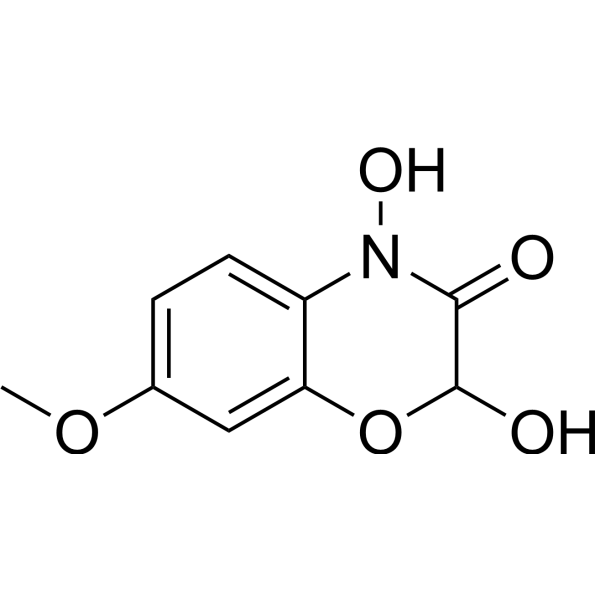
DIMBOA, an antibiotic, has antibacterial properties and inhibits bacteria such as Staphylococcus aureus and the mycotoxin-producing fungus Fusarium graminearum (which causes scab). DIMBOA exhibits strong free radical scavenging activity and weak iron(III) ion reducing activity, and has antioxidant activity. DIMBOA inhibits the biosynthesis and accumulation of toxic trichothecenes by affecting the expression of Tri6 and Tri5. DIMBOA reduces plant susceptibility to scab. DIMBOA also exhibits cytotoxicity to plant cells, causing plasmolysis, cell collapse, and cell rupture .
loading...
    loading...
Cat. No.: HY-N7432R
CAS No.: 15893-52-4
DIMBOA (Standard) is the analytical standard of DIMBOA. This product is intended for research and analytical applications. DIMBOA, an antibiotic, has antibacterial properties and inhibits bacteria such as Staphylococcus aureus and the mycotoxin-producing fungus Fusarium graminearum (which causes scab). DIMBOA exhibits strong free radical scavenging activity and weak iron(III) ion reducing activity, and has antioxidant activity. DIMBOA inhibits the biosynthesis and accumulation of toxic trichothecenes by affecting the expression of Tri6 and Tri5. DIMBOA reduces plant susceptibility to scab. DIMBOA also exhibits cytotoxicity to plant cells, causing plasmolysis, cell collapse, and cell rupture[1][2][3][4][5].
loading...
    loading...
Cat. No.: HY-W751266
CAS No.: 113565-32-5
DIMBOA-Glc is a benzoxazinoid glucoside insecticide that exists in two epimeric forms. DIMBOA-Glc helps enhance the resistance of maize to lepidopteran larvae. When plant cells rupture, plant-derived (2R)-DIMBOA-Glc interacts with glucosidases and undergoes hydrolysis to produce toxic DIMBOA for defense against infestation. The accumulation process of DIMBOA-Glc is negatively regulated by ZmMPK6 and the ethylene signaling pathway. DIMBOA-Glc does not react with plant glucosidases and can act as a detoxification metabolite to help insects counter plant defenses .
loading...
    loading...
Cat. No.: HY-W130115
CAS No.: 19932-84-4
Synonyms: 6-Chlorobenzo[d]oxazol-2(3H)-one
Target:  

Fungal

Research Areas:  

Infection

6-Chloro-2-benzoxazolinone (6-Chlorobenzo[d]oxazol-2 (3H)-one) is a derivative of DIMBOA (HY-N7432) and an antibacterial agent. The minimum inhibitory concentration (MIC) of 6-Chloro-2-benzoxazolinone against Ralstonia solanacearum is 100 mg/L, and its minimum bactericidal concentration (MBC) is 500 mg/L. 6-Chloro-2-benzoxazolinone reduces biofilm formation and inhibits swarming motility of *Ralstonia solanacearum*. It can be used for the research of bacterial wilt .
loading...
    loading...
Cat. No.: HY-E71827
Research Areas:  

Others

4-Hydroxy-7-methoxy-3-oxo-3,4-dihydro-2H-1,4-benzoxazin-2-yl glucoside β-D-glucosidase (EC 3.2.1.182) is a hydrolase that can catalyze multiple reactions, including reaction 1: convert DIMBOA beta-D-glucoside and H2O into DIMBOA and D-glucose; reaction 2: convert DIBOA beta-D-glucoside and H2O into DIBOA and D-glucose.
loading...
    loading...
Cat. No.: HY-E71425
Research Areas:  

Others

2,4,7-Trihydroxy-1,4-benzoxazin-3-one-glucoside 7-O-methyltransferase (EC 2.1.1.241) is involved in the biosynthesis of the protective and allelophatic benzoxazinoid DIMBOA [(2R)-4-hydroxy-7-methoxy-3-oxo-3,4-dihydro-2H-1,4-benzoxazin] in some plants, most commonly from the family of Poaceae (grasses).
loading...
    loading...
Cat. No.: HY-E71431
Research Areas:  

Others

2,4-Dihydroxy-7-methoxy-2H-1,4-benzoxazin-3(4H)-one 2-D-glucosyltransferase (EC 2.4.1.202) is involved in the detoxification of the benzoxazinoids DIBOA (2,4-dihydroxy-2H-1,4-benzoxazin-3(4H)-one) and DIMBOA (2,4-dihydroxy-7-methoxy-2H-1,4-benzoxazin-3(4H)-one) which are stored as the respective non-toxic glucosides in the vacuoles in some plants, most commonly from the family of Poaceae (grasses).
loading...
    loading...

