10 Results for "

DNA binding capacity

" in MedChemExpress (MCE) Product Catalog:
Products (10)

10 Results for "DNA binding capacity" in MCE Product Catalog:

4
4 Cited Publications
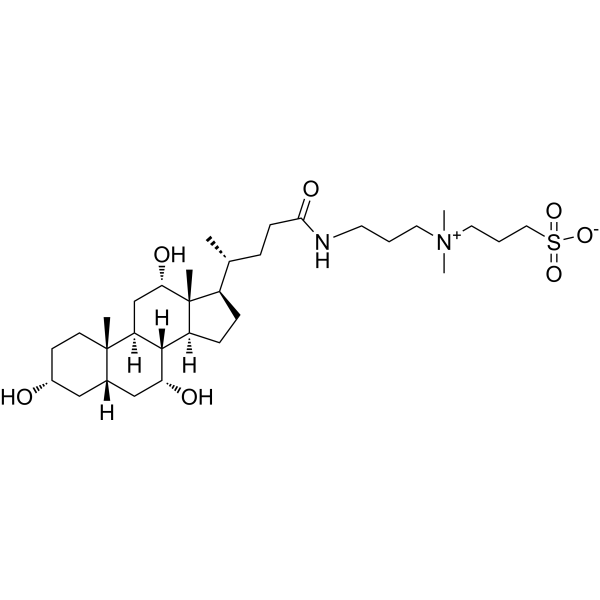
Cat. No.: HY-15435
CAS No.: 75621-03-3
Purity:  99.91%
Research Areas:  

Others

CHAPS is a cholic acid-derived, sulfobetaine-type zwitterionic detergent and micelle-forming agent. CHAPS exhibits properties of weak cationic or nonionic surfactants in different solution systems, undergoes micellization, and forms small, loose hydrophilic aggregates that are temperature-dependent. CHAPS stabilizes mononucleosomes under different ionic strengths, reduces nucleosome sequence specificity, promotes sliding of histone cores along DNA, solubilizes Tamm-Horsfall protein to reduce its interference with urinary exosome isolation, and maintains vesicle structure and the activity of related proteins at the same time. CHAPS is used to recover native folded fusion proteins, enhance the binding capacity of GST fusion proteins, and restore GST enzyme activity. However, CHAPS cannot refold proteins denatured by urea, guanidine hydrochloride or heat, nor can it construct the structure of intrinsically disordered proteins. CHAPS is commonly used in research on the separation and purification of membrane proteins .
loading...
    loading...
4
4 Cited Publications
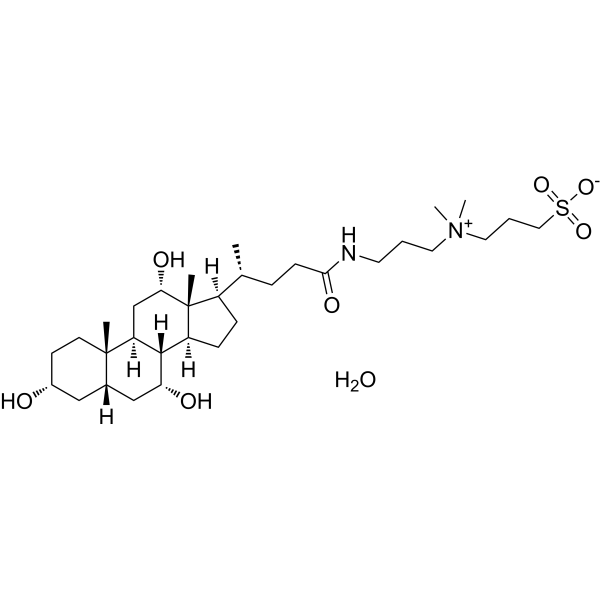
Cat. No.: HY-15435A
CAS No.: 331717-45-4
Purity:  ≥98.0%
CHAPS hydrate is a cholic acid-derived, sulfobetaine-type zwitterionic detergent and micelle-forming agent. CHAPS hydrate exhibits properties of weak cationic or nonionic surfactants in different solution systems, undergoes micellization, and forms small, loose hydrophilic aggregates that are temperature-dependent. CHAPS hydrate stabilizes mononucleosomes under different ionic strengths, reduces nucleosome sequence specificity, promotes sliding of histone cores along DNA, solubilizes Tamm‑Horsfall protein to reduce its interference with urinary exosome isolation, and maintains vesicle structure and the activity of related proteins at the same time. CHAPS hydrate is used to recover native folded fusion proteins, enhance the binding capacity of GST fusion proteins, and restore GST enzyme activity. However, CHAPS hydrate cannot refold proteins denatured by urea, guanidine hydrochloride or heat, nor can it construct the structure of intrinsically disordered proteins. CHAPS hydrate is commonly used in research on the separation and purification of membrane proteins .
loading...
    loading...
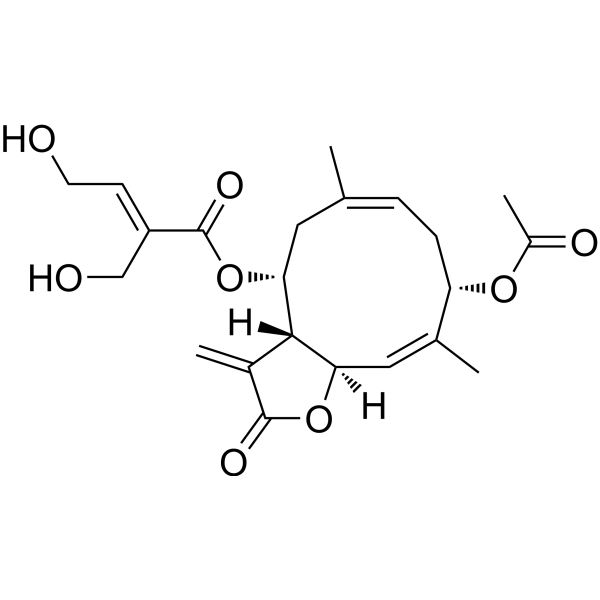
Cat. No.: HY-118618
CAS No.: 38458-58-1
Synonyms: Hiyodorilactone A; Schkuhrin I
Eucannabinolide is a STAT3 inhibitor. Eucannabinolide suppresses STAT3 activation at tyrosine 705, inhibiteds its translocation to nucleus, and decreases its DNA binding capacity. Eucannabinolide can be used for triple negative breast cancer (TNBC) diseases research .
loading...
    loading...
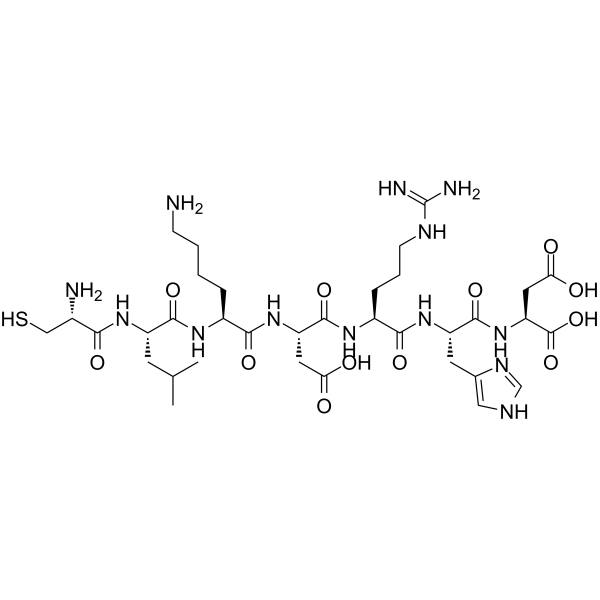
Cat. No.: HY-P1758
CAS No.: 153840-64-3
Synonyms: IRRP1
Target:  

IFNAR STAT Influenza Virus

Research Areas:  

Infection

IFN-α Receptor Recognition Peptide 1 (IRRP1) is an amino acid synthetic peptide and also a regulator of IFN-α Receptor. IFN-α Receptor Recognition Peptide 1 binds to IFNAR2, enhances the binding capacity of IFN-α receptor, and slightly increases the IFN-α-induced growth inhibitory activity. IFN-α Receptor Recognition Peptide 1 inhibits IFN-α-induced STAT1 phosphorylation and STAT-DNA binding by blocking the activation of IFNAR by IFN-α. IFN-α Receptor Recognition Peptide 1 increases the occupancy of IFN-α on cell surface receptors, enhances the phosphorylation activation of ISGF3, and elevates IFN-α-induced antiviral activity. IFN-α Receptor Recognition Peptide 1 can be used in studies related to encephalomyocarditis virus infection .
loading...
    loading...
Cat. No.: HY-108409
CAS No.: 302-97-6
Synonyms: Etienic acid; Testosterone-17β-carboxylic acid; 3-Oxoandrost-4-ene-17β-carboxylic acid
Target:  

Drug Derivative

Research Areas:  

Metabolic Disease Cancer

Progesterone carboxylic acid (Testosterone-17β-carboxylic acid) is an androstenedione analogue. Progesterone carboxylic acid can conjugate with 20-mer peptide nucleic acid (PNA) and the conjugate has superior binding capacity on complementary DNA. Progesterone carboxylic acid can be used for cancers and type 2 diabetes (T2D) research .
loading...
    loading...
Cat. No.: HY-175219
Target:  

Carbonic Anhydrase

Research Areas:  

Cancer

CA-II/Dkk1-IN-1 (Compound 5d) is a dual-functional inhibitor of CA-II and Dkk1 with a IC50 of 6.90  nM for CA-II. CA-II/Dkk1-IN-1 has significantly antioxidant activity and superior DNA binding capacity. CA-II/Dkk1-IN-1 can be used for cancers research, such as esophageal, renal, and lung cancer .
loading...
    loading...
Cat. No.: HY-108409R
CAS No.: 302-97-6
Synonyms: Etienic acid (Standard); Testosterone-17β-carboxylic acid (Standard); 3-Oxoandrost-4-ene-17β-carboxylic acid (Standard)
Progesterone carboxylic acid (Standard) is the analytical standard of Progesterone carboxylic acid (HY-108409). This product is intended for research and analytical applications. Progesterone carboxylic acid (Testosterone-17β-carboxylic acid) is an androstenedione analogue. Progesterone carboxylic acid can conjugate with 20-mer peptide nucleic acid (PNA) and the conjugate has superior binding capacity on complementary DNA. Progesterone carboxylic acid can be used for cancers and type 2 diabetes (T2D) research .
loading...
    loading...
Cat. No.: HY-185344
CAS No.: 2929236-94-0
Synonyms: TRX01
Target:  

NF-κB

Research Areas:  

Cancer

Ratutrelvir is a NF-κB p65 inhibitor. Ratutrelvir blocks the translocation of NF-κB p65 from the cytoplasm to the nucleus, reduces the phosphorylation levels of NF-κB p65 and IκBα, and inhibits the DNA-binding activity of NF-κB p65. Ratutrelvir inhibits the migration and invasion abilities of breast cancer cells, and reduces their viability and colony-forming capacity. Ratutrelvir can be used for the research of luminal A breast cancer .
loading...
    loading...
Cat. No.: HY-183622
CAS No.: 304896-41-1
Target:  

MDM-2/p53

Research Areas:  

Cancer

UCI-1014 is a mutant p53 (p53 R175H) corrector/reactivator. UCI-1014 restores the wild-type-like DNA-binding activity of p53 R175H, promotes the redistribution of the mutant protein to chromatin, and induces the expression of p53-dependent target genes. UCI-1014 inhibits the proliferation of p53 R175H-mutant cancer cells through an SLC7A11-independent mechanism. UCI-1014 can be used for research related to p53-mutant cancers .
loading...
    loading...
Cat. No.: HY-P1758A
Synonyms: IRRP1 acetate
Target:  

IFNAR STAT Influenza Virus

Research Areas:  

Infection

IFN-α Receptor Recognition Peptide 1 acetate (IRRP1 acetate) is an amino acid synthetic peptide and also a regulator of IFN-α Receptor. IFN-α Receptor Recognition Peptide 1 acetate binds to IFNAR2, enhances the binding capacity of IFN-α receptor, and slightly increases the IFN-α-induced growth inhibitory activity. IFN-α Receptor Recognition Peptide 1 acetate inhibits IFN-α-induced STAT1 phosphorylation and STAT-DNA binding by blocking the activation of IFNAR by IFN-α. IFN-α Receptor Recognition Peptide 1 acetate increases the occupancy of IFN-α on cell surface receptors, enhances the phosphorylation activation of ISGF3, and elevates IFN-α-induced antiviral activity. IFN-α Receptor Recognition Peptide 1 acetate can be used in studies related to encephalomyocarditis virus infection .
loading...
    loading...

